Wednesday, May 21, 2014

Sentimental about my Scrivener Beginnings


A popular saying advises, "you can't go back." Time's arrow moves in one direction: forward. While I acknowledge this maxim and know it to be true, I think it's important to visit the past regularly and think about what roles specific people, actions, and events played in scripting the story of my life. I have no intention of writing my bio here. I only want to share an exhilarating and memorable day that reminded me who and what and where was important in the tale of how I came to be what I am today.
April 2014 marked the 32nd anniversary of my writing career. Of course, I've been a writer since I first grasped a pencil in my small, grubby hand in first grade and scrawled my thoughts. In April 1982, however, it became official. My first published piece appeared that month in Ideals magazine--a poem in the "Friendship" issue. A copy arrived in my mailbox in early May, accompanied by a check for $30 and a note from the editor telling me to send more poems. My kids remember that I did a cartwheel in the driveway, so excited that in less than a year of sending out stories and poems I was published. (I can't do cartwheels anymore when articles and books are published, but I still do them in my imagination!)
Anyone who has found satisfaction and earned success as a writer knows the feeling that comes with such a "first." A byline is one thing; earning money for it is quite another, even if it's a mere $30. And being asked to "send more" is the icing on the cake! I made a photocopy of that check and still keep it among my writing treasures.

 
Thirty-two years is a substantial time to labor in any career, much less one that involves too much sitting, lonesome hours communing with books and notes and a silent room,  and pounding a keyboard day after day to turn out endless strings of words. The craft has taken a toll on my back and hands, and staying "social" beyond having a cat on my desk has required effort. (A lack of tangible human co-workers is much of the reason I teach. Students keep me social!)  Thirty-two years is almost half of my life, years rife with important milestones, including that first $-check-$. Yet, lonely as writing can be, we never find our way in it alone. I don't know any writer who believes he or she single-handedly finds success. There's always help if you look for it and want it.

I've seized it! I had and still have mentors--my mother and mother-law, my college adviser, my husband and kids, editors, friends, librarians, other writers. Sometimes it's not a person I owe gratitude, but a place. One institution in particular deserves HUGE thanks for helping to launch my writing and speaking career....


Last weekend my son's family took me on a memorable visit to Mystic Seaport Museum where I worked from 1986 until 1994. It was a quick, spur-of-the-moment trip, a Saturday jaunt with no time to linger and savor. But it was so nostalgic and revitalizing that I feel the need to share my gratitude here and encourage everyone who reads my blog to re-connect with their past in much the same way.

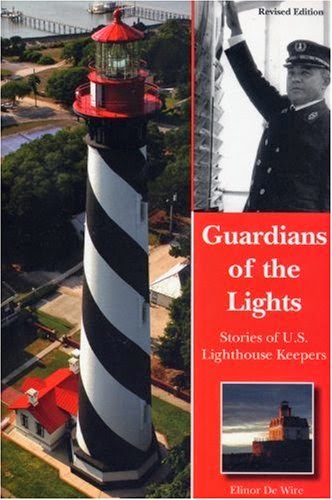
Working at MSM happened quite by chance. In the mid-1980s I was heavily into research for my second book on lighthouses--Guardians of the Lights. I often joke that this book was my third child. I have two flesh and blood children I brought into the world with effort, help, and love, and then there's Guardians of the Lights. Sometimes you labor so hard on a project, it seems like you've given birth!
 
 
How did MSM figure in all of this?
 
 
MSM had (and still has) a terrific nautical library on its grounds, the Blunt White Library. (Photo of the library garden from MSM.) Not long after moving to Connecticut in 1985, I made arrangements to visit the library and do research. The collection was a smorgasbord of fantastic resources, mostly books and photos, along with letters, personal collections of papers, and official government publications and documents--all related to lighthouses. But access to the collection was cumbersome. I had to make an appointment with the library and arrange to be met by a library staff member at the library gate; then, I was accompanied to the library, asked to remain in a research room, and all my library activities were monitored and assisted by the assigned library staff member. I had no issues with this protocol; it's standard in specialized libraries. But the process ate into precious hours I needed to pore over books and files. Much of my time in the library was spent waiting for materials to be fetched from the collection and brought to the table I was assigned in the research room. There were no laptop computers at this time, no scanners or IRIS pens. Photocopies cost $0.10 each, and not every item could be copied. I was on a budget too. Those dimes were precious. So I did much of my work by hand, taking notes. It was tedious, but it was a labor of love.

Diligently, I went to Blunt White Library day after day, in the rain and snow and cold of the winter of 1985-1986. The librarians all began to recognize and greet me, and a few went out of their way to make me feel comfortable and welcome, given the rigorous rules for outsiders using the collection. A few weeks into the research, one of the librarians--a friendly guy named Paul--tiptoed into the research room one morning and asked if he could chat with me. I was happy for a break and a chance to talk about my work; he had helped me more than any of the staff.

"You seem to have a big project," he said. "And I'm impressed with your research and study habits! Have you considered working at MSM?"

This caught me totally by surprise, but Paul explained that anyone who worked or volunteered at MSM had free access to the library stacks--no need for a staff chaperone, no rigorous rules beyond a reverence for the collection. Obviously, he knew the frustration I had with waiting and waiting and waiting.... He knew how precious those research dimes were too! And, though I didn't realize it, he knew I'd enjoy working at MSM.

Paul suggested I work just a few hours a week as a relief interpreter, providing coffee and lunch breaks for the all-day interpreters in the public exhibits. The hours seemed right, and there was paid training. I could do my research before and after my shifts. I put in my application and was hired to do the relief shift three days a week (12 hours total) in the nautical instruments exhibit, the working printing press, and the shipcarving shop. My training--three weeks of it--was intensive and inclusive. I learned about the entire museum, with a focus on my three exhibits. For an avid reader and writer, and someone fascinated with maritime history, it was heaven!

Blunt White Library thereafter became my haunt. Its massive specialized collection spawned writing project after writing project, and Paul became a trusted adviser and friend in my research and writing. Soon, my work in the exhibits expanded, as did my interests. The museum provided grist for hundreds of freelance articles about all things maritime and nautical--figureheads (shown in a photo from MSM), messages in bottles, sextants, ships, marine weather, animals that went to sea, nautical words and sea chanteys, scrimshaw, wreckers and mooncussers, shipwrecks, and lighthouses, of course.


Another opportunity I enjoyed at the museum was working as a model on Kodak Photo Day every September. Hundreds of photographers, professional and amateur, would descend on the museum that day to vie for prizes for the best images. Staff and their family members dressed in period costumes to roam the streets of the village. Some of our best family photos were taken on these days. The one of my husband and I below is better than our wedding picture!


I'm in the center, playing a colonial housewife. Notice the woman playing my mother, on the left, is doing all the work!
 
In the back row are my son, holding the flag at age 10, me, and my husband, and other models posing with visitors.

There were surprises too. One morning a man stepped into the Nautical Instruments exhibit and introduced himself as John, the contractor who operated the horse and carriage rides: "I need a driver pronto," he said with an infectious smile, "and I'm told you can handle horses." Within a week I had signed on for additional work driving a wagon or carriage around the 17-acre museum, in costume, giving tours. I learned to harness and hitch the horses and cared for them every day, including grooming, feeding, and shoveling the proverbial horse poop. Stormy, a Belgian mix, was my favorite, along with Max, a sturdy and even-tempered quarter horse. I was thrilled to combine my love of animals with my work as an interpreter and freelance writer. (Photo below by the late Bob Stinette shows me in costume--dressed as a man because women wouldn't have been hired to drive carriages in the 1870s--with Max and a visitor.)


One warm day in May 1988, the director of the MSM planetarium joined me in the driver's seat for a wagon ride. "Warm today! I need the breeze off the river!" he said, "And I love to hear all the neat things you tell visitors." He often came to the livery to pet the horses and chat, and he had shown up in my exhibits a few times to visit. Some days, as I ate my lunch sitting on the rock wall by the lighthouse, he'd join me for a few minutes and we'd talk about the stars and ships and sextants and chronometers and whatever else interested us. His name was Don Treworgy, and he was probably the museum's most beloved staff member. What I thought was simply a friendly visit that warm May afternoon in the driver's seat of the wagon turned out to be a job offer to teach astronomy and navigation in the planetarium.


I began working fulltime in the planetarium in June 1988 and continued there until 1994. My studies and research for the job spawned more articles and several books on amateur astronomy. The Florida Night Sky for Pineapple Press is pictured above. I also wrote three kids astronomy books through the museum's in-house press.

My final two years at MSM saw me wearing two hats--Assistant Supervisor of the Planetarium and Supervisor of Curriculum & Instruction for the entire museum. I'd come far since that conversation with Paul in the library years earlier. After eight years total at the museum, I left in September 1994 to teach public school. MSM had inspired new stories and projects, given me many new friends, and enriched my life beyond measure. I continued to do contract work for the museum, helping with exhibits and other projects, even after moving to the Northwest.

MSM photo of the exhibit "Sentinels of the Sea."
 
Which brings me to the two primary reasons for my visit to the museum last weekend--to see a special exhibit and re-visit the planetarium. During my years on staff, I constantly pressured the exhibits staff to do something fun with the interior of the lighthouse on the museum grounds. The lighthouse is a replica of Brandt Point Lighthouse on Nantucket. Visitors repeatedly asked if they could go inside or climb it; they wanted more than walking by and taking pictures. Finally, in 2004--a decade after leaving my job at the museum--I was contacted by the interpretive director about helping to create an exhibit on lighthouses for the interior of the replica lighthouse. It was pure fun, and I jumped at the chance to work for MSM again! I provided archival images and helped write the script. A Boston-based production company created the two videos that are projected on a five-panel screen inside the lighthouse. It's a long-awaited and marvelous addition to the museum.

When you work hard on a project, you ought to be able to at least see how it turns out! But...I've had few trips back to Connecticut since moving to Puget Sound twelve years ago, and I'm usually too pressed for time on my trips east to visit MSM. Imagine my delight last weekend when my son and daughter-in-law suggested we drive to Mystic and visit the museum. At last, I could see the lighthouse project! My son, now 36, was a kid volunteer at the museum in the late 1980s and wanted to see the place too.
 
 
Saturday, May 18 was a glorious spring day in Connecticut; it had been twenty years since I left the museum. I visited the lighthouse again and saw its long-time-coming interior exhibit (http://www.mysticseaport.org/locations/exhibits/lighthouse/), met some former co-workers, rode the horse and wagon I used to drive, got to see my granddaughters playing in the Children's Museum inside MSM--an exhibit I helped design in the early 1990s--and visited the planetarium. My director at the planetarium, Donald Treworgy, died in 2009, and the planetarium has been renamed in his honor. He worked there for almost fifty years; the place truly is his legacy to the museum. The dome has a new, more modern projector run by computer. (I used to manually operate the old projector!) Echoes of hundreds of planetarium shows I presented to audiences in the late '80s and early '90s whirled in my head like so many shooting stars...and memories of stellar moments working with Don and the other staff--Ted, Jack, Roy, Barbara, and Martha--came rushing back. Imagine my surprise when I found Martha working in the Children's Museum!


It was a fabulous experience re-visiting MSM after so many years, and great to reconnect with the past and remind myself how critical this place was to my success as a writer and speaker, even as a teacher too. Blunt White Library provided much of the grist I ground into articles and books about all things nautical, especially lighthouses. The exhibits generated story after story too, as did my friendships with people who had special skills and knowledge. I'd like to think the museum and I served each other well and that I contributed as much to the museum as it did to my career and personal life.

The take-away message of this blog post is clear, no matter what passion you pursue in life: As success is achieved, go in search of the history of your story. Be thankful to your mentors, whether subtle or  forthright. Give back. And, pass it along...

A footnote: Mystic Seaport Museum restored and sent its most treasured artifact, the wooden whaleship Charles W. Morgan, on a tour beginning May 17. While I missed seeing it anchored on the river front and being launched on this landmark journey, I'm thrilled with its recent restoration and the very public 38th voyage it's taking. For more info go to http:www.mysticseaport.org.

Tuesday, April 22, 2014

Green Seaweed for Earth Day

Part of the milieu of the old-time lighthouse keeper was seaweed, in all its diverse forms. This sea algae is plentiful, colorful, and is a shape-shifter, depending on whether it is wet or dry.

Yaquina Head Lighthouse, Oregon, has a rocky, seaweed rich shoreline. Photo from rdmosley.wordpress.com.
 

What some might regard as worthless and inexhaustible, even a nuisance and a discard of the sea gods, was to the lighthouse keeper a material of many uses. It served as fertilizer and mulch for the garden and flowerbeds and insulation for crops during cold weather. It was fed to livestock and dried for use as stuffing in pillows and mattresses. We may enjoy our memory foam beds in these modern times, but seaweed was just as soft for bedding if properly rendered.

Perhaps the most important use of seaweed was for food. "Yuck!" you say? No, it was enjoyed. Seaweed was eaten raw in salads, it was added to soups (lighthouse miso anyone?), it was steamed or boiled like spinach, it was used as a thickener for puddings such as blancmange, and it was dried to make a salty flavoring similar to monosodium glutamate, the modern taste enhancer of prepared foods.

If the lighthouse larder ran low on salt, seaweed provided it and even added iodine, necessary for proper thyroid function. (Iodized salt is a fairly recent invention.) The fact that seaweed is also nutritious and free only added to its value in the lighthouse kitchen.

Seaweed made a great insulation for a clambake, steaming the succulent, buried clams just right. It dressed wounds, served as a kind of moisturizer for the skin and hair, and was thought to have curative powers for respiratory ailments.

Of course, there were other, less obvious uses for this ubiquitous alginate. Imaginative lighthouse children might fancy themselves merfolk with seaweed hair. They donned it as wigs and beards, made wreaths of it to hang up for decorations, and wove it into the station horse's mane. Bull whip kelp became the tentacles of a sea monster or the lariat of rodeo rider. Forests of kelp fired creative storytellers!

Kelp beds abound off Race Rocks Lighthouse, British Columbia. Photo by geckopaddler.blogspot.com.


Lighthouse keepers were truly thankful for this versatile marine greenie. Earth Day hadn't been invented in the days of the old U.S. Lighthouse Service, but if it had been...you can be sure seaweed would have topped the list of green things to celebrate!


Wednesday, April 16, 2014

The Lighthouse as a Religious Symbol


During Easter, the holiest week in the Christian faith, and the Passover season celebrated by the Jewish faith, I am reminded of the sacred symbolism of lighthouses. We see their images and lights evoked in sacred traditions and emblems of both faiths.


(Photo of Point Cabrillo Lighthouse at sunset by Bruce Lewis.)

Light has great significance in all Jewish festivals. Passover is a dusk-to-dusk celebration; thus, sunset and the lighting-up of the lighthouse at dusk is a popular image at Passover, akin to the beginning of Passover and the the lighting of candles and reciting of the blessing.


The Old Testament is rife with references to light and the banishing of darkness. While the word “lighthouse” itself doesn’t appear anywhere in the Bible, translators and interpreters give it life in the many verses that portray God, the Word, and Christ as embodiments light.


As symbols of Christianity, lighthouses have special meaning. They represent the guidance, refuge, and salvation that characterized the life of Christ and the meaning of the Easter season. Images like those below illustrate the connection. Some of the lighthouses pictured are generic. The first one is definitely North Head Lighthouse at the entrance to the Columbia River, Washington.


 These images all appear on online sites for churches and faith-based blogs and web pages. There's an abundance of them! Just type "lighthouse + Jesus" in a search engine.


Many churches have the word "lighthouse" in their names. Some also take the shape of a lighthouse or have a lighthouse as part of their architecture or logo.


This church, called Jesus' Name Tabernacle, is in Louisiana. Elma Vaney shot this photo.
 
Jukesong Lighthouse in South Korea is a church and lighthouse combined. It's featured on Jan Defietser's Panoramio page.


The Church of Atlanta, Georgia fancies itself a lighthouse. I'm not sure it really has one, except in this image. The website says: "A lighthouse helps navigate mariners through storms, dense fog, dark nights and other dangers. Lighthouses reveal safe entries to harbors and assist in aerial navigation.  Similarly, at Church of Atlanta Lighthouse, we help navigate people through the storms, dense fog and dark nights of life."
 
Ukraine's Alushtyns'ka Lighthouse on the Crimean Peninsula doubles as a church. The city of
Alushtyns'ka has this image on their website.
 
 
 The U.S.Lighthouse Society tour on the Texas coast in 2013 found this lighthouse holding a beacon and the church bell at Sabine Pass.


The symbolism is endless. I could write a book called The Lighthouse Made Me Believe. There would be endless illustrations.
 
I'll leave you with these, in hopes you will believe...that lighthouses are powerful and often-used religious symbols.
 

This last one is a jigsaw puzzle.

Tuesday, April 15, 2014

National Library Week: Lighthouse Keepers Were Avid Readers!

Happy National Library Week! Thanks to Benjamin Franklin's idea of a lending library and his establishment of The Library Company of Philadelphia in 1731, free-circulating libraries began in the United States more than 200 years ago. Franklin is one of my favorite historical personalities--a man with so many great ideas and a lust for life. It's no surprise he though up the idea of a free library system paid for by taxes. After all, he was a printer!

In honor of National Library Week, I thought I'd talk a little bit about reading, books, and lighthouses....

You've probably guessed that reading was a popular past time with lighthouse keepers. While there wasn't as much free time at lighthouses as we might expect, there were watches to stand and leisure hours, usually in the evening after all the day's work was completed. Many lighthouses were in remote locations, so entertainment had to be something you created for yourself. It's a well-known fact that lighthouse keepers liked to read.
Tillamook Lighthouse, Oregon, from "The Freelance Adventurer." Getting to the library from this place wasn't easy! That's why the library came to the lighthouse keeper. Read on!
 
Many lightkeepers were book collectors and had vast libraries collected over a lifetime of service. Some even wrote their own books. Robert Thayer Sterling was a lighthouse keeper at Portland Head Lighthouse and an author too. His Lighthouses of the Maine Coast and the Men Who Keep Them was published in 1935. Donald Graham, who wrote two fine books about the lighthouses of British Columbia, was a more recent lighthouse author. So was the late James Gibbs, who served on Tillamook Lighthouse (pictured above) as a young Coast Guardsman and wrote a number of books about West Coast lighthouses. He claimed his time on "Terrible Tilly" was what encouraged him to read and become an author.

Many lightkeepers and their family members wrote books about their lighthouse experiences after they retired. One of my favorites is The Light on the Island, by Helen Glidden, in which she captured the fun of a large family living on isolated Patos Island Lighthouse in Washington. Her father, Edward Durgan, was the lightkeeper.


There are LOTS of books about lighthouses written by non-lighthouse keepers. I'm one of those non-lighthouse-keeper-lighthouse-book-authors. Many people think I live or once lived on a lighthouse, because I've written so many books about them. I don't, and I haven't. All my information comes from interviews, documents, visits to lighthouses and libraries...and...reading! I have a passion for the subject.

There are many lighthouse books on the market today. When I started writing about lighthouses in 1980, there were few books on the topic. Edward Rowe Snow, mentioned later in this blog, was one of the authors known for his lighthouse books. The first lighthouse book I read was by Snow--


I borrowed it from the library at the Brunswick Naval Air Station in Maine. Years later, I bought my own copy, and later still I interviewed Snow on the phone. He died in the 1980s,and his books slowly went out of print. His wife, Anna-Myrle, kept a correspondence with me for many years after her husband died. Thankfully, Snow's books have experienced a comeback. Author and friend, Jeremy D'Entremont, has brought back new editions of many  of Snow's wonderful books, including this one--


There are hundreds of other lighthouses books you can add to your wish list at the library or on Amazon. com. Just type "lighthouse" into the search bar and see what you find. Read the reviews though, and make good choices.

If it's kids' books you want, there are a gazillion! A few years ago, as a project for the American Lighthouse Coordinating Committee (now called the American Lighthouse Council), I put together an annotated bibliography of kids' books about lighthouses. You can find it here: http://www.amlhcc.org/research.htm 
(Scroll down to "Current Publications" and find the PDF under "Annotated Bibliography...".)

This is one of my favorite kids books about a lighthouse because it inspired "Lighthouse Kitty," the mascot of my kids' column about lighthouses that ran in Lighthouse Digest for a number of years.


A fascinating chapter of lighthouse history that fits today's topic--

The U.S. Lighthouse Board, which assumed control of the nation's lighthouses in the early 1850s, was concerned about the edification of its employees who lived and worked on lighthouses and lightships. Of course, lightkeepers were required to know how to read and write, and they were encouraged to read books and magazines that dealt with topics germane to their occupation. The need for reading materials was satisfied in several ways--

The Seaman's Church Institute in New England provided books and magazines to lighthouses. Local businesses, fishermen, and people involved in the maritime trades were known to give books to lighthouse keepers. In the 1980s I visited New London Ledge Lighthouse in Connecticut, a caisson sentinel sitting on a rock ledge at the mouth of the Thames River. The Coast Guard keepers showed me their library of books (some of them for adults only!) and said that local boaters often stopped by and brought "beer and books."

Photo by NewEnglandBoating.com shows New London Ledge Light in the foreground and the elder New London Harbor Light in the background.

For many years, author Edward Rowe Snow (mentioned above) sent books to lighthouse keepers; he was keenly interested in navigational aids and wrote a number of books about them. I feel a kinship with him there--I've given some of my books to lighthouse keepers. Sometimes, they discovered them in bookstores, bought them, and then wrote to me and shared stories. I struck up a great friendship this way with lighthouse keeper Chris Mills on Ivory Island Lighthouse, British Columbia. He bought my Guardians of the Lights and sent me several letters. We remain fast friends some twenty years later. Chris went on to write several fine lighthouse books himself and is now living in Nova Scotia, working on behalf of the Nova Scotia Lighthouse Preservation Society, and also working for the Canadian Coast Guard. Here's a shot from his lightkeeping days.


Back to the topic of the U.S. Lighthouse Board's desire to edify lightkeepers--
In 1876, the Board introduced circulating libraries for lighthouses and lightships. These were housed in suitcase-style, oak bookcases that could be transported easily and exchanged between the lights. They were filled with about 80 books on topics of all kinds, including history, how-to books, novels, poetry, birds and sea animals, and even "The Good Book" itself. Each time the supply ship visited a lighthouse (usually three to four times a year), it swapped out one library for another. Lightkeepers could request titles or topics. Each library had a checkout system to track who on station had which book. Each book had a lighthouse service bookplate affixed on the inside cover. Lightkeepers had to be careful with and responsible for the books. If they lost or damaged any of the books, they paid for them. When a book became too worn, it was replaced and the worn copy was given to a deserving lightkeeper as a gift.
 
The next four images show the design of the U.S.L.H.E. (United States Lighthouse Establishment) portable libraries and the bookplate that was affixed inside in each book. These images are from the Michigan Lighthouse Conservancy.


The bookplate featured two lighthouses, thought to be American Shoal on the left, in the Florida Strait, and Minots Ledge on the right, off Boston.

Other countries, such as England, also offered similar portable libraries to their lighthouse keepers. The Carnegie Library also had a portable library system used by lighthouse keepers in remote parts of the world.

As common as reading was at lighthouses, it's tough to find pictures of lighthouse keepers doing just that! Here's one given to me by Art Losvar of Mukilteo, showing his grandfather and grandmother reading in the quarters at Mukilteo Lighthouse, Washington in the 1920s.


Language is a truly a gift, one given to humans only, it seems. This is what I tell my college students when they grouse about reading assignments. I remind them how precious language is, and that books are, to quote my late mother, Ruth: "windows open on the world." Having a free library system is a gift too!

Happy National Library Day! Go forth and read!


Friday, April 11, 2014

Book Give-Away!

In honor of the Florida History Fair (see info below), and to encourage kids of all ages to learn more about Florida's lighthouses, I'm giving away a free, autographed copy of Florida Lighthouses for Kids. The 58-page softcover book was published in 2004 and is chocked full of neat stuff about all the lighthouses in the Sunshine State. Drawing will be held May 6th, 2014, the same day as the awards ceremony for the Florida History Fair.


To enter, send your name and address and a short statement about why you're interested in Florida lighthouses to:

Cat in the Window Press
c/o Elinor DeWire
P.O. Box 1022
Seabeck, WA 98380

All entries received will be placed in my lighthouse cookie jar (minus cookies of course!), and then I'll ask someone special to blindly draw out the winner on May 6, 2014. I wonder who that special person will be? The book will be mailed to the address on the winning entry by mid-May.

And, don't forget to attend and participate in the Florida History Fair!

May 4–May 6

Florida History Fair state competition The state contest is held on the campus of Tallahassee Community College. The Awards Ceremony is held at the Tallahassee Automobile Museum.
  • May 4:  Registration and exhibit set up
  • May 5:  Registration and competition judging (daytime);
    Open House at the Museum of Florida History (evening)
  • May 6:  Awards Ceremony