Wednesday, October 15, 2014

Those end-of-program questions...


I present several lighthouse programs each season to various groups—historical societies, travel clubs, yacht clubs, women’s clubs, book groups, libraries, and Coast Guard auxiliaries. I also speak to youth groups and schools.  These programs raise the profile of my work, educate the public, get the word out about lighthouse projects and preservation, and they keep me “social.” It’s easy to become a recluse when you’re a writer. I am definitely an introvert who derives energy and inspiration from quiet, solitary time, but I also enjoy interacting with the public. Public programs are a source of great fun for me.

One aspect of my public programs that I think is fascinating is the questions audiences ask. Questions generally fall into two categories—questions about lighthouses and questions about writing.  I’ll share of these queries in this blog and my responses to them. I hope you’ll share some comments and observations too, especially if you are a writer or a someone who loves lighthouses.


Lighthouse questions:

The #1 question I get from every group is “How did you become interested in lighthouses?”

I’m always ready for this one and quick to tell audiences that I am not “interested” in lighthouses; I’m “passionate” about lighthouses. Passion is the fuel for my work. It grows and multiplies with each project. The more I write and speak about lighthouses, the more passionate I am. Passionless work is easy to spot. It lacks something essential, most often emotion. So, I’d prefer audiences ask me how I became so passionate about lighthouses, not how I became interested in them.

I can’t really put my finger on the answer to this question; it isn’t any one thing. Lighthouses came into my life at a time when I needed something new to learn. I had withdrawn from college, out of money to finish, started working for a company that manufactured heart monitors, then married and moved to Maine. It was winter 1973, snow was piled high, and I was stuck day-after-day inside an apartment in the top of an old house. My husband stopped by the library on his way home from work one afternoon and grabbed some books for me. One of them was Edward Rowe Snow’s Lighthouses of New England. I read it cover to cover in a couple of days and then asked my husband if we could drive to Popham Beach. I wanted to look for Seguin Lighthouse.


We found it, a small white spike sticking up on a high island about a mile offshore with a pencil-like beam piercing the misty air. I stared and stared…and was transfixed. Someone lived out there. Someone was keeping the light so boats and ships didn’t bump into the shore of that island it guarded. The light was hypnotic.

I found more books, and articles, and I started a scrapbook…and then another and another. By 1982 the scrapbooks gave way to articles I wrote out by hand, typed up on an old Royal manual I bought at a garage sale, and then sent to newspapers and magazines. Mobil Oil’s Compass Magazine was the first periodical to publish my work on lighthouses, followed by Sea Frontiers.  A byline fueled my passion, not only for lighthouses but for writing. I had an audience with whom to share my passion! Thirty-something years later, I’m still sharing my passion.

Another question I usually hear from audiences is “What is your favorite lighthouse?”

If I’m speaking to a lighthouse group, of course, I tell them their lighthouse is my favorite, and then I wink. “Will this answer help me sell more books?” I quip! Then I confess: “Lighthouses are like grandchildren; you never have a favorite.” But I will admit my favorite lighthouse, for a short time, is always the one I’ve just visited. Each lighthouse I see makes me fall in love with all lighthouses all over again.” Audiences get it. Passion needs to be refueled.


“Are there any lighthouse keepers in your family?”

Everyone assumes I have a family connection to lighthouses. Why else would I be so passionate about them? There are no lighthouse keepers or lighthouses in my pedigree, as far as I know. It would be fun to say there are though! I could joke that I was shipwrecked off Cape Cod as a baby, floated ashore on a spar and was adopted by the local lighthouse keeper. I could say Ida Lewis is my great-great-great grandmother, but all lighthouse aficionados know she never had any children. She said “The light is my child.”


You don’t have to be a parent to love children. You don’t have to be a sailor to love the ocean. You don’t have to have lightkeepers in your genealogy to love lighthouses. I live the lighthouse life vicariously through my stories and books.

“You didn’t show my favorite lighthouse!”
Yes, I get this comment/question too. It’s really a question, as in, “Why didn’t you show my favorite lighthouse?” I’m not sure people realize how many lighthouses there are in the world. The United States alone has almost 700. Russ Rowlett, who publishes the very useful and popular online “Lighthouse Directory,” estimates there are close to 38,000 lighthouses worldwide. The size of the count centers on the definition of “lighthouse.” If you consider skeleton towers and pole beacons and ramshackle remains of towers to be lighthouses, the tally goes higher. So if I don’t show your favorite lighthouse, I apologize. But I’m glad you asked, because this is my chance to tell people how very, very many lighthouses there really are!

Finally, there’s always a question about lighthouse ghosts. “Have you ever met one?” someone will ask. Lighthouses are notorious for ghost stories, deliciously frightful ones too. Books have been written on this subject, dozens of them. It’s fun stuff, and I admit I enjoy a good ghost story. I have a program called “Haunted Lighthouses” I present this time of year. It’s quite popular and much in demand every October. There’s always cider and candy corn on the refreshment table, and maybe a Jack-o-Lantern. I see this program as an opportunity to sneak in the real story, which I do with each PowerPoint slide. “Oh, by the way, this lighthouse has a first-order Fresnel lens, a technology developed in France in the 1820s…” If a ghost is what makes people excited about lighthouses and willing to visit them and possibly work to preserve them, then I’m all for haunted tales. Boo! says the foghorn!


Have I ever met a lighthouse ghost? I don’t think so. First, I don’t believe in ghosts, so that makes it tough to translate an eerie moan, a rattling window, or a clomping sound as a ghost going about in a lighthouse. I can always come up with a reasonable explanation for what is heard or seen or felt. I had a bit of an unsettling experience at Heceta Head Lighthouse a few years ago, but it turned out to be one of the housecats making noise in the darkness outside my room, not a ghost. That’s as close to “scared” as I’ve gotten. While I don’t believe in lighthouse ghosts I do believe lighthouses are spooky places. And I believe in the power of the human imagination. Ghost tales are woven into the rich, colorful fabric of lighthouse history, so there's no harm in telling them.

Click on the Book

I usually do a book sale and signing at my talks. My book table is full—eighteen lighthouse books published over twenty-seven years, plus hundreds of articles.  The books, with their beautiful covers and many pages, always elicit questions about writing, publishing, working with editors, writing income, and more. Sometimes kids will ask me straight out if I’m rich, assuming authors make lots of money and the number of books an author has in print equates to the size of her income. I’m quick to dispel the myth: Most authors rarely earn back the hours (days? weeks? months? years?) they put into a book. I once calculated that I earn roughly $0.22 an hour as a writer. Writing is hard work when it’s done right; I put in many hours for the money I make. There’s no shortcut to getting rich. Few of us in the writing/publishing business get rich. The wealth comes in learning about new things, in the friends and acquaintances we make along the way, and in the pride our family and friends have for what we do. Royalties, while sometimes respectable, usually aren’t huge, and they’re a fraction of what publishers earns. (Just last week I got a royalty statement from one of my books where my lifetime royalties on the title are listed at $3,708 and my publisher ‘s earnings are $37,085.99.) Royalties are, however, a gift that keeps on giving, provided a publisher keeps a book in print and continues to market it well.

I love what I do, and I’m not aiming to get rich doing it. I’d have given up long ago if a big bankroll was my goal.


One question that always comes my way, in various forms, is “How do you find time to write all these books?”

Time is a curious construct. It means different things to different people, and we all have cute little words and phrases to describe how we use it. “Make good use of time” is a wise adage, but how is it done? We know time moves in one direction only—forward--and it’s an equal opportunity resource in our lives. We all get 24 hours a day, 168 hours a week, and so on. What we do with our time is highly individualized. My students are masters of excuse-making about how they use their time. “I had to do this…instead of my assignment” or “I wasn’t able to get to class yesterday because…” or my favorite student excuse: “I was too busy…” Busy at what? Time was out of their control, they’ll say. I tell them there are few people for whom that’s true, except those in a coma or abducted by aliens.

Somehow, somewhere, from wise teachers and hard-working parents, I learned to stay organized and keep my time sensibly scheduled so I get a lot done. Like everyone, I procrastinate from time to time, but not much. The older I get, the more I worry about how much time I have left to do the projects I have planned. I have notebooks full of projects broken down into tasks, those I want to complete and those I’ve completed. And I keep lists—lots and lots of lists to make sure my days are organized. (I wrote a blog about my notebooks and lists earlier this year.)

I use time tools as well. There’s a calendar on my desk and clock over it.
 
I set timers, because I get lost in my work, I prioritize, and I’m a dedicated crosser-offer of things I’ve completed. I firmly believe that it takes planning and reflection to make time work for me. Yet, I do have trouble remembering some things, the tedious things like setting out meat to thaw for dinner or answering the dryer when it buzzes. It’s funny how I don’t hear that buzz when I’m writing in my office! A joke I tell my audiences after I’m introduced is: “On any given day I may know where my car keys are or what I’ll cook for supper tonight, but I can tell you anything you want to know about lighthouses!”

As for getting the writing done, I tell people I have a simple rule about it:  I sit my butt down and do it. If my backside is in the chair, my hands are on the keyboard, and my eyes are on the monitor, work will get done. Getting started is the first step to getting done.


When audiences find out I’m a successful writer, there’s always someone who comes forward, usually quietly, and asks if I will read a manuscript they’ve written. It might be a novel or a how-to book of something they are expert at doing, or it’s their personal life story. They believe that having a published author review their work will give them an advantage with publishers...or perhaps save them the pain of rejection by a publisher. I usually politely decline. This is a difficult request. What they're really asking is for editorial advice. While I’ve worked as an editor, I can say with all honesty that it’s a tough job. Writers, even seasoned ones, have trouble with edits. It’s hard to be objective about something you give birth too, and that’s what writing is—a birth process. Everyone’s baby is darling and sweet and wonderful. Enough said.
Photo above of Seguin Lighthouse: www.ghostsofnewengland.blogspot.com


Saturday, October 4, 2014

Lighthouse Rose Hips Jam


The late Barbara Beebe Gaspar, whose father was a lightkeeper in New London, Connecticut and on Block Island, Rhode Island, gave me many great interviews and pictures of her family's life on the lighthouses. I thought of her last week on a trip to New England. The Rosa Rugosa rose hips were everywhere along the shore, round and red like cherry tomatoes. They made me think of Barbara Beebe Gaspar's Rose Hip Jam.


She learned the recipe from her mother, a resourceful lightkeeper's wife who used many natural materials and plants around her home. This time of year, Mrs. Beebe always sent her children to gather rose hips for jam. The area around the Old North Light on Block Island had lots of beach roses, as did the family's later home at Southeast Lighthouse.

"Often" Barbara remembered, "we'd gather them on our way home from school. The smell of them cooking on the stove was slightly floral and tangy."

Rose hips are edible, of course, and packed with vitamin C. If you live near the beach and have access to beach roses--Rosa Rugosa--try Barbara's jam. It's sweet and delicious. Barbara told me: "This jam is quite an effort to prepare, but it's worth it!"

Her recipe appeared in my 1996 book, Lighthouse Victuals & Verse (now out of print). It's reprinted below.

4 cups of rose hips puree (see puree recipe below)
1 teaspoon of butter
1 cup canned crushed pineapple
1/2 a lemon with rind, sliced very thin and cooked until tender
5 cups of sugar
1/2 a package of Sure-Gel

Make the puree first: Remove stems from rose hips and wash them. You'll need about 8-10 cups of raw rose hips to make 4 cups of puree. Put them into a kettle and cover them with water. Bring to a boil and cook until tender. Drain off most of the juice.

Put puree into a blender for a few seconds to make it smooth. (Barbara's mother didn't have a blender, so she went to the next step.) Pour blended puree through a food mill to remove the seeds.
Mix together puree, butter, pineapple, and lemon. Bring to a boil. Add sugar and cook until mixture begins to thicken. Add Sure-Gel and cook until thick.

Pour into sterile jam jars and seal with paraffin. The jam is a rose color, perfect for toast!

Friday, October 3, 2014

Lighthouse Jack-o-Lanterns

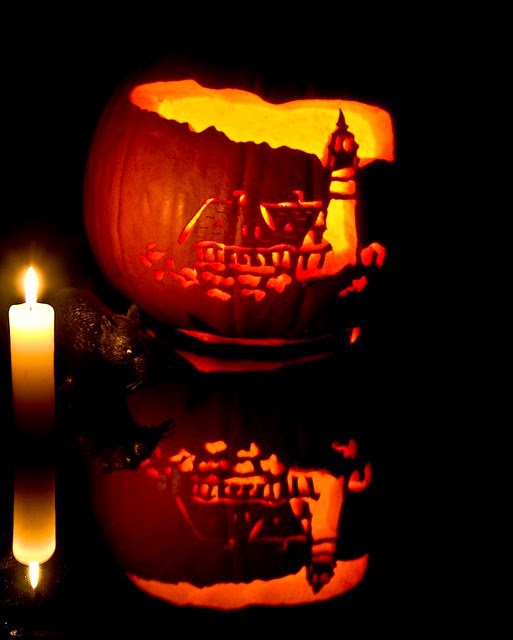
It's pumpkin season! I have pumpkins and scarecrows on my front porch and will add a few Jack-o-Lanterns as we edge closer to Halloween. Jack-o-Lantern carving has become an art!  My sister-in-law posted on Facebook earlier this week that she attended a Jack-o-Lantern carving class. Sounds fun to me...and, of course, I'd be carving a lighthouse into my Jack-o-Lantern. Go figure! (The one pictured was made by my daughter, Jessica, a few years back. It's Yaquina Head Lighthouse in Oregon.)


At the end of this blog are pictures of some awesome lighthouse Jack-o-Lanterns, but first let's find out the origin of this fun tradition. I'll quote from an article I wrote for Weatherwise Magazine last year for Halloween. The article was about the will-o-wisp and the old ghost lights in Great Britain that gave rise to our current Jack-o-Lantern craze. Those ghost lights were really glowing swamp gases from peat bogs and other wetlands, but as you can imagine, people thought otherwise in the old days before science could explain these phenomena:

There’s plenty of science today to explain ghost lights, but long before reason and logical inquiry provided sensible explanations, a multitude of imaginary characters were believed to carry these luminous specters through the wetlands of England, Scotland, Ireland, and Wales. They terrified villagers and lured unwary travelers into spongy fens where they became helplessly mired and slowly drowned. They haunted graveyards, marshlands, and peat bogs. And, they gave us the delightfully frightful traditions of Halloween. Foremost among them was Jack-o-Lantern, the ghost of Stingy Jack, an Irish trickster spawned from the dark nights of Gaelic history and reincarnated every October 31st as a carved and lighted pumpkin sitting on a front porch.

Stingy Jack is said to have been a farmer who cheated the Devil. One night Jack robbed his neighbors and then began running through a marsh to elude his pursuers. Suddenly, the Devil rose up in front of Jack and threatened to take his soul for the wicked deed he had done to his kinsman. Quick-thinking Jack fingered the crucifix he carried in his pocket and came up with a plan. He told the Devil he could produce many souls to take to hell if the Devil would pose as a coin in his pocket.

“I’ll toss the coin to the villagers as payment for the things I stole, and they’ll greedily argue over who gets it. You can take their wicked souls for fighting.”

The Devil liked the idea and turned himself into a coin. Jack picked up the coin and slid it into his pocket. The duped Devil landed next to the crucifix and was stripped of all his power. Stingy Jack then struck a deal by promising to let the Devil go only if he swore never to take Jack’s soul. Thus, when Jack died years later he could not enter heaven, for he had been a thief and cheat all his life, nor could he go to hell, because the Devil would not take his soul. Jack’s unwanted spirit was forced to roam the earth in darkness. The Devil, perhaps taking a pity on Jack, gave him a small bit of fire from hell. Jack carved out a large turnip and placed the fire inside. When villagers saw the eerie light of Jack’s turnip lantern, they knew he was restless and wandering.

Eventually the Jack-o-Lantern became part of Samhain, a Gaelic festival to celebrate the end of the autumn harvest. The date chosen was the night of October 31- November 1, the halfway point on the calendar between the autumnal equinox and the winter solstice.  In the rapidly waning daylight, bonfires were lit to ward off the darkness and the dead, who came back at this time to walk among the living. The ghost lights seen in the marshes and bogs and graveyards on chilly autumn nights were manifestations of departed friends and family members, as well as the ill-fated Jack-o-Lantern.
 
When the tradition of Stingy Jack and his turnip lantern was brought to America, a pumpkin replaced the turnip, since turnips here don't grow as big as in the old country, and pumpkins are plentiful. I'm rather glad for the switch; a turnip wouldn't be near as much fun to carve as a pumpkin!
 
If you volunteer for a lighthouse nonprofit group, think about having a "Lighthouse Pumpkin Carving" event. Kids would love it, and adults too. Prizes are always in order, as is cider and candy and cookies, along with tours of your lighthouse. Often, this a better choice for a family event with young children than a haunted lighthouse tour. Little kids get scared. Save the haunted lighthouse tours for older kids and adults.
 
And if, like me, you are mad for all things "lighthouse," carve your favorite lighthouse into a pumpkin this year.
 
Here are some beautiful lighthouse-carved pumpkins to inspire you!
 
Beckett Gladney posted this one on Flicker.
 
 
Here's one from Norbini on Flicker.
 
 
Purdueila on Flicker, of Cape Hatteras Lighthouse.
 
 
Steve on Flicker did several designs, including Portland Head Lighthouse.
 
 
Here's one from www.fantasypumpkins.com of the Flying Dutchman and a lighthouse.
 
 
Cory carved this one from www.imgarcade.com.
 
 
www.nauticalcottage.com has several, including this one.
 
 
And another from www.imgarcade.com.
 
 
A really fun one of "The Beast from 20,000 Fathoms" from monsterkidclassichorrorforum.yuku.com


Get out those carving tools, do a little sketching on a fat pumpkin. Carve your favorite lighthouse or a generic one. As seasoned pumpkin carvers know, you can carve straight through to the inside of the pumpkin, or you can cut away layers to create a relief that glows. To reduce the risk of fire from a candle, use a battery-powered  candle or a glow stick. There's no right way or wrong way, though, just a fun way!
 
In October, all lighthouses become tall Jack-o-Lanterns!


Thursday, October 2, 2014

Lighthouse Visitors on the Wing


Lured from far,

The bewildered seagull beats

Dully against the lantern...

Robert Louis Stevenson, The Light-Keeper II


Engraving from All Among the Lighthouses. Author's collection.

The birds are beginning to move on their autumn migrations. In Rhode Island last week, I saw great congregations of them in trees and winging over Narragansett Bay. Here in the Pacific NW, they're feeding and gathering in large groups in preparation for long flights to warmer climes. All this bird activity makes me think of lighthouses...

Certain lighthouses, because of their location along the great migratory routes, attract birds. These include the tall, bright sentinels at Fire Island, Cape May, and Assateague. All three lie along the great Atlantic Flyway — the Eastern Seaboard's busy, feathered freeway. A number of Great Lakes lighthouses and those of the Northwest states and British Columbia witness great waves of birds migrating between the tropics and Canada, and most of Britain's lighthouses stand along the busy migration routes to and from Africa. In fact, there are lighthouses all over the globe that witness bird migrations.

In the spring and autumn, these lighthouses serve as a backdrop for thousands of birds passing overhead during the daylight hours, but at dusk the weary flocks may fly in and roost on aerial wires, rooftops, clotheslines, and the light towers themselves. Or, they may continue on their long journeys, passing close to the lighthouses. In the process, the bewildered, avian travelers are sometimes injured or killed:

"I remember being on Bardsey Island off the coast of North Wales on what experts called a 'bird night,' wrote birdwatcher Wynford Vaughn-Thomas in 1985. "The swarms of small birds poured onto the island, some of them exhausted after long flights from distant Africa. They could not resist the attraction of the night light and, when dawn came, the evidence of that fatal attraction lay sadly at the foot of the tower." Today, Bardsey Lighthouse is home to a bird observatory. A current observer named Rich noted on his blog "Lighthouse Journal" that the lighthouse is sometimes a bane to the birds:

The majority are relying in a large part on the visible night sky to aid navigation and on light, particularly from the moon, illuminating the landscape. If bad weather descends whilst they are on the move they use other features to orientate themselves. The beams of Bardsey Lighthouse, which officially reach up to 43km out to sea, are particularly attractive if other navigational cues are absent. Up to 31,573 birds have descended upon the Lighthouse in a single night. Sadly some of these birds fatally collide with the light, typically Manx Shearwaters and thrushes, but also species such as Thrush Nightingale and Red-eyed Vireo. We are based at the light to monitor these attractions, help to direct birds away from the tower using gantry lights and catch grounded birds to stop them again flying at the light.

So great is the bird problem at some lighthouses, screens have been installed around the lanterns to protect the windows and lenses, and bird spikes are mounted on the top of the cupolas to discourage birds from perching and fouling the ventilation openings. Keepers of yesterday spent much of their time cleaning the outside glazing and scrubbing the gallery decks and railings. At stations where rainwater was caught on the roof and drained into a cistern, birds were sometimes even a menace to health.

Pictured is Fenwick Island Lighthouse, Delaware, with a bird screen around the lantern. Photo from www.lighthouseinn-ct.com.

Haaks Light in Den Helder, Holland looks like it's wearing a crown. The crown is actually a ring of bird spikes to discourage feathered visitors.
 
A modern beacon on the coast of Maine shows the mess birds can make of navigation lights. Photo by Bob Trapani, Jr.
 
 
Long Island's Shinnecock Lighthouse had chicken wire wrapped about the lantern to protect the glazing, but huge flocks still pelted the tower during migrations, often snagging in the wire screen. So many were killed that the keepers dug a trench around the lighthouse to make disposal of the dead bodies easier. The problem appeared to be solved until hunters invaded the station, lured by the prospect of easy targets. The government was forced to declare the area a wildlife refuge to protect the lightkeepers!

Exactly what lures birds to lighthouses is still unknown. Tall towers, with brilliant, flashing beams seem to hold the greatest attraction, but any lighthouse is a target, whether by accident or deliberate aim. Logbooks make frequent mention of encounters with birds and are prolific sources of information for ornithologists.

The most recent theories of bird navigation suggest long flights are accomplished using a combination of celestial cues (the position of the sun, moon, and stars), known landmarks, and a keen sensitivity to the earth's magnetic field. Birds appear to have amazing built-in compasses and sextants, not to mention excellent memories for the lay of the land, that allow them to monitor their flight patterns, comparing them against magnetic north and true north.


Lighthouses may disrupt this navigational ability and disorient birds. Perhaps the birds mistake the bright beacon for the moon or the sun, or on starless nights it becomes an immense, blinding star. A flashing or revolving beacon adds to the confusion and may contribute to the inexplicable bird-suicides and bird-attacks that have occurred at some lighthouses.
 

Whether by choice or by necessity, many lightkeepers became avid birdwatchers. The keepers at Boston's Graves Lighthouse were beguiled by the cheerful little rock plovers who visited the rocky islet. The Shanahans of Sanibel Island Lighthouse in South Florida tamed a pelican in the 1880s, one of many wild animals that kept the thirteen children of the keeper amused. Matinicus Rock's keepers worked amid a breeding ground of comical, clown-faced puffins, members of the auk family who return to breed in the burrows from which they hatch and fledge.

Heligoland (Helgoland) Lighthouse (pictured below in an old postcard view), in the North Sea thirty miles off the German coast, is so often the scene of massive and noisy flybys that an ornithological observatory has been set up there. According to German bird authority H. Gatke, October is the most active month when "under the intense glare of the light swarms of larks, starlings, and thrushes career around in ever-varying density, like showers of brilliant sparks or huge snowflakes driven onwards by a gale." Sometimes he observed predatory owls swooping through the beams in pursuit of a midnight meal. On October 28, 1882, so many tiny, golden-crested wrens swarmed about the lighthouse, the keepers could only describe them as a "blizzard of birds."


New Zealand's Arakoa Lighthouse had several families of blue penguins living under the porch of the lightkeeper's house each winter during the 1940s, when T.A. Clark and his Maori wife, Meri, kept the light. A perceptive amateur naturalist, Meri Clark noted that the little warm-blooded creatures were seeking the warmth of the brick chimney foundation. The cries of the penguins, which the family likened to those of unhappy children, forecast the arrival of storms with incredible accuracy.

Great rookeries of seabirds live on a number of lighthouse sites. Navassa Light, between Jamaica and Hispaniola, sits on a 250-foot high coral atoll and guides shipping to the Panama Canal. Commissioner of lighthouses, George R. Putnam, described the island as having "the appearance of a great petrified sponge." Pock-marked volcanic limestone, extreme drought, and unbearable remoteness from civilization made the desolate island a difficult assignment for yesterday's lightkeepers. Other than the lighthouse, the only human activity there has been the collection of guano for use in making fertilizer. Tons of it are still harvested annually, due to the large numbers of seabirds that make their home on the island.

Southeast Farallon Light off San Francisco also has a rookery of seabirds. Nineteenth century lightkeepers, though miserable from the noise and smell of the birds, were thankful for their presence. Bird eggs were an important part of their diet and also a second source of income, for the eggs were a coveted exotic food in San Francisco, particularly in Chinatown. "Egg wars" erupted when collectors argued over who should harvest the eggs. Gathering them was no easy task. The island's rough terrain and the aggressiveness of the nesting birds called for enormous personal fortitude.
An old engraving from Harper's Magazine showed an egg picker on Farallone Island fighting off the seabirds. He worked on the slopes below the lighthouse.


Ornithologists have long known that lighthouses provide excellent opportunity for the study of birds. In 1860, Texas lightkeepers were asked by the Smithsonian Institution to collect wild bird eggs, and great effort was made to educate the keepers, not only about the proper methods for collection, but also the importance of bird study. More than one lightkeeper became an avid birdwatcher, and by contrast, a few birdwatchers applied for lighthouse positions so that they could enjoy their hobby.
 
This was certainly true of Norman McCanch, a British lightkeeper who served in the mid-1970s. He had been interested in birds since his childhood on the Welsh coast and later the shores of Pembrokeshire. Trained as a taxidermist and passionately interested in birds, he joined the ranks of Trinity House and spent three years at various light stations. His experiences as lightkeeper, birdwatcher, and artist resulted in the 1985 publication of A Lighthouse Notebook, a handsomely illustrated personal journal dedicated to the winged traffic at the massive towers of Coquet, Cromer, St. Mary's, South Bishop, and Longships.

McCanch's deft pen and paintbrush perceptively captured the avian world of the lighthouse keeper: "Then, without warning, a small, brilliantly-lit shape dances momentarily in the beams of the light and is gone. Gradually another appears, and a couple more, until perhaps twenty or thirty small warblers and chats are flickering in the dazzling light. Unable to pinpoint any other landmark in the drizzle and mist, they fly towards the light, circling in its beams until exhaustion or daybreak frees them."
 
McCanch was licensed to ring birds, thus his detailed journals on their populations, physical conditions, and movements provided valuable data for British researchers and wildlife managers. He often caught birds in special nets as they flew near the brilliant lantern at night. Birds that collided with the tower and survived were nursed back to health and set free.
 

A one-legged, sickly herring gull was befriended after it awoke from a slam into South Bishop Rock Light. McCanch and his comrades hand fed the scruffy outcast and grew quite fond of it. Though the gull was eventually returned to the wild, it often came back to visit the keepers. Most birds that collided with the towers did not fare as well. Those that were merely stunned recovered quickly and flew off, but injuries were usually fatal. McCanch used dead birds for dissection or taxidermy.
 

The late and noted bird expert Roger Tory Peterson has never been a lighthouse keeper, but in an article for Smithsonian Magazine he admitted: "For years I had wanted to spend a night in a lighthouse when the birds were flying; to see the small travelers pouring out of the darkness into the dazzling beams." Peterson got his wish in April 1952 when he and fellow birders, Guy Mountfort and Keith Shackleton, received permission from Trinity House to visit St. Catherine's Lighthouse in the English Channel.


St. Catherine's, pictured below, is a lonely sentinel on a prominent headland of the Isle of Wight. At the time of Peterson's visit, the beacon was about 6,000,000 candlepower and a great enticement for weary migrating birds. In its earlier years, when the beams were nearly three times as brilliant, the keepers recorded enormous loss of birds, as if they were lured to their deaths against the light by some invisible force.


The night of Peterson's visit, conditions were nearly perfect for birdwatching — no moon and a gentle change from fair to rainy weather was due. With no celestial beacons to guide them, the radiant beams of St. Catherine's Lighthouse became artificial stars in the heavens for the birds traveling over the English Channel. Near midnight, a fine, misty rain began to fall, and the local foghorn commenced moaning its warning to sailors.

"Then we caught sight of our first real night migrant," Tory remembers. "Flickering and ghostly, it darted toward our high catwalk and swept over the top of the tower into the darkness. Soon another came in and another, like moths to a street lamp. During the next two hours there must have been hundreds."
Tory believed the birds were navigating across the 75-mile channel by a kind of avian dead reckoning — knowing direction and speed. The lighthouse may have temporarily suspended their direction-finding ability and caused them to veer off course and behave erratically, or it could have been a known landmark on their route north. Either way, it's likely the birds would fly near the tower and perhaps even land for the night.

Sometimes, interacting with the birds was just plain fun. Block Island, Rhode Island's Old North Light sits in the midst of a seagull rookery. Barbara Beebe Gaspar, daughter of the lightkeeper in the 1930s, tried to catch the gulls and tame them: "You had to be very sneaky and fast. I caught quite a few. I always let them go, though. I just wanted to cuddle them for awhile." Early 20th century lightkeepers on Block Island donated the bodies of dead birds to a colorful, local character named Mrs. Dickens, who was a bird lover and taxidermist. Her large collection of specimens is now in the care of the local historical society. Many of the little feathered "stiffs" assumed their odd poses after a night of aerial misjudgment around the Southeast Light or the Old North Light.

On the American Eastern Seaboard, there have been numerous documented instances of huge gatherings of birds during the spring and autumn migrations. Some coastal points — Cape Hatteras, Cape Charles, Cape May — regularly see this phenomena, which Tory believes results from cold winds from the northwest pushing migrating birds toward the eastern shores where they experience a kind of avian traffic jam. Alfred Hitchcock's fictional "The Birds" thrilled movie-goers with this theme in the 1960s, but at one lighthouse it was more fact than fiction.
Hog Island Light along the barrier islands of Virginia was attacked by birds in 1900. The tower, shown above, was built in 1896 to replace an earlier stone tower. It was an iron pile design meant to allow wind and water, and perhaps even birds, to pass through it unobstructed, and also to anchor it more firmly in the erosive sands of the island. The two keepers of the lighthouse were not surprised when a flock of birds collided with the lantern around 8:00 PM that February night in 1900, for this was a rather common event at the lighthouse, which was situated in the busy Atlantic Flyway. It seemed a few weeks early for such accidents though. When the birds did not immediately depart, one of the men climbed to the lantern and fired a shot into the darkness to frighten them away. It seemed only to increase the frenzy, so more shots were fired.

Soon both keepers were firing into the night, then taking aim at individual birds. The feathered raiders persisted, breaking glass and spattering blood. One even pierced the lantern glazing and lodged itself in the delicate prisms of the lens. The onslaught continued for several hours. When the keepers used up their ammunition, they took up clubs, then finally retreated to the base of the tower. Morning revealed the carnage - 68 dead ducks, geese, and brandts.

The men rigged a makeshift screen around the lantern and managed to repair the lens. But two nights later the berserk birds returned and once again battered the tower. Considerable damage was done to the lens this time, and at dawn the keepers counted more than 150 dead birds on the lantern and the ground. No explanation was found for the attack and it remains the worst on record at an American lighthouse.
 
A lighter side to birdwatching at lighthouses can be found in the logbooks of Florida lightkeepers stationed aboard the wave-swept sentinels along the Florida Reef. Atop the keeper's quarters at many of the Reef Lights were lofts for carrier pigeons, which were used to communicate with shore before the advent of radio transmission. The gentle, cooing doves were much-loved and reliable messengers. If a ship in distress was sighted or the lighthouse crew needed help, pigeons were the quickest emergency couriers.

Far north, at Maine's Boon Island Lighthouse (pictured below), a different sort of assistance was rendered by birds. One Thanksgiving almost a century ago the keepers faced a holiday without family or the traditional fare of turkey and its trimmings, for the weather had not allowed them to row nine miles to shore for supplies and no visit from the lighthouse tender was impending. The keepers sorrowfully concluded that holiday dinner would be potatoes and bread.

But to their surprise, a flock of geese crashed into the 137-foot lighthouse on Thanksgiving Eve. The next day, the aroma of roast goose, slathered with rich gamy gravy, wafted through the lighthouse and proved the perfect complement to potatoes and bread.

Foghorns at lighthouses also could prove tragic for birds. Edward Rowe Snow noted in his Lighthouses of New England that in the non-foggy season birds liked to nest inside the foghorn at Seguin Lighthouse in Maine. The horn was a large trumpet-shaped object that provided a secluded place to incubate eggs. But when active it gave out a deafening HONK!! Every summer when the fog rolled in and the keeper started up the foghorn, the first loud blast hurled the nest and any occupants out of the trumpet and into the air. Below are the large for trumpets at Nash Island Lighthouse in the UK.
 
Parts of this article originally appeared in Lighthouse Digest, December 1995.

© Elinor De Wire, 1995


Tuesday, September 16, 2014

That "September" Feeling


If you’re a teacher, you probably love September and the start of the school year. I do. It stirs a special sort of excitement in me—anticipation really—rooted in the Septembers of my childhood when mornings in Western Maryland were crisp enough for a sweater that would be shed by lunchtime and squirreled away in my book satchel at dismissal time. I have deeply embedded memories of school from my first day in September 1959 all the way through high school and college...
The bus, the new duds, rekindling friendship missed over the summer, new teachers, and books, lots of books. The lunchroom fare with a Dreamsicle for dessert. There were FTA meetings and working in the library, designing the scenery for a school play, pep rallies, locker breaks, and going to fall football games with the band marching on the field like so many toy soldiers, cheerleaders doing gymnastic stunts, and the “Rams” bursting through a paper sign at one end of the field as the game began. Rah!
These days, I sometimes go to a local high school game just for the pleasant remembrance of it all.

September's pleasant expectations are rooted even deeper in the years I taught school, first as a contract museum teacher at a planetarium and then in my own classroom in public schools. The newly-shined floors and stacks of books ready to be given out, freshly decorated bulletin boards and learning centers, name tags, labeled cubbyholes, new plants on the windowsill and the class pet in his turtle tank, and a chalkboard free of dust—all gave promise of wonderfully fun weeks of school that lay ahead. The kids came the first day shiny-faced with enthusiasm and dressed in new clothes, toting lunchboxes bearing the popular characters of the day. They found their desks, sat down, got out their new notebooks and pencils and looked at me as if to say: “I couldn’t wait to get out of here last June. And I couldn’t wait to get back this September!”

Going back to school—it truly was and still is exciting! My husband teases me about the sale fliers of August that lure me into stores to buy notebooks, pencils, pens, rubberbands, markers, clips, and other assorted school supplies, most of which I no longer need but still like to collect. Sorry, but I love school stuff!!
Each year, the school stuff changes, progresses, morphs. New stuff amazes. Notebooks are now small, pancake flat computers with finger-touch screens. Cell phone take snapshots of book pages I once tediously copied notes from. And how can a cigarette-lighter-sized plastic thingy that stores in your jeans pocket hold 32G of information?
Certain things become scarce or go extinct too. I can’t find those little sticky rings called reinforcers that we used years ago to repair a torn hole in a piece of notebook paper. Mr. M, my sixth grade teacher, wouldn’t accept a paper with torn holes. I spent a lot of time licking and sticking those odd little rings to my assignments. Not many office stores have reinforcers anymore, at least not the kind I'd recognize. On a trip to Staples recently, a store clerk led me to a wall of brightly-colored packages of them. You can now encircle that torn hole with flowers or stars or the colors of your school team!
 

Little plastic pencil sharpeners are fewer, and plain yellow #2 pencils seem not as popular as the glitzy ones with fancy toppers and gawdy colors and patterns. One store had pencils decorated with holograms! I was a collector of pencils in my youth, the tools of my trade then and now. They were rife with ideas and possibilities! They were ready to go to work. I was also a collector of the shavings pencils made when I sharpened them in my little plastic pencil sharpener. It was fun and a challenge to try to sharpen a pencil while making just one long curled shaving. If I succeeded, I stored the souvenir in my pencil box, a re-purposed cigar box with my name sprawling across the lid, and showed it to my best pal EllaMae on the school bus as we rode home. Often, she had one too!

That pencil box was a treasure in itself, a cache of personal goodies that went far beyond pencil storage—a wooden ruler with my name printed on it in ink (all things important were written in ink!), a picture of my cat taped to the inside of the lid, some emergency safety pins, my Jacks and ball, milk money, a box of Luden’s cough drops, a neatly folded plastic rain scarf my mother made me wear if the weather turned dirty. My father had wired two large buttons on the cigar box, one to the lid and one to the front, and then made a leather catch with buttonholes. That’s how I kept the box closed tight so its contents didn’t spill inside my satchel or desk. Improvised tools were the rule of the day in a community where poor farm families couldn’t afford to buy fancy pencil boxes.

Lunch boxes were the one indulgence. We always got a new one every year. Lassie, the collie dog from the popular TV series, was big when I started school, and she adorned my first lunch box. It had a small thermos inside, a red handle, and metal clips to hold the lid shut. After a week or so of use, it smelled like bologna and bananas. Just like pencil boxes, modern lunch boxes have become quieter and fancier. No more handles rattling and metal sides banging against bus seats and desks, or hapless hardboiled eggs getting cracked. Lunch boxes are soft sacks now, with insulation and compartments for everything. Waxed paper sandwiches have stepped back for Ziplock sandwiches. Thermos bottles have been upstaged by drink boxes with tiny straws. That loose Tootsie Roll in my lunch box is now a small serving-size packet of Skittles.
Sometimes lunch is simply a Lunchable, an all-in-one deal with cheese, crackers, and cookies sealed in a plastic form. My mother would shake her head in disbelief if she arose from her eternal slumbers and saw Lunchables! She prided herself on packing a lunchbox by hand and making sure the midday mealtime was a wholesome experience and a reminder of her love. That piece of yellow cake with buttercream frosting, so expertly wrapped and stowed, was delicious. I especially enjoyed licking the frosting off the waxed paper!

And who carries a book satchel anymore? It’s a backpack these days, probably a better idea all around. Satchels put a strain on arms and backs, especially when you feel compelled—as I did—to bring home every book and notebook in your desk…just in case you needed them for homework…or to show them off to family and friends. Possibly, the reason I carried home a pile of books was pride, coupled with an emerging sense of becoming an academic. I loved books even then, and felt edified hauling them around. They were windows on the world waiting to be opened.

The buckles on my book satchel usually wore out by November every year, and I was forced to hold them shut with shoelaces, clothespins, or paper clips. Speaking of paper clips, have you seen some of the new ones? Flowers, cats and dogs, geometric shapes, superheroes, letters of the alphabet…what happened to the plain metal ones? We used them for sundry tasks, clipping together papers of course, but also as hooks, bookmarks, tools to clean the pencil trough in our desk, toys to string together in long chains out of boredom. Or even to poke the kid in front of you and make him yell “Ouch! Hey, teacher! Elinor poked me with a paper clip!”

Yesterday, I followed a school bus home after doing some errands in town. It was slow going, as always, a stop-and-start-and-stop affair that tries many people’s patience. But I loved it. The bright yellow color, the roar of the engine and smell of exhaust, the kids chattering and waving from partway-down windows, smiling parents waiting at the ends of driveways—all of it was so very nostalgic. Not much has changed with school buses, except the distance between stops and the distance kids walk to meet them. It’s better that we protect our kids these days. No more mile-long walks to the bus stop with no adults to accompany us. No more getting off the bus in the rain or snow, or in the twilight of a winter afternoon and walking home alone. That part wasn’t so fun for me, except when our dog was waiting at the bus stop. He was my walking-home companion, and he got an earful…all the details of the day. Once home, he was conscripted to be a student in my class when I played school.

There are no school buses where I teach now. I’m an adjunct professor at local community college. I drive to the campus at odd hours to teach classes or attend meetings; I’m only there a short time. The students drive too; at least most of them do. Some walk to campus or get dropped off. The iconic yellow school bus isn’t part of the picture.
My daughter-in-law texted a picture of my oldest granddaughter on her first day of school this month: New shoes, a princess lunchbox full of goodies, a backpack decorated with her latest favorite Disney character, both front teeth missing as she smiled for the camera. Another texted picture showed her getting on the bus, all smiles. Her first day of first grade. I showed the pictures to a pre-term intensive three-day class I taught last week. We had a short dialogue about “firsts.” Many of them were in their first college class, and it was their first day too.

“Who’s got new shoes?” I asked. And we chuckled for few minutes and looked at each other’s new shoes.
 
Then we put away our I-Phones, unplugged the earbuds and music, pulled out those 32G thingies with scads of info stored on them, plugged them into computer USBs, and then went to work. Not a single pencil surfaced from a bookbag, or notebook, or ringy thingy reinforcer. There were no decorated cigar boxes or Lassie lunch boxes. But it went fine, as I knew it would.
Despite the many changes, I still, thankfully, get that "September" feeling this time of year.