Wednesday, August 13, 2014

Old Barnegat Light: What's in a Name?

I had a wonderful time yesterday--August 12, 2014--speaking to a group of women on Bainbridge Island, Washington. They call themselves SWERV--Savvy Women Exchanging Relevant Views. We talked about women lightkeepers. They were a fantastic audience for my "Keepers in Skirts: Women of the U.S. Lighthouse Service."

During Q&A time, one of them asked me if I'd ever been to Barnegat Lighthouse on the New Jersey shore. I have...many times!


This snapshot was taken by my husband on a trip to Long Beach Island and Barnegat Lighthouse in the late 1990s. It was a warm summer day, perfect for the beach.

We also visited the Coast Guard Station in Barnegat and saw the grave of Sinbad, the famous Coast Guard mascot. There's a fun article about him here: http://www.jacksjoint.com/sinbad2.htm (Photo of Sinbad's grave at the Barnegat Coast Guard Station is by Jerry Lentz)

 
Back to Barnegat Light:
I've heard many explanations for the name Barnegat. The one that makes the most sense and is historically accepted is that Barnegat was named by the Dutch settlers of the area. They called it Barendegat, meaning "inlet of the surf." Apparently, they thought the water here was turbulent, and it is. Hence, there's a lighthouse! Barendegat soon got slurred and compressed on non-Dutch-speaking tongues until it became Barnegat.
 
A more amusing and fun explanation for the name Barnegat comes from the lore of the area. Lore, of course, often provides a much more colorful interpretation of fact. See for yourself! Here's a poem that explains the origin of the name:
 
 
The Light-Keeper’s Daughter
A Naughty Gal Ballad
By Adam Clark
 
In the bay of Barnegat sailed a jolly, jolly tar,
And he watched like a cat o’er the water,
‘Til he spied from the main-top-gallant-forward-mizzen spar
The pretty little light-keeper’s daughter.
 
Then he landed on the land, did this jolly, jolly tar,
And he chased her o’er the sand ‘til he caught her.
Says he, “My pretty miss, I’ve got to have a kiss
From the pretty little light-keeper’s daughter.”
 
But she squealed a little squeal at the jolly, jolly tar,
And said she didn’t feel as if she ought to;
Then she scooted up the bar and hollered for her ma, —
Oh, the pretty little light-keeper’s daughter!
 
“Sure my name is Barney Flynn,” said the jolly, jolly tar,
And at drinkin’ Holland gin I’m a snorter.”
Then a tub of washing-blue, soap she suddenly threw—
Did the mother of the light-keeper’s daughter.
 
“Now, Barney, git!” she spat, at the jolly, jolly tar;
And you bet that Barney gat for the water.
Thus the place from near and far was named by the ma
Of the pretty little light-keeper’s daughter!


Barnegat Light is well worth a visit, especially this time of year when the beach is breezy, the lighthouse is open for tours, and there are plenty of good food stands nearby selling fried clams and ice cream! (If memory serves me right, Jon and I had fried clams, fries, and ice cream sundaes after visiting the lighthouse!)
 
 
The lighthouse went into service January 1, 1859, replacing an earlier tower built in 1835, one much too short and feeble to aid mariners. This sort of learning curve was common in the early days of the U.S. Lighthouse Service. There were many lighthouses built too small, too close to the erosive beach, or not bright enough to do the job needed. Barnegat's first lighthouse was among them. It's second one was much better!
 
The 1859 tower was tall and strong! It was built by Lt. George G. Meade, an engineer for the U.S. Army. Meade built a number of lighthouses early in his army career, and he was innovative at times. He designed a special lamp for lighthouses and he also designed and built several of the amazing screwpile lighthouses that stand on the Florida Reef. Then, as a General during the Civil War, he became famous for leading Union troops to victory at Gettysburg. Meade, it seems, could fight a battle on land and sea!
 
The photo above shows Meade's lighthouse and its dwelling for two keepers and their families, courtesy of the Library of Congress.
 
 
The 163-foot-tall lighthouse had a first-order flashing Fresnel lens purchased from the firm of Henry Le Paute of Paris. This was a great expense and was a quarter of the total budget for the lighthouse. The beacon served admirably for more than 60 years.
 
The lighthouse was downgraded to a small gas lamp in 1924 in favor of a lightship anchored offshore closer to the perils of this part of the coast. The shoreline had changed, and lightships were a popular solution to the problem of getting the light out to sea over the shallows that could so easily snag ships.
 
The  Barnegat light tower with its small gas lamp was given to the State of New Jersey that same year, and the opulent Fresnel lens was removed, stored in New York City for a time, and then taken to a museum in Chicago, far from its home.
 
Erosion plagued the lighthouse, but local citizens rallied and did all they could to halt the march of the sea toward their beloved sentinel. In the early 1930s they created a makeshift jetty out of junk cars and other materials that were sunk around the lighthouse to protect it. In 1934 the federal government funded a series of steel rings to girdle the base of the tower and steel pilings near the water's edge.
 
In 1944 the light in the tower was decommissioned, no longer needed. Local residents were relentless in assuring their lighthouse wasn't destroyed, a fate that was dealt to many excess light towers in these years. In 1955 they managed to get back the lens from Chicago's Museum of Science & Industry and place it on display in the Barnegat Historical Museum. A bust of George G. Meade was erected at the base of the lighthouse.
 
Photo of the lens on display at the Barnegat Historical Museum is courtesy of Kraig Anderson of Lighthouse Friends.
 
 
For several decades, the public visited and climbed the tower for a bird-eye view of the barrier beach and ocean. In the late 1980s, after a piece of the tower broke loose and fell to the ground, funds were secured to give the lighthouse a complete overall. It was opened again for public tours in 1991 and a new jetty was built to protect it. Then, in 2008, money raised by the Friends of Barnegat Light, resulted in a beacon being returned to the lantern, a modern optic from Vega Industries of New Zealand. The lighthouse was ceremoniously relighted on New Year's Day 2009, exactly 150 years after it was originally placed in service.
 
 
Old Barney, as the lighthouse is nicknamed, may be a ornery as Barney Flynn, the jolly, jolly tar. It's definitely more persistent...and still on watch 160 years later!


Thursday, July 31, 2014

Flat Hoarder or Flat Collector?

This will be a true, through and through, confession: I'm a collector, maybe a fanatic--an avid, excited, fascinated, beguiled, determined, directed, helpless hoarder...of lighthouse stuff. A hoarder, yes.

I credit a lingering "hunting and gathering" urge for the cache of collectibles in my office, useless but beloved things filling up cabinets and shelves and drawers, hanging on walls and packed away in trunks, in cardboard boxes, and inside plastic see-through tubs. If it has a lighthouse on it, I have it or want it or feel that I desperately need it. I may, single-handedly, keep eBay solvent!


But, unlike the dreaded hoarders we see on a popular but pathetic TV series, I hoard a specific type of item for a specific purpose, and I keep my collection organized and neat. You won't stumble over piles of lighthouse stuff in my house or office or get lost in a morass of meaningless minutia. It's all categorized and maintained in an efficient, almost obsessive-compulsive way. This is how the accumulated lives of passionate people are kept. If I were the Santa Claus of lighthouse stuff, my flying reindeer would be named: Stasher, Amasser, Gleaner, and Snippin, Squirreler, Ferreter, Filer, and Packrat.

The reason my stash is not a hoard is that most of my collection is flat. Call me the Flat Stanley of lighthouse collectors. I like stuff that can be folded, smoothed, laid on a page or in an album, or filed in a box. In the years when my family moved frequently on military assignments, flat collectibles were easy organize and store. They usually were cheap too, and they didn't take up much space or weigh much--important when there were poundage limits imposed for a move to a new duty station.

So, what does a flat lighthouse-themed collection look like? Patches, for starters. Ziploc bags filled with them. I just bought this one a few weeks ago as a sort of remembrance of spring 2014 and many pleasant hours of writing the Itty-Bitty-Kitty Guide to the Lighthouses of New Hampshire. It features Lake Sunapee Lighthouse.

Sometimes I sew my lighthouse patches on shirts or jackets, but I always remove them when the clothing is sent to a donation center and store them...flat. Recently, I went through my lighthouse patch collection and was amazed at the variety of them--Coast Guard units and ships, police and firefighters, city seals, museums, states, and more. At the beginning of this blog is a Boy Scout Council patch. There are at least a half-dozen of these with lighthouses featured.


Lighthouse stamps and cachets store flat. I can hoard scads of them in a small space. And I do! I loved collecting stamps of all kinds when I was a kid, cutting them neatly off the mail that came to our house and pondering their postal travels. People saved stamps for me. My grandmother in Pittsburgh kept a stash of them in an empty sugar bowl in her cupboard and gave them to me when I visited her every summer. A Sunday school teacher I had in Maryland cut them off her mail and doled them out to me on Sunday mornings--maybe as encouragement to attend and as a reward too.

Lately, I buy lighthouse stamps. Here's a set of pretty stamps I bought in Poland a few years ago. They're special to me because I visited all four of these lighthouses, plus many others in Poland. And, these souvenirs came home flat in my suitcase.

 
I like to collect (hoard?) postcards for the same reason I like stamps and patches. Postcards and patches have travels attached to them. I have a very large collection of lighthouse postcards, stored in shoeboxes. I collect shoeboxes too, not for the shoes that come in them, but for all the flat things I can store inside those boxes! Here's a small sampling of my lighthouse postcards. Every one of them reminds me of a story or a tidbit from history:
 

Genoa Lighthouse, kept by the uncle of Christopher Columbus--I'd like to think old CC came to love the sea and wonder about what lay beyond the horizon while visiting his uncle Antonio Columbo at this lighthouse.


I love this colorful 1909 postcard of Sand Key Lighthouse in Florida. It's not only a historic look back at the station when it had a dwelling and boathouse on site (before hurricanes destroyed them), but it also it has that wonderfully plump ring of alligators. I'm sure no alligator ever swam out to Sand Key, adrift as it is in saltwater. But Florida tourists love to send postcards with emblems of the Sunshine State...like alligators...and lighthouses.

Here's an old postcard of Cape Disappointment Lighthouse, before it got the big black strip around its middle. You can see the cannons from the fort that encompassed the site and some buildings that are gone now. It's a glimpse back in time. That's the Graveyard of the Pacific behind it at the mouth of the Columbia River. The ship that brought building materials for this lighthouse actually sank right off the site. If that doesn't underscore the need for a lighthouse, nothing does! I've stood on this bluff dozens of times, and it always impresses me.

Labels and decals, paper coasters and matchbook covers--all of these collectibles store flat. I have quite a few of them. Here's a little sampling:


I found the label above in a trade store in Seattle. I never pass a collectibles shop with second-hand stuff. The measure of a treasure is in the eye of the beholder!
 
Below is one of many lighthouse-themed matchbook covers I've found and stashed over the past thirty years. The New York Times reports that "Close cover before striking" is the most printed phrase in the history of the printed word! Yikes! And it does make sense to put a lighthouse on a matchbook cover. Flash!
 
Flattened pennies! It's so fun to make these in the penny machines at museums. This is Presque Isle Lighthouse in Pennsylvania, on Lake Erie. This summer, I'm working on an Itty-Bitty-Kitty Guide about the lighthouses of Pennsylvania.


Duck stamps. Every year these colorful waterfowl stamps for hunters offer a few lighthouse scenes. They are so beautiful. I plan to devote a blog this autumn especially to these specialized works of art. Below, from the top, are Barnegat Lighthouse in New Jersey, Assateague Lighthouse in Virginia, and the Sullivan's Island Lighthouse in South Carolina. And, yes, these store flat!!


Magazine ads, torn out and saved, are treasures. Sometimes I frame them, but most go in albums...flat. Advertisers do love lighthouses and the symbolism of them. The older ones can be purchased on eBay or at trade shows. These two ads--alas!!--encourage drinking and smoking. Yes, many lighthouse keepers did both, though the drinking was strictly forbidden. Both of these items were popular gifts for lighthouse keepers at holiday time, usually brought to the lighthouse in a boat by some grateful shore resident. Author Edward Rowe Snow, who played Santa Claus for the lighthouse families in the 1940s-1970s included cigarettes in the packages he dropped from an airplane. Everything in moderation, yes? Times have changed, and cigarettes would NEVER be a gift now. I think we all agree on that.


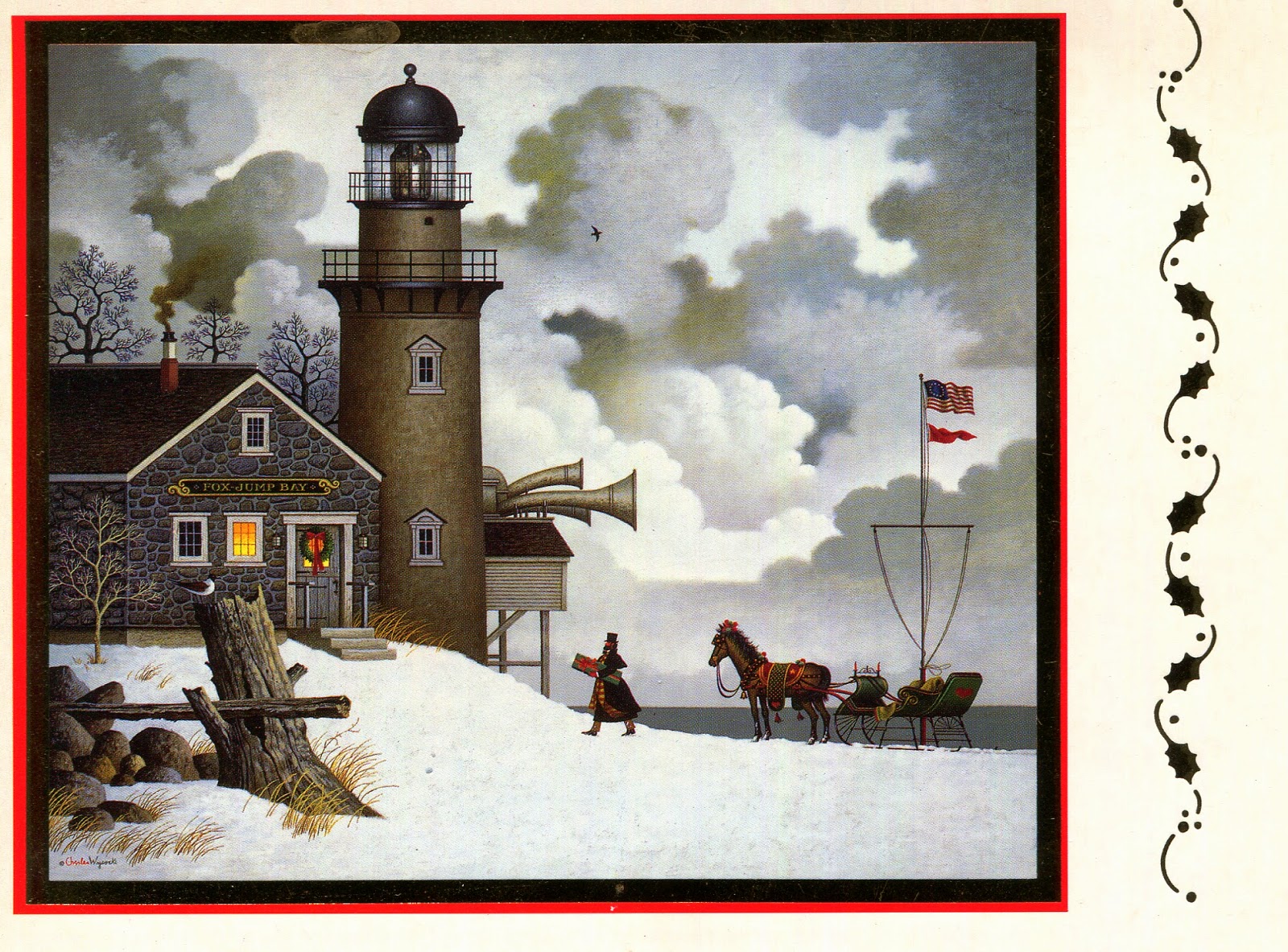
Speaking of Santa Claus and gifts, Christmas cards are another flat collectible I like. I get a slew of them every December from friends and fans. They are gorgeous! I tape them to the front of a closet door for everyone to see. After Christmas, I carefully peel off the tape and store them. I have hundreds, literally, hidden away in a filing cabinet. I wish I could think of a clever way to display them...maybe on a Christmas tree. Here's one I sent out last Christmas 2013. It was from the National Geographic gift store.
 
Here's a card with a Wysocki image called "A Gift for the Lighthouse Keeper." Wysocki definitely knew his lighthouses; the details are terrific in this painting. It makes me wonder if he actually witnessed this activity one Christmas, or perhaps he gave a gift to a lightkeeper.

Here's a holiday greeting card I received from England many years ago, from a real lighthouse keeper! John was a great corresponder, and he had plenty of time to write letters and postcards and caption the photos he sent. He's retired now; yet, he still sends me stuff--postcards, pictures, and other goodies. He's a collector of lighthouse things himself...maybe even a hoarder...except that I think he's an expert minimalist, due to years of living on a small lighthouse out in the North Sea. At the very least, he is a flat hoarder.

 
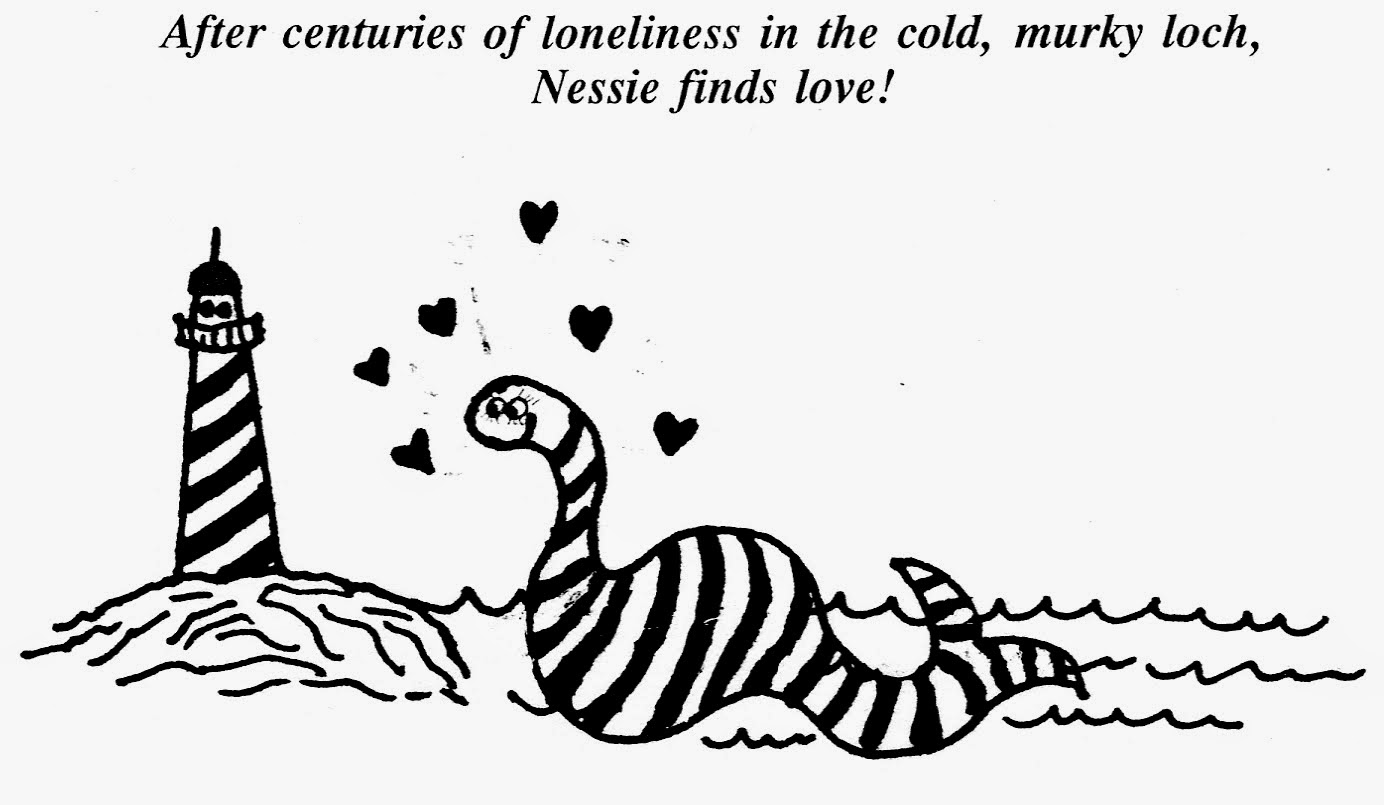
Lighthouse cartoons? There are so many of these, and if you guessed that they store flat, you're right! I've featured a number of them on my Facebook Page, and people absolutely love them. How many ways can a lighthouse be funny? Here are three, including one by me.


I draw my own lighthouse cartoons from time to time. I thought of this one after writing a magazine article about sea monsters and realizing that many of these crypto-creatures were sighted around lighthouses. There must be a reason for that. I'm not sure what it is, but if I were a striped, plump water-horse, I'd fall in love with a lighthouse! (Check out the expression on the lighthouse. Yikes!)


And the list of flattables could go on and on and on...  There's no end to the kinds of lighthouse collectibles that store flat and can be appreciated flat. Articles, trading cards (Hassan Tobacco Company produced such pretty ones in 1910!), photos, fabric swatches, bumper stickers, book covers, posters, calendars, license plates, drawings, restaurant menus...  You get the idea.

This might be my favorite flat collectible, a drawing my daughter made in the car on a trip from New London, Connecticut to Long Beach Island, New Jersey in the summer of 1991. She was eighteen and loved to draw. We were celebrating her high school graduation with a fun road trip together. We lounged on the beach and visited this lighthouse. Can you guess which one it is?


So...what are you collecting...that's flat?


Thursday, July 17, 2014

Eeecckkk!!! Lighthouse Mice


I found some telltale signs of a mouse in my home yesterday, on a shelf in the guest room closet where I store copies of my books. I rarely go in that room, unless company is coming, and our cats can't get into the closet. So that mouse had fun exploring...and possibly checking out all the lighthouse books.

Everyday experiences like this trigger ideas for my lighthouse blog. Mouse...mice. Lighthouse mouse...lighthouse mice. Let's talk about them--

Most, if not all, lighthouses had/have mice. Mus Musculus, as the house mouse is properly called, moved into every new lighthouse soon after it was built. Some of them were already in residence in the fields and woods surrounding lighthouses. Others came by way of ships, as stowaways, or as those famous mice and rats that desert a sinking ship.

Lighthouse keepers dealt with mice much the same way we do: They set traps, they kept cats and dogs, they went after the pesky little vermin with clubs and BB guns, and they complained bitterly about having to live with these tiny, opportunistic creatures. I haven't found a happy true tale of lighthouse mice yet. They weren't adopted as pets or even tolerated as nuisances.
Lighthouse cats were prized for their rodent-catching skills, especially at island lighthouses where few or no predators lived and mice populations could explode. Accounts of mousers are numerous though, some of them quite fun!

One of my favorite mouse tales comes from Cape Neddick "Nubble" Lighthouse at York, Maine. The lighthouse sits on a tiny islet a few hundred yards offshore. Lightkeepers at the "Nubble" kept cats for companionship but also to catch the mice. One mouser in particular was so efficient he eradicated the entire mouse population on the islet and then had to go ashore in search of the rodents. His name was Sambo Tonkus and he lived on the island in the 1930s. It was quite a treat for tourists standing on shore to watch old Sambo swim the tidal channel between the "Nubble" and the mainland. He'd come ashore some mornings, shake the brine off his fur, and walk past the onlookers with a determined tomcat stride. Hours later, he might be seen returning with a fat mouse in his mouth, which he carried home for his supper. Below is the "Nubble," the light station, and the channel Sambo swam. Further down is a picture courtesy of William O. Thomson from the website http://www.newenglandlighthouses.net/cape-neddick-nubble-light-history.html that shows lightkeeper Eugene Coleman with Sambo.
 
 
A lighthouse in Western Australia got its name from the belief that rats infested the place. Abel Tasman, the first westerner to chart this area, went ashore at the island a few miles off present-day Freemantle in the 1600s. There was no lighthouse yet, but he found a curious little creature that resembled a rat. In fact, there were lots of these little rat-like creatures, hopping like mini-kangaroos. So Tasman named the place Rottnest, which in Dutch translates roughly to Rat's Nest. It turns out the little creatures weren't rats at all, but a rare endemic marsupial the Aboriginal people called a quokka. I met one of these cute little guys on a trip to Rottnest Island in 2000. He gladly took a potato chip from me. (Shame on me for feeding the wildlife, but...he was too cute!) Here's one of the two lighthouses that now stand on Rottnest Island, Wadjemup Light.
 
And here's that cute little quokka that took a potato chip from my hand! Yes, it does resemble a rat...from a distance anyway. Up close, it's more squirrel-like. I'm sad to report the Aboriginal people hunted these little guys and toasted them on a stick over a fire. They were endangered for a few years but their population on Rottnest is now healthy. Photo by my husband, Jon DeWire.


The idea of a rat in a lighthouse is not so pleasant, but a mouse in a lighthouse is somewhat beguiling. Poets and storytellers haven't overlooked this cute little character; they've embrace him! Check out some of the children's books written on this theme (most of these are found on Amazon, evidenced by the "Look Inside" arrow):


The mice featured in these stories are always nice mice. They help out the lightkeepers, rescue people, and do amazing stunts. Real lighthouse mice do what real mice do--chew up stuff, raid the foodstores, leave mouse droppings everywhere, scare the lighthouse family, and perhaps provide entertainment and a meal for the lighthouse cat.

Disney's famous mouse, Mickey, is associated with lighthouses. Walt Disney seems to have had a fondness for lighthouses and included them in all his parks and resorts. When Disneyland opened, the attraction called StoryLand had a lighthouse to greet visitors. It became a popular place for pictures, often staged with Mickey Mouse. Below is a trinket from a Disneyland gift shop that speaks volumes about the lighthouse mouse! I posted it on my Facebook page today, because Disneyland first opened on July 17, 1955.
Cartoon mice have had their day at lighthouses too. Warner Brothers cartoons featured Sylvester the cat as a lighthouse keeper's cat who did battle with a naughty mouse. The rodent couldn't sleep because the lighthouse beam swept across his mouse hole, so he went up to the lantern and cut the electrical cord to the beacon with scissors. (Nickelodeon cut that part when it revamped the cartoon for modern-day viewers--too unsafe!) There was also a kangaroo in the story. Here's a website that shows clips from the cartoon with commentary:


To wind up this blog on the ever-popular and ever-present lighthouse mouse, I think John Ciardi's 1962 poem is in order:
 
The Light-House Keeper's White Mouse
 
 
As I rowed out to the lighthouse
For a cup of tea one day,
I came upon a very wet white-mouse
Out swimming in the bay.
 
"If you are for the light-house,"
Said he, "I'm glad we met.
I'm the light-house keeper's white-mouse
And I fear I'm getting wet."
 
"O light-house keeper's white-mouse,
I am rowing out for tea
With the keeper in his light-house.
Let me pull you in with me."
 
So I gave an oar to the white-mouse.
And I pulled on the other.
And we all had tea at the light-house
With the keeper and his mother.
 
Squeak!!


Tuesday, July 15, 2014

Notebook Fetish


Yesterday, I attended at workshop at the college where I teach. I took along a new notebook and labeled it appropriately for the topic at hand. It’s a bright red, spiral-bound notebook. On the front I neatly wrote the topic with a black Sharpie, and in the upper, right-hand corner I affixed a return-address label, in case the notebook gets misplaced. The woman sitting next to me in the workshop smiled and introduced herself, then added: “New notebook, I see! Here’s mine.” She had a similar one in aqua blue.

Notebooks. I can’t own enough of them; I can’t pass up a sale on them. The back-to-school sales have begun in local stores, and I’m in heaven…because…well…I LOVE office stuff!!—paper clips, rubberbands, all types of pens and pencils, folders and files and those wire gadgets for holding them, labels and adhesive dividers (because I simply must categorize everything!), 3x5 cards, 5x8 cards, desk calendars, notepads, file crates and file cabinets, scissors, glue sticks, rulers, markers, highlighters…

You get the idea.

I do feel sorry for the kids, though, having all this school stuff thrown at them in mid-July when summer vacation isn’t even half over. Here in Washington, school vacation has barely begun! But I’m glad to browse the back-to-school sales and stock up on things I probably don’t need. Notebooks are 19-cents at one of the stores in town. I’ll buy a dozen or more.

I like spiral-bound notebooks with colorful covers. There’s an entire drawer full of them in my main desk, and lots of smaller types in the other office desk. The closet outside my office has a stack of notebooks. Then there are the various small notebooks and notepads and sticky-note thingies for keeping track of everything. The filled and partially-filled notebooks are saved…in files of related topics, in boxes, on shelves as if they are books. Sometimes I splurge and buy fancy notebooks with pretty scenes on the covers. I have many with lighthouse scenes and cats and flowers and dragonflies.


I’m wondering if anyone else out there has a notebook fetish. All writers probably have this harmless addiction; some have it worse than others. We dedicated scriveners like our “stuff,” and it’s usually made of paper. I have trouble throwing away anything with writing on it. So the notebooks collect and gather into piles, and fill boxes and drawers and filing cabinets; they sit in stacks on desks and in crates and on chairs. Ultimately, I turn to the keyboard to finish projects. But all writing starts with notebooks, even this one. (I have a notepad in my handbag I scribbled with these thoughts while waiting at the pharmacy last week.)  I could transcribe my notes into files on my computer, and sometimes I do; but, I’m mostly old-fashioned about the process. Pity the trees! I can’t give up paper and notebooks.
 
 
I’ve decided that my notebooks are extensions of my brain. I have dozens and dozens of them at any one time, and I get really excited when I can start a new one...like I did yesterday at the workshop. I collect notes like some people collect stamps or postcards or recipes. Those items get mounted in albums. I mount my notes in notebooks.

I have active notebooks, notebooks in limbo (who knows when the topics might come to life?), and retired notebooks. Every few weeks, I dig out a few notebooks and look through them…commune with the ideas and information they contain. I simply cannot throw away any notes and ideas.

What kinds of notebooks do you have? I'd hate to think anyone lives that celebrated uncluttered life, minus a notebook or two.

Here are a few of my notebooks. See if you have any of the same—

Ideas: There’s a little idea notebook in my handbag, for when I’m out and about and that Eureka moment hits or I stumble upon an important bit of info. I began this blog entry in my little handbag idea notebook. There's a small one tucked in the drawer of the nightstand by my side of the bed. I have a bigger idea notebook on my desk, and one by the sofa where I sit in the evenings. They are more formalized and more detailed. With regularity, I transfer the ideas in these notebooks to topical files and my Facebook/Blog/article idea notebook.

Assignments: I usually generate my own writing assignments, but sometimes editors send them to me. Either way, I start a notebook immediately. One part, usually the back, is jumbled thoughts and plans, very scribbled. The front is organized and outlined—a framework for the article or book or video or talk. Right now I have a notebook on Pennsylvania. It’s my workbook for a new eBook that should debut in August: The Itty-Bitty-Kitty Guide to the Lighthouses of Pennsylvania. Notebooks for the other two eBooks in this series are already retired. And in my large filing cabinets are the notebooks for my other books. I save these huge files and show them to my students, usually when they start grousing about having to write a two-page response to something I assigned them to read.

Daily Activities: I use a desk calendar as an at-a-glance scheduler, but I use a notebook to plan, track, and reflect on my work. Work needs initiation, action, and closure. The “DA,” as I call this notebook, is a running list of things I need to do each day, everything from emails I need to answer and write to organizational tasks (filing pictures is a huge one!) to actual hours of writing. Do I write a blog today? What will go on my author Facebook Page? How much time will I devote to my current book project? Is there an article I want to work on? Do I need to go to campus today to teach or attend a meeting and what needs to be done for that? I spend time each night reviewing the day’s activities in my DA notebook and making a list of tasks I want to do the next day. I prioritize the tasks and check off each one as I complete it, or jot down a note about what's left to be done. Every few days, I look back to see what I’ve accomplished. This notebook keeps me organized, on task, and motivated. I suppose I could use the planner on my phone or my computer, but I like a notebook. It feels more in the moment, and a page is more friendly to the touch than a screen.

Inventory: This is a multi-use notebook where I keep lists of things. I like lists as much as the notebooks that hold them. Some of my lists are trivial, as in a list of all the countries I’ve visited, a list of all the pets I’ve ever had, a list of books I’ve read, a list of lighthouses I’ve visited. Others lists are critical: all the things in the house that need re-setting after a power failure; dates bills are due; phone #s of credit card companies and billers; people to call if there’s an emergency; family and friend birthdays. I like to send birthday cards and birthday wishes.

Health Journal: I learned to keep this many years ago. It keeps me honest about what goes in my stomach and how many calories I consume, how many steps are on my pedometer, my weight, what my blood pressure is throughout the month, what meds and supplements I take, and so on. Years ago, I suffered from migraines and my doctor asked me to document them: how often, how severe, vision symptoms, etc. He emphasized patterns. They’re important, I know. Patterns tell a lot about anything and everything. I have to admit I don’t enjoy this notebook much…would rather skip writing in it.

Essentials: Maybe you have one of these. I call mine the "Little Black Book," because I'm a slave to it and I love it too. It keeps me in order! I’m forgetful, but I also think my life has become really complicated in recent years. There’s a lot of stuff to remember and keep track of…I can’t remember all the logins, user names, passwords, etc. in my life. I haven’t memorized account numbers. I can’t recall which bills go to which credit cards. I need pages of protocols for how to do things on my computer. I need step-by-step directions for how to get into Netflix, how to use features on my cell phone, how to send a package UPS third party, how to hook up my little RV to power; how to program the sprinkler system, how to start the generator if the power goes out, which gas cans in the shop go to which machines. This is my secret notebook. Don’t ask me where I keep it!

Minutia: Here’s where all the stuff goes that doesn’t seem to have a home yet. If I see or hear or read something that I think is special or inspiring or funny, I put it here. Often, a tidbit gets transferred off a sticky note or from my little handbag idea notebook, even a paper napkin or a receipt on which I’ve scribbled notes. For example, two nights ago there was a gorgeous sunset to the west of my house over the mountains, a bank of cantaloupe-colored clouds with gold fringes. Orange clouds comingled with lavender and purple ones. I could, in places, see curtains of rain pouring out of the clouds over the mountains. There were distant flashes and rumbles. I watched for about twenty minutes, until the colors faded and the mountains turned purple. (The glory of a sunset is too fleeting!) When I crawled in bed I was thinking about that tableau and how differentiated it was—some spots blazing with rays behind the mountains’ profile, some a mix of sun and clouds and virga, and other places dark, wet, ominous and noisy. I Googled “sunset” and found this quote: “There is nothing more musical than a sunset.” Claude Debussey thought. I scribbled it into my Minutia Notebook, because I like it. Sunset Symphony in three movements. I also looked up the lyrics to Judy Collins' song "Clouds." Who knows if these words will ever be used in any project. At the very least, they exercised my imagination.

And, then, there are all my topical notebooks, with research notes and clippings taped in them, sketches, lists of books and articles and websites and other sources, photos affixed… On my desk at this moment are topical notebooks on Pennsylvania, Europa Point Lighthouse, and redwood trees.

I can’t seem to have enough notebooks. A notebook hoarder, I am! When I’m gone, there’ll be so many of them to be cleaned out of my office. No one will want them, as they‘re hard to decipher. I scribble in invented shorthand. Many writers do that. These notebooks of mine will make a great bonfire, I suppose. But...possibly...perhaps...they are a record of sorts, of me. Documenting life isn’t all that bad. I don't think this is abnormal...


It appears I'm in good company!


I’ll wrap up this confession now. Those 19-cent notebooks are calling, and I suspect all the writers in my neck of Washington have already descended on the sale and grabbed up some of the best ones!