Tuesday, May 12, 2015

The Covered Way


Architectural styles of lighthouses vary greatly, as do their geographic locations. In colder regions many lighthouses were designed with covered walkways between buildings. These facilitated lightkeeping--lightkeepers could access the light tower from their house without ever going outside--and reduced the work of shoveling snow and keeping a trail to the light tower cleared.

Above is Owls Head Lighthouse in Maine. In 1903 a 60-foot covered way was built between the lighthouse and the oilhouse. Three years later another walkway connected to the first and provided a weather-free link between the keeper's quarters, the light tower, and the oilhouse. The keeper, if he so desired, could tend the lighthouse in pajamas, though I doubt any ever did. The covered way simply made access easier and safer. The keeper still had to trek outside to work the fogbell. Owls Head's covered way is gone today.

Safety was a great concern at some lighthouses. At White Island Lighthouse in the Isles of Shoals, New Hampshire, situated on an island several miles off Portsmouth, the covered way (seen in the old postcard and HABs b&w view below) protected the keepers from the sea. Waves could breach parts of the island during severe storms. The walkway itself was damaged on several occasions by storm waves. The keepers reported how fearsome the sound of the waves was at they crashed over the walkway.


While most covered ways were found in New England, smaller ones were seen in other parts of the nation, such as the Great Lakes lighthouses.
Fairport Harbor Lighthouse in Ohio still has its wooden covered way connecting the house and tower, seen in this travel book photo. So does Beaver Island Lighthouse, Michigan, seen below. (Coast Guard Archives photo)


Terry Pepper of the Great Lakes Lightkeepers Association took this picture of the covered way at St. Helena Lighthouse, Michigan.
 
 
Here are some other examples of covered ways at lighthouses--
 
This vintage postcard shows one of the twin light towers at Thachers Island, Cape Ann, Massachusetts. Only one of the twin towers had a covered way running from the house to the tower. The other twin light was accessed by a rock path several hundred feet long.


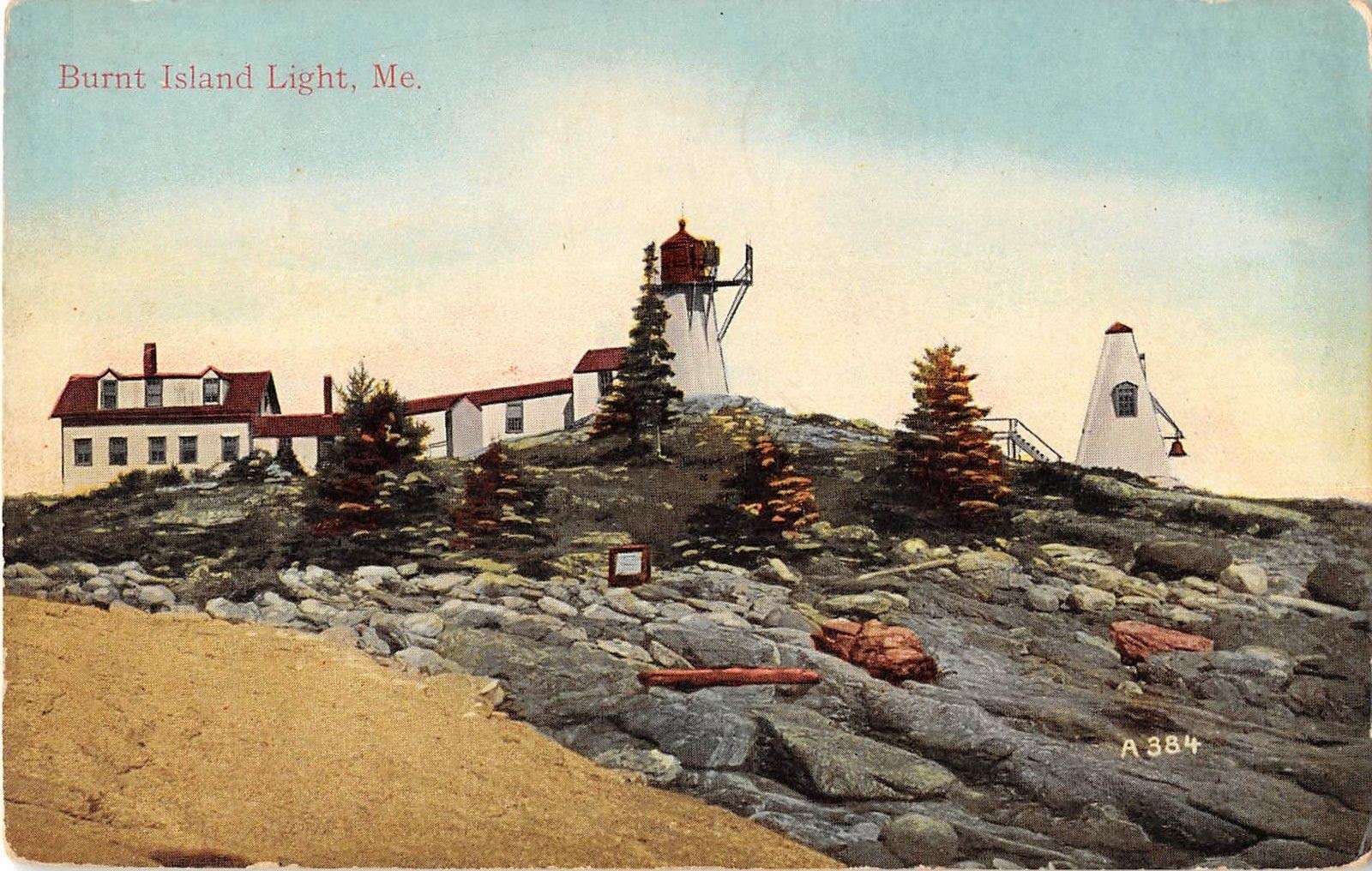
This old postcard shows the covered way at Burnt Island Lighthouse, Maine. The way was not connected to the bell tower, seen on the right, but there was a plank walkway and bridge to the bell tower.


Of course, development of the integral lighthouse/keeper's house made access to the light tower exceedingly easy. Here are some examples--


New York's Selkirk Lighthouse was built with the tower rising from the roof of the keeper's home.


Block Island Southeast Lighthouse in Rhode Island had the light tower connected directly to the house. (Coast Guard Archives supplied the b&w images in this section and the next)
 
 
Of course, if you lived in this lighthouse below, at Barbers Point, Hawai'i, there was no need for a covered way. In fact, a jaunt from the quarters to the light tower was pleasant and clement!!


Tuesday, May 5, 2015

Kipling's Love of Lighthouses


Joseph Rudyard Kipling (1865-1936) saw many lighthouses in his time. They found their way into his works, along with buoys, ships, sea captains, and other nautical emblems.

He was born in Bombay during British rule and then sailed to England at the age of five to live with friends and of his parents in the naval port of Portsmouth and be properly schooled. At the age of seventeen, unable to get a scholarship to Oxford, Kipling returned to India and began work as an editor for a newspaper in Lahore and, later, Allahabad.

At the end of his newspaper job, he returned to England via the Pacific route, landing in San Francisco. From there he traveled north to British Columbia and then through the Midwest to Boston where he sailed for England, arriving in 1889. He was a celebrity by this time, at the young age of 24.
Kipling saw many lighthouses on this trip. Farallon Light probably greeted him as he approached San Francisco, and then Point Bonita Lighthouse and the famous sentinel on Alcatraz Island. Up the West Coast he may glimpsed St. George Reef Lighthouse, then still under construction, and Cape Disappointment Lighthouse as his ship entered the Columbia River, bound for Portland. In British Columbia he surely saw Race Rocks Lighthouse.
At Boston, his ship passed the historic Boston Lighthouse and then sobering Minots Ledge, where a masonry lighthouse stood on a submarine shelf of rock. American lighthouse builders had learned to construct wave-washed lighthouses from the British and Scots. Minots Ledge, Kipling no doubt knew, mimicked Robert Stevenson's great Bell Rock Lighthouse, built by the father of one of Kipling's favorite writers, Robert Louis Stevenson. (NOAA image of Minots Ledge Lighthouse)

 
He took another sea voyage, this time for his health, and then married. He and his wife settled in Brattleboro, Vermont where he started a family and wrote many of his most famous pieces, including The Jungle Book and Captains Courageous.  The Kiplings returned to live in England in 1896 in a home in Devon overlooking the English Channel. Undoubtedly, the twinkling lighthouses of the channel influenced his writing.

In 1897 he moved to Sussex. A decade later he won the Nobel Prize for literature—the first English language author to do so. Even so, he is remembered as a controversial figure for his political views and his acceptance of British Imperialism. He died at Sussex on January 18, 1836.

 
Kipling’s many travels at sea influenced his work, as did the British reputation as a sea-going nation and its work in the Crown Colonies where Trinity House, the British Lighthouse Authority, erected many handsome and enduring lighthouses.

Kipling’s 1896 volume, The Seven Seas, included many nautical poems. Below is “The Coastwise Lights,” extoling the lighthouses of England, which Kipling considered the best in the world.


Our brows are bound with spindrift and the weed is on our knees;

Our loins are battered ‘neath us by the swinging smoking seas.

From reef and rock and skerry—over headland, ness, and voe—

The Coastwise Lights of England watch the ships of England go!


Through the endless summer evenings, on the lineless, level floors;

Through the yelling channel tempest when the siren hoots and roars—

By day the dipping house-flag and by night the rocket’s trail—

As the sheep that graze behind us so we know them where they hail.


We bridge across the dark, and bid the helmsman have a care,

The flash that, wheeling inland, wakes his sleeping wife to prayer.

From our vexed eyries, head to gale, we bind in burning chains

The lover from the sea-rim drawn—his love in English lanes.


We greet the clippers wing-in-wing that race the Southern wool;

We warn the crawling cargo tanks of Bremen, Leith, and Hull;

To each and all our equal lamp at peril of the sea—

The white wall-sided warships or the whalers of Dundee!


Come up, come in from Eastward, of the guardports of the Morn!

Beat up, beat in from Southerly, O gypsies of the Horn!

Swift shuttles of an Empire’s loom that weave us main to main,

The Coastwise Lights of England give you welcome back again!


Go, get you gone up-Channel with the sea-crust on your plates;

Go, get you into London with the burden of your freights!

Haste, for they talk of Empire there, and say, if any seek,

The Lights of England sent you and by silence shall ye speak.
 
 
Above is the W. Heath Robinson painting done in 1909 to illustrate Kipling's poem, "The Coastwise Lights."


Monday, May 4, 2015

Wolfe Lighthouses

 
Every school year I visit local schools in my area to talk about lighthouses. Most are elementary level, and second grade is popular, primarily because Keep the Lights Burning Abbie is a second grade level book. Nothing is more fun than a group of exuberant second graders learning about lighthouses!
 
I enjoy the school visits for many reasons---I once taught elementary school and miss hanging out with the youngsters, I'm the education guru on the board of the U.S. Lighthouse Society and education chair for the American Lighthouse Council, I know that the citizenship attitudes needed for tomorrow's lighthouse preservationists start young, and kids need to rub elbows with passionate people. I tell them everyone needs a passion in life, something to get excited about, learn about, share with others, and work to save and appreciate. They quickly see that for me it's lighthouses.
 
I visited Wolfe Elementary School in Kingston, Washington last Thursday for a day of fun with the second grades. We met in the library and shared a PowerPoint about lighthouses, learning that they are all different shapes, sizes, and colors and that they stand watch all around the globe. Then I headed to each classroom and helped the students build their own paper cup lighthouses. (You can find my video on You Tube about making the lighthouses here:
 
 
We learned all about lighthouse signals too, including optics and the daymarks lighthouses wear to differentiate themselves during the day. One class lined up their lighthouses on a windowsill (photo above). To quote their teacher, Mrs. Johnson: "This was such a fun activity, and they're adorable!" (Both the lighthouses and their builders, I think!)
 
Adorable, yes!....but even more, the fun experience of learning about lighthouses and building them was cemented in the kids' minds in a place I call the "Fun Center." With luck, that experience will remain with them for years, and they'll recall it whenever they see a lighthouse or an image of one, and as adults they'll want to visit lighthouses and take their kids to them. With even more luck, they'll someday join in the effort to save lighthouses. We always remember with pleasure the fun times in life. I know these kids will remember their day with me and the fun they had building their own lighthouses.
 
Here are a few more images from Wolfe Elementary--
 
These two second graders teamed up to build Abbie Burgess' twin lights at Matinicus Rock, Maine. They were quite creative in their method of joining the towers together. Abbie would be proud!
 
Here's a pleased, excited lighthouse builder!
 
Her lighthouse is finished. Now to make the island for the lighthouse!
 
She needed to glue the cupola on the lantern room! All the students loved the new word "cupola!"
 
 
He worked hard on the daymark so ships can see his lighthouse during the day!
 
Hey Mrs. DeWire, how does this look?
 
 
As always, I learn things from the students when I visit schools. Wolfe Elementary has a "quiet" hand sign--important when kids are gathered in large groups having fun. I saw the students making this sign to alert each other about being quiet--


They were quiet wolves from Wolfe Elementary, on the hunt for lighthouses!


Monday, April 27, 2015

The Functional Lens-Lantern


We all know penny-pinching can stretch a dollar. We also know the size of the tool should match the size of the job. The old lighthouse establishment lived by these two rules. Lights for navigation were built as economically as possible, and seldom was a light brighter or bigger than needed.

In places were a small light would suffice, the post lantern was the tool of choice. These were, as their name implies, simple structures---posts, masts, poles---that held aloft a small lamp. Above is a good example, the 1893 Funck Lens Lantern. Lens-lanterns were in use earlier, though.

Rivers and small harbors had them. There were many on the Mississippi River. The West Coast also had a fair number of lens-lanterns in the early years of its lighting by the U.S. Lighthouse Establishment. These were cheap, and they sufficed in some places until lighthouses could be built.

A tripod structure held the lens-lantern aloft, and a pulley system allowed the lamplighter to lower and raise the lamp to clean and refuel it. After the Civil War, most lens-lanterns were fueled by kerosene. The bottom of the lamp had a reservoir that held a supply of the fuel, usually enough for a week. The lamplighter was a local person who had his or her own residence nearby. The government paid this person to fuel and clean the post light and report any problems with it. Below is a tripod post light on the Mississippi River about 1920. Also shown is one of the river's lamplighters in 1940 with her post light. Photos are from the Coast Guard Archives.


Lens-lanterns provided more light than a simple house lantern. The beacon could be seen a couple of miles in clear weather thanks to the addition of a small Fresnel-type lens that surrounded the light source. This sufficed in rivers and small harbors. Bad weather significantly diminished the effectiveness. Even so, economics dictated their use in areas that would have been better served by lighthouses.

When Hawai'i first began lighting its island coastline, there was little funding for expensive lighthouses and lenses. Thus, many of the early Hawaiian lights were lens-lanterns. Below is Ka Lai Light, on the southernmost point of the Big Island of Hawai'i. It's beacon was elevated on a metal skeleton tower, but the light itself was feeble. A lens-lantern hardly cast a beam more than a mile off the shore. Smoke from the active volcanoes on the island obscured it. Ships went off course looking for it. But it was all the government felt it could afford in the early years of the twentieth century. 

You can see the lens-lantern on the left side of the superstructure in the image of Ka Lai below. This was a bit more sophisticated than a simple post lantern. It had a windmill on top. The building was for storing fuel and tools. The lamplighter lived some distance away and walked to the site until the lighthouse service bought him a horse.


Browns Point at Tacoma, Washington had a lens-lantern to serve the busy harbor until the 1930s (shown below). It was mounted on a small wooden tower that looked more like a privy than a light tower. A fogbell hung above the beacon, which was enclosed in a box on the side of the tower facing the harbor. The rainy climate of Tacoma convinced the lighthouse service to at least protect the lens-lantern. Prior to erection of the tower in 1903, the lens-lantern hung on post at Tacoma Waterway Light, shown below the Browns Point Light.


Structures to support lens-lanterns were more sophisticated at some sites. Point Robinson on Vashon-Maury Island, a few miles north of Browns Point, had two iterations of lens-lantern towers, shown below, each using the same lens-lantern. These were established in the 1880s and 1890s. The site did not receive a lighthouse until 1915.


Howland, Baker, and Jarvis islands in the Pacific Ocean were U.S. territories marked with beacons in the 1930s. They, too, had lens-lanterns for beacons. But these were mounted on lighthouses. The one at Howland Island is shown and was named in honor of Amelia Earhart after she disappeared on her flight around the world. It was accessed by an exterior ladder. The island is so flat, the beacon was needed to help ships find it. Today, only a stub of the tower stands. It was ruined during World War II bombings.


You might wonder if the work of lamplighters who tended lens-lanterns was much respected. It's likely these humble servants got less credit for keeping the waterways safe than their counterparts at majestic lighthouses with huge lenses and on-site resident crews of keepers. Certainly, lamplighters gained no fame. They also were paid less....but then they had less work to do. It could be dangerous work, though, as when a Mississippi River lamplighter opened his lens-lantern one afternoon to find a rattlesnake curled up around it! He used a stick to push the snake off the post, but the determined reptile threaded itself up the ladder and threatened the lamplighter again. It was knocked into the river several times before it gave up the assault.
 
The service of lens-lanterns and lamplighters was important. I've written about it here to preserve the story, small as it is in comparison to others in the lighthouse service. You can see lens-lanterns on display in a few museums. The one below hangs in the Coast Guard Museum Northwest in Seattle and is the lens-lantern that once hung from a post on Alki Point, the southern gate of Seattle's Elliot Bay.


Friday, April 10, 2015

A Flash of Lighthouse Green


Amateur astronomy is one of my many hobbies. I taught in a planetarium for about ten years in the 1980s-90s and have written several books on skywatching. I find that my skywatching hobby goes well with lighthouse hunting.
 
(Photo above shows the green flash behind La Perdix Lighthouse on the Brittany Coast of France and is from Astronomy Picture of the Day by Laurent Laveder http://apod.nasa.gov/apod/ap120510.html)

Lighthouses usually have wonderful skies over them and unobstructed flat horizons beyond them.  They often afford the chance to observe the skies at their finest—dark, looming, and touched by the hand of an ocean atmosphere that produces intriguing special effects.

One interesting phenomena I’ve seen several times from lighthouses is the Green Flash. You’ve got to be patient and observant to see it, and sky conditions have to be just right. Lighthouse locations can provide those “just right” conditions. You’ll need a clear view of the flat western horizon—no trees, mountains, hills, buildings, or any other elements. And Green Flashes occur most often when the air is still and no clouds obscure the horizon.
 
If such a serene day winds down at the shore, park yourself with your favorite drink, relax, focus, and wait. Wear dark sunglasses too, or better yet, look at the sunset through #14 welder’s glass, as staring at a bright horizon a long time will cause discomfort and may even harm your eyes.
 
(Photo below is from Colin Legg Photography. It appeared on www.earthsky.org and shows a sun dome with a green flash setting behind Rottnest Island Lighthouse in Western Australia. What an amazing shot! Find more of Colin Legg's fantastic images of the sky on https://www.facebook.com/ColinLeggPhotography)


Catch it if you can, and you’ll never be deceived by a lover!  So says an old Irish superstition concerning the Green Flash. That seems reason enough to look for it. Even more, it’s one of nature’s special magic shows. Now you see it; now you don’t!! Your eyes can catch it. So can your camera.
 
The Green Flash is, just as its name implies, a momentary flash of green light that appears just as the Sun's orange disk disappears over the horizon at sunset. It also occurs at sunrise but is less often observed at this time, due to the difficulty of predicting the exact moment when the upper rim of the Sun will rise. But go for it anyway, especially on the East Coast at your favorite lighthouse. Just watching the sunrise at a lighthouse is beautiful enough. Add the Green Flash, and you'll really experience something memorable.
 
A morning or evening following a cleansing rainstorm is good for Green Flash conditions, as are days when a cold front has just moved down from Alaska or Canada.  Although the ocean horizon works best because of its flat line, the Green Flash can appear on any flat horizon.  Some people have seen it on mountaintops and over buildings, but this is very rare. Your best chance of catching it is at the coast over the ocean horizon. Summer and winter are the choicest times to look, when the angle of the Sun’s descent is shallowest.
            If you’re using welder’s glass to dim the bright sun (and I highly suggest you do!!), you might also see some sunspots, which appear as small dark flecks on the Sun.  These are cooler areas on the Sun’s surface and are associated with its magnetic field.  Very near the moment when the sunset disk is about to disappear over the horizon, look at it intently through the welder’s glass.  If conditions are right, you’ll see green color effects just as the disk disappears. Depending on its intensity, the Green Flash may be bead-like, spiked like a star, or elongated into a dash or ray. 
            What causes this momentary flash of emerald light on an otherwise tangerine Sun?  Unknown to your eyes, the upper edge of the Sun’s disk is rimmed by a green arc of light.  The reason your eyes can’t see the green when the Sun is still up is that green occupies a much narrower part of the visible spectrum than other colors.  Yellows, oranges, and reds have much longer wavelengths and dominate your field of view.  But at the final moment of sunset, the shorter wavelength green gets its chance to shine.  It shows through in a jewel-like flash.
            When you see it, consider yourself lucky.  Not many people catch this elusive phenomenon.  Science can’t guarantee that seeing the Green Flash will keep your love life intact, as the Irish believe, but observing it will automatically admit you to a unique circle of skywatchers.

            If you happen to observe it at a lighthouse, consider yourself even luckier: You’ll see a manmade beacon in the lighthouse and a nature-made beacon on the horizon! Don't despair if the elusive Green Flash doesn't appear. Trade the green "flash" of a lighthouse instead--maybe Portsmouth Harbor's handsome old beacon, seen below. (Lens photo by Bruce "Boondog" Robie, who caught his reflection in the lens as a bonus. Bottom photo by Matt Currier.)


To find out more about the Green Flash, check out this website from astronomer Andrew Young --  http://mintaka.sdsu.edu/GF/.
 

Monday, April 6, 2015

Sojourn at the Lighthouse

Meet my newest eBook! Sojourn at the Lighthouse. It's based on a journal I kept during my keeper weeks at New Dungeness Lighthouse on a sand spit off Sequim, Washington. I've served there as a volunteer keeper twice now, and I've visited the site many times with work parties or for a day trip. It's a special place, and being a volunteer lightkeeper is a unique experience.


This is one of the most fascinating lighthouses I've visited. It has a wonderfully rich history, dating back to 1857 when it went into service. U.S. Lighthouse Establishment keepers occupied the station from 1857 until 1939 when the Coast Guard took over operations, and then Coast Guard keepers lived at the lighthouse for fifty-five years. It was nearly boarded up and abandoned when the Coast Guard left in 1994, except for the determination and hard work of a group of local citizens who wanted to keep it staffed. They became the New Dungeness Light Station Association. Since 1994, they have maintained a 365-day-a-yeat presence on the light station with volunteer lightkeepers. I was on their board for several years in the early 2000s, and I remain close with the group.

You, too, can be a volunteer lightkeeper here. The book will familiarize you with the experience and the duties of modern-day lightkeeping. This is a vacation spot--yes!--but it's also a place to do some important work to preserve the history and mission of the light station. The scenery and wildlife alone make it worth the trip.

If you're looking for a lighthouse for a meaningful vacation retreat, or you've booked a week at this one, read my book first. It's written somewhat like a diary and is rife with interesting anecdotes and tidbits of history. If you've had a stay at any other lighthouse, compare your experience to mine.

You'll find Sojourn at the Lighthouse on Amazon.com under Kindle Books for $1.99. Here are some images I included--


Monday, March 30, 2015

The Lighthouse Garden


Springtime! Till the soil, get rid of weeds, add compost, plant the seeds, and watch your garden grow!

Many lighthouse families enjoyed flower gardens. They added some beauty and color to light stations that were largely gray--gray rocks, gray tower, brown sand. A keeper at Cape May Lighthouse in New Jersey--Harry D. Palmer--won awards for his flowers and beautiful hydrangea garden. In the 1920s the Cape May Chamber of Commerce repeatedly gave him the annual prize for the city's "Best Kept Lawn."

The grounds of Point Pinos Lighthouse in Pacific Grove, California were groomed and colorful when Emily Fish was the lightkeeper in the 1890s. Her servant, Que, was an expert gardener. Both this lighthouse and Cape May Lighthouse had many visitors, so keeping the grounds attractive was important.

The handsome Carpenter Gothic lighthouse at Point Fermin, California always had lovely flowerbeds, thanks to the women who lived at the lighthouse. The plantings have been researched and are still done today, thanks to the Point Fermin Lighthouse Society. Here's a picture of me in 2004 at the lighthouse with some of the lovely flowers. Who wouldn't want to live here??!!


Keeper P.N. Christiansen and his wife are shown below at Washington's Mukilteo Lighthouse about 1925. They were proud of all their flowers, especially the roses.


The docents at Mukilteo Lighthouse still keep the grounds nice with flowerbeds. This is a very public light station and a museum, so it needs to look good. I took the picture below in the spring a few years ago.


A Master Gardener Project helps keep Yaquina Bay Lighthouse beautiful. It's keepers were removed in the 1870s and for years the lighthouse was an eyesore, until the BLM took over and spruced it up with the help of local gardeners. Kids get to help too! This picture shows some of the gardeners at work. The tall green plants in the back are fava beans.


Gardening was not only a popular pastime at lighthouses, it was a subsistence effort too. While the lighthouse service provided a few nonperishable staples--sugar, molasses, flour, rice, beans, salt beef, and more--lightkeepers planted gardens to have fresh vegetables and herbs.

 
Point No Point Lighthouse, Washington had a large garden when keeper William Cary and his family were there. The photo above, taken about 1916, shows the Carys working in the garden. Keeper Cary had a parrot on his shoulder!
 
Lighthouses at northern latitudes took advantage of the long periods of daylight after the vernal equinox. Alaska lightkeepers at Mary Island boasted of cabbages the size of beach balls and kale leaves three feet high. No doubt, the Cary's garden above flourished at 47 degrees latitude. But many lighthouses are at higher latitudes. I recall reading about a New Zealand lightkeeper who bragged about his parsley bed!
 
Gardens were encouraged by the lighthouse service for many reasons: They kept the families active, provided hobbies and food, and gardens gave the public a good impression of their tax dollars at work. Gardens could be patriotic efforts too. During World War I, lightkeepers were told:
 
"In view of the threatened shortage of food supplies, the Secretary of Commerce has written the Bureau of Lighthouses urging that keepers and other employees on lighthouse reservations cultivate as much land as possible for growing foods during the present season. Every man in the service is not only permitted but encouraged to grow something for himself in order to relieve as much as possible the shortage in food and high cost of food supplies."
 
But gardening in sandy, rocky soils was not easy. Many lighthouses were located in soil and weather conditions that challenged gardeners. Soil had to be amended or carted to the light stations. A chicken coop or horse barn provided good compost.
 
The lighthouse service gave lightkeepers plenty of advice about gardening, and garden books were popular inclusions in the portable libraries exchanged between lighthouses. So were books about food preservation. The U.S. Bureau of Lighthouses included this information on "Seeding Sandy Soils" in its 1913 Lighthouse Service Bulletin:
 
"The most satisfactory method we have observed for starting grass and other vegetation on the pure sand is to cart in soil from the timbered sections lying back of the drifting sand dunes, and spreading this to a depth of about 1 inch on the surface of the sand." 
 
Sometimes there was no soil at all. Rock light stations like the Libby Islands, Matinicus Rock, and Mount Desert in Maine were bereft of soil. Storms had scoured it all away. This was no impediment to gardening, however. Lightkeepers at these stations, especially Mount Desert Rock, hauled barrels of dirt by boat to their rocky homes every spring and crammed it into the nooks between rocks. Flowers and vegetables were planted. Sailors began calling Mount Desert Rock "God's Rock Garden" because of its lavish color every summer after flowers bloomed in the rock crevices. Sadly, late autumn and winter storms tore away the gardens, and soil had to be hauled out again the next year for the rock gardens. It was a never-ending cycle.
 
I wrote a short story about this tradition for the U.S. Lighthouse Society Keepers Log in the 1980s. The children's book Lighthouse Seeds by Pamela Love and Linda Warner remembers this heartwarming tradition--


Lighthouse keepers in Canada still grow gardens. Canada is among the few nations worldwide that still has a few staffed lighthouses. British Columbia has about 20 of them. I visited Chrome Island Lighthouse in British Columbia a few summer ago and was amazed to see a greenhouse full of vegetables and flowers in bloom on the island. Keepers Leslie and Roger Williamson catch rainwater for their plants. Here's the rain barrel in the photo below. You can see the keepers' garden through the greenhouse window. A small decorative lighthouse in a flowerbed is reflected in the greenhouse door window.


Stalks of corn are seen growing in small area by one of the homes on Chrome Island. The island is only a couple of acres in size, and it's a few miles from the mainland. In the background is the lighthouse, a modern fiberglass tower.


As I look at my office window today at the dandelions scattered over my lawn, I'm reminded of the natural beauty at lighthouses. Gardens make for some lovely pictures, like the one above of Point Arena Lighthouse with daffodils.

Gardening helped pass the time for lighthouse keepers, made their homes beautiful, and gave them a sense of pride, and it put fresh food on their tables. Today, we take for granted that produce and other garden fare is just a quick walk or drive away at a grocery store. If you lived on rock out in the ocean, it wasn't so easy!