Friday, July 17, 2015

The Lure of Faux Lighthouses


Yesterday was  the 90th birthday of a friend in the lighthouse community, a man named Bob I've never met in person but I feel I know almost as well as any face-to-face friend. He's an email and Facebook "friend." I regularly correspond with his wife, Sandra, when I need pictures or information about lighthouses the couple has visited. They've traveled to and photographed all the existing lighthouses in the United States, they say, and have seen a number of sentinels outside the country. Recently, Sandra sent a picture of Bob sitting on a chair in the couple's front yard, putting up the American flag. It was the Fourth of July. She asked if friends could send birthday cards. Her goal was for Bob to receive 90 cards by his landmark 90th birthday. I think he did!
 

Next to the flagpole in the picture of Bob is the decorative lighthouse he built some years ago. He keeps it painted nicely, and it has a beacon that he turns on for special occasions. His lighthouse--and lighthouses like it---are the subject of my blog today--faux lighthouses.
Faux (pronounced like "foe") means fake, false, phony, an imitation. In the case of lighthouses, faux lighthouses might be defined as those not listed as navigational aids in the official Coast Guard Light List.  You could call them unofficial lighthouses. They weren't built by the old U.S. Lighthouse Establishment or the U.S. Coast Guard, mariners often don’t know about them or use them, and they seldom appear in lighthouse books and history books.


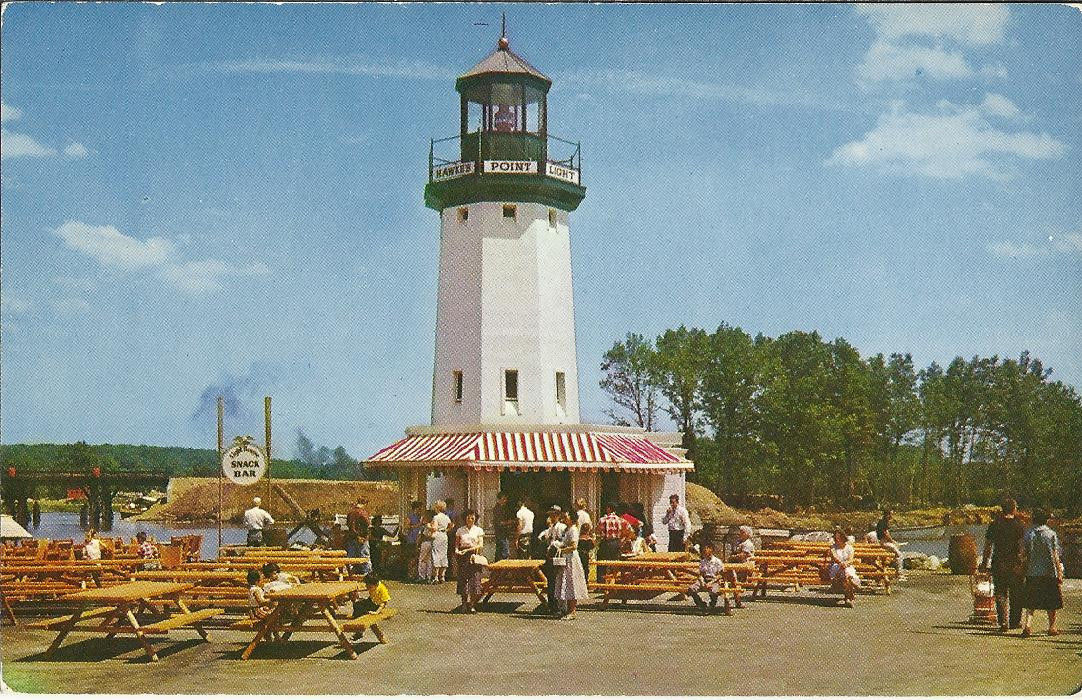
Usually they stand on private lawns, in playgrounds and parks, or are built by businesses such as marinas, restaurants, gift shops, campgrounds, theme parks....  The list is long. Bob and Sandra’s lighthouse is sort of a metaphor for all the work they’ve done over the years to preserve “real” lighthouses in pictures and books. It’s a testament to their love for lighthouses. Some faux lighthouses memorialize something or someone.

Metaphors are strong in faux lighthouses too. "Lighthouse for the Blind" not only purports to show the way for those without physical sight, but it also represents itself with a lighthouse.  Below is Bruce Robie's photo of the old Lighthouse for the Blind building in New Orleans.


Purists in the lighthouse community often dismiss faux lighthouses. I'm not among them. Yes, I agree fake lighthouses aren't official navigational aids, and for many years I did not include them in my guidebooks. But I do like them, and with so many books now in print about official lighthouses I've begun including faux lights in my books. People love to hunt for them and take pictures of them. They like the various designs for them. They love their stories. I've never been on a lighthouse tour where group members didn't like faux lighthouses. Pass one without pulling over for a picture and some admiring looks, and someone will yell "Stop!"


The stories are usually fascinating, often heartwarming, and sometimes funny. No, they aren't the dramatic historic tales I've related in my books about real lighthouses. Nonetheless, there are reasons why faux lighthouses are built and there is meaning attached to them. I think this is the reason I like them. There’s always a story surrounding a faux lighthouse.

 
Last year I published a book on the lighthouses of Pennsylvania. Some eyebrows raised. Pennsylvania? There are official lighthouses in the Quaker State...a few of them on Lake Erie and around Philadelphia....but also there are many, many faux lights. The leaning faux lighthouse above fascinated me for a number of reasons, not the least being its presence in a Pennsylvania community where I lived from 1963-1972. I passed it many times in my little Volkswagon Beetle, long before I became interested in lighthouses. In summer, the cattails and duckweed surrounded it; in winter snow piled up on its cupola and its base was iced in. Sometimes people would ice skate around it and pose for pictures. From time to time, someone painted it or did repairs. I never thought much about it after I was married and left the area.

Then, a couple of years ago, I received an email through my website from a man named Ryan Brown who lived in Limerick, Pennsylvania. He had purchased the property on which the lighthouse sat in its small lake and wanted to know if I had any history of it. I didn’t, but I was excited to tell him I knew that lighthouse from my youth. I was interested in what he might discover and asked him to remain in touch with me. After all, it was a memory from my youth, a faux lighthouse I had driven by hundreds of times.

Ryan got back in touch a few weeks later and said the local historical society had given him some images and information. I examined the images closely and began a search online for anything that looked similar. After a few days, I hit pay dirt! On eBay I found an image from about 1925-1930 of a faux lighthouse at a small lake resort in southeastern Pennsylvania. The seller said she had bought a lot of old photo albums in the Pottstown area, not far from Limerick. I couldn't be sure, but it really did look like the faux lighthouse Ryan owns. I don't know the identity of those women in the image below, clinging to the base of the lighthouse, but they definitely look as if they were having fun.


I’ll excerpt a profile of this lighthouse. I’ve named the Landis Creek Lighthouse. The excerpt is from my eBook, Itty Bitty Kitty Guide to the Lighthouses of Pennsylvania:

In 1915, Aldes J. Bernhardt purchased land from the Hunsicker family in the small community of Limerick, Pennsylvania, about 40-miles northwest of Philadelphia. Bernhardt created a large pond on his new property by building a small dam on Landis Creek. After this, he opened a summer camp at the pond. The hot, humid days at the popular camp were made more fun with a faux lighthouse Bernhardt built on a rock foundation in the pond.

The camp closed many years ago after the property was sold into private hands, and the lighthouse deteriorated. It was a bit of an eyesore back when the author lived in the area in the 1960s. The present owner, Ryan Brown, is researching the history of the property and is planning to refurbish the lighthouse, which is in bad shape. Very little is known about it, and Brown is anxious for information.

The recent photo that follows, courtesy of Ryan Brown, shows what remains of the lighthouse. The rock foundation of the lighthouse appears to be overgrown. The tower was leaning precariously and had no door until Brown made it level and added a temporary door. Inside are traditional spiral stairs. This small decorative sentinel is a little treasure from Limerick’s past and deserves preservation. Contact Ryan Brown at mrryanbrown@gmail.com if you have additional information or old pictures of this lighthouse, or you’d like to help with refurbishment and preservation efforts.
 
Ryan, is indeed, intent on fixing up this little fake lighthouse and learning/preserving its story from beginning to present. He sent me the image above after he straightened the lighthouse and stabilized it with 2x4s. Behind it is the road I used to drive as teenager before I left the Limerick area.

I salute Ryan for his effort. As with any lighthouse, this one is part of a community. It deserves to be researched and saved. It has a history, one bound up in the aura of most lighthouses—real or fake. Someone took the time to build it and keep it painted and in good shape. It is remembered fondly, and people have memories of their experiences with it. They cared enough to take pictures of it when it was part of a water resort. They still take pictures of it. And like me, they remember it as being part of my neighborhood for many years.

With that in mind, here’s a short selection of the many faux lighthouses I've discovered in my lighthouse travels. I could post hundreds of pictures here. Maybe you have some too. Enjoy them, and know that they have meaning for someone, somewhere….which makes them important.


Monday, July 6, 2015

Absecon Lighthouse: Atlantic City's First Landmark


Atlantic City, New Jersey has changed a lot since I was girl and drove there every few weeks in summer to swim, sun, and walk up and down its famous boardwalk. Back then, the big casinos and mega-hotels were yet to be built. The steel pier was known for Dick Clark and his "American Bandstand," and the Miss America Pageant was held in the city. Driving down Pacific Avenue, you could easily see Absecon Lighthouse, a landmark in the city since the 1850s.

Today, Atlantic City looks more like a mini-Las Vegas. You'll need a GPS to find the Absecon Lighthouse near the intersection of Pacific Avenue and Rhode Island Avenue, and it doesn't come into view until your car is almost upon it. But I'm glad to report the lighthouse looks much better than it did years ago, even in the 1960s when I first saw it. It's loved and protected today and venerated for its beauty and its long history as a beacon for the city.

 
Atlantic City as seen at night, by Ron Miguel for Wikimedia Commons. No wonder Absecon Lighthouse was deactivated! How would a mariner find it in this glare of lights?

The Atlantic City Coastal Museum opened the lighthouse as a museum in 1979, after it was deactivated. The Coast Guard was looking to close budget loopholes, and a lighthouse beacon upstaged by the bright lights of casinos and hotels was of little use to the mariner. Ships easily recognized Atlantic City from sea as first a loom and then a glare of light! Hidden in all the glitzy glare was Absecon Lighthouse.

So the light station was closed and given to the city. Volunteers got to work refurbishing the place. The tower was spruced up and painted, and a brand new replica of the keepers' quarters was almost ready to be opened as a museum when disaster struck. It happened on July 6, 1998--seventeen years ago today. A police officer patrolling the city in the early morning hours noticed flames coming from the new keepers' dwelling. He reacted immediately, but not before the fire raged through the dwelling and destroyed it.

An investigation pointed to arson. The Absecon Lighthouse Committee, in charge of the project, mourned the loss the new dwelling...but not for long. An insurance settlement allowed them to start over again, and the dwelling was rebuilt and finished in 2001. In the meantime, the tower (it escaped fire damage) was opened for tours. The grand opening of the rebuilt dwelling took place in October 2001.

A bit of history--
Absecon Lighthouse takes it name from the island hunting grounds of Absegami, as the present-day area around Atlantic City was called by the Lenni-Lenape when Henry Hudson passed by in 1609. The name means little water.

Absecon had a busy seaport by 1776. When Dr. Jonathan Pitney arrived and made his home on the island in the 1820s, he began touting the place as healthful and encouraged people to come for vacations and recuperation from illness. Tourists began flocking to Absecon. Pitney urged Congress to approve funding to build a lighthouse at Absecon, but it wasn't until the Camden-Atlantic Railroad connected the island with Philadelphia that the government got serious about a lighthouse.

Absecon Lighthouse was completed in 1856 and lighted on January 15, 1857. It was the first lighthouse completed by the new U.S. Lighthouse Board. Several noted engineers worked on the handsome brick lighthouse, including George G. Meade (he later led Union forces at Gettysburg). When inaugurated it was the tallest lighthouse in New Jersey. It still is.
At 178-feet tall, it's stately indeed, and certainly majestic for its time. Composed of over 500,000 bricks it has a 228-step spiral staircase and for all of its active career exhibited a first-order lens made in Paris. Two homes for the keepers stood beside the tower. They were later expanded to allow a third keeper to reside on the site and help with the work.

But nature, in the unpredictable way she works, soon began changing the shoreline. The tower stood 1,400-feet back from sea when it was built. Slowly, sand was stolen away by the waves until high tides encroached on the lighthouse property. To remedy the situation, several short jetties and one long jetty were constructed. These not only slowed the erosion, they eventually reversed it! Sand piled up and enlarged the island, leaving the lighthouse a considerable distance from the tideline.

In the meantime, the U.S. Lighthouse Board wavered on what the tower's daymark should be. Over the years, it has worn bands of yellow, orange, and blue. Today it sports a dark blue and white banded pattern.

As throngs of beachgoers invaded Atlantic City every summer, visitors began coming to the lighthouse asking for tours. In 1922, for example, 117 people climbed the tower in a single day. The lighthouse became somewhat of a showplace, with pretty gardens and everything kept shipshape by its three keepers. There was no fog signal to tend, but there was plenty of work to do maintaining the place for the public and guiding visitors up and down the tower. The lighthouse earned the nickname "Eiffel Tower of the Atlantic."

 
Absecon Lighthouse keeper Frank Adams on the lantern gallery with a guest, possibly the district inspector. The photo is dated September 1914 and is courtesy of Jim Claflin.

Today the lighthouse is owned by the New Jersey Dept. of Environmental Protection Division of Parks & Forestry. It is open to the public 10:00-5:00 daily in July and August (until 8:00 pm on Thursdays) and 11:00-4:00 Thursday through Monday the rest of the year.

Lots of fun events are held throughout the year, including weddings, full moon tours, and holiday fun. Check with www.abseconlighthouse.org for more information.

I especially love this part of the website: http://www.abseconlighthouse.org/members/. It honors all the hard workers who keep this lighthouse in good shape and open to the public!

Photo at the beginning is from Wikimedia Commons.

Saturday, June 27, 2015

The Lighthouse Keeper and the Mermaid


One stormy, starless, Stygian night,
The lightkeeper sat beneath his light
Reading a tale in the warm watch-room,
Safe from wind and waves and gloom.
 
T'was a story of sailors long at sea,
Of fishwives, sirens, and green Selkies;
As the pages turned and the hours passed,
He heard the ocean tempest crash!
 
 
But with the dawn the wind died down,
The sea grass stilled, waves ceased to pound;
The keeper extinguished his yellow beam—
He fell asleep and dreamed a dream…
 
Into his slumbers swam a plump seal
With the face of a woman that looked so real,
He could not resist that briny coquette;
He tried to snare her in his net!
 
But she was slick and slipped away
To her home in the coral of a lonely cay;
The keeper followed her down, down, deep,
To her quiet, pelagic palace keep.


She fed him sandwiches of kelp and clams,
She offered him squid-cakes and seaweed jams!
She combed his beard with a coral sprig,
And then she danced a fishy jig!
 
"I'll marry you!" the lightkeeper said,
"To a pretty fishwife I shall be wed!"
The mermaid nodded, gave her tail a swish:
"Dear husband to be, then give me a kiss!"
 
But as they kissed at the bottom of the sea,
The keeper awoke from his reverie;
And found in his arms a less tempting pearl—
His big fat dog instead of the girl!
 
 
By Elinor DeWire
 
Excerpted from Lighthouse Victuals & Verse, 1996


Wednesday, June 24, 2015

New Jersey Lighthouse Society Celebrates 25 Years!


There are so many lighthouse groups around the United States and the world, and all of them do good work. One of the earliest groups in the United States was the New Jersey Lighthouse Society, which formed on June 24, 1990 as a chapter of the U.S. Lighthouse Society. The group is 25 years old today, June 24, 2015, and now operates as an independent 501c3 organization.

The first meeting of the NJLHS (New Jersey Lighthouse Society) was held at the Atlantic County Library in Mays Landing. There were nineteen members in the original group. Today, there are many, many more. This active society has accomplished a great deal in its 25 years, educating the public and fostering preservation efforts at Garden State lighthouses.

The society's original logo featured Sandy Hook Lighthouse, the oldest standing, operative lighthouse in the United States. The Sandy Hook Lighthouse was commissioned in 1764. (Note the postcard below says 1762. The lighthouse was still not illuminated at that time.) Last June 2014 it celebrated 250 years of service to mariners. The society's current logo, shown above, still features the historic Sandy Hook Lighthouse.


There are about a dozen lighthouses in New Jersey. You'll find a variety of architectural styles, from the old octagonal stone tower at Sandy Hook to the twin lighthouses at Navesink. Hereford Inlet Lighthouse is a handsome carpenter gothic lighthouse; only a few of this style were built in the United States, most in California. Barnegat, Absecon, and Cape May lighthouses are tall conical brick towers, fun to climb and with fabulous views from the top. Sea Girt and East Point lighthouses are both house-top towers. (Who wouldn't like a lighthouse on top of their house?) The Finn's Point and Tinicum lights are iron-pile towers with central stair cylinders and tubular legs.

 Above--Absecon Lighthouse
Below--Navesink Twin Lights


Above--Tinicum Rear Range Lighthouse
Below--East Point Lighthouse


Above--Hereford Inlet Lighthouse
 
Below--Cape May Lighthouse


The society produces a newsletter and holds regular meetings around the state. Most New Jersey lighthouses are easily accessible, and many operate as museums. The society website offers much information for travelers and people interested in history and lore. I visited the website today and was glad to find some trivia questions and a matching game. There are special tours to lighthouses outside New Jersey. This month, for example, the group is going to Michigan. Also, you can get a souvenir postal cover of the Sandy Hook Lighthouse's 250th celebration for a mere $2.00! Go to the website (address below) and find out how to get one.

 
From www.njlhs.org

I think the most notable accomplishment of the New Jersey Lighthouse Society was the creation of the first "lighthouse challenge," an autumn weekend of fun for the public visiting New Jersey's lighthouses. Many other groups have copied this event, which seems fine with the NJLHS. They're simply glad to share a good idea!

I was a special guest at one of the challenges. Hereford Inlet Lighthouse invited me to sit at a table on their back porch, meet challenge participants, and sign my books. It was a glorious day, the gardens at the lighthouse were still in bloom, and many people came to share in the fun. I enjoyed meeting all of them! Here are some images taken that day--


Lighthouse fan, Tom Bodall, bought a book and asked me to sign it, then asked my husband to take our picture. Tom posted this image online. It remains one of my favorite fan photos.
 
Another visitor showed me her fancy lighthouse fingernails!

 
NJLHS is a terrific organization. If you'd like to learn more, join the group, attend a meeting or trip, or volunteer to help out with the society's work, go to their website at www.njlhs.org or email them at njlhs@njlhs.org. The next society meeting is this Saturday, June 27th at 10:00 a.m. at Maurice River Township Elementary School, 3593 Route 47, Port Elizabeth, NJ 08348. The public is always welcome at meetings, which usually include a speaker, refreshments, displays, and souvenirs to purchase. This Saturday's meeting includes a talk on East Point Lighthouse and a silent auction, followed by a tour of East Point Lighthouse. What fun! I used to attend the meetings regularly when I lived in Connecticut, just a few hours drive from my home. (It's a bit more difficult to go now that I live in the Pacific NW.)

 
Sandy Hook on its 250th birthday! From www.njlhs.org

If you haven't yet visited the Garden State lighthouses, plan to go. The NJLHS has done a fabulous job saving their lighthouses and educating us about them. Congratulations to these hardworking people on 25 years of service!


Wednesday, June 17, 2015

Lighthouse Blunders


Do you notice anything unusual about the card above? If you know a little about lighthouses, then you'll quickly see the lighthouse pictured is not on Cape Cod; rather, it's Portland Head Lighthouse in Maine. This is typical of the blunders made by advertisers, giftware makers, and public affairs people when it comes to images of lighthouses.

If they only knew how "bright" we lighthouse folks are, they'd be more careful in choosing what they print or make!

Here's a lighthouse blunder on a souvenir plate from Bermuda. There isn't a lighthouse in the Bermuda Islands that looks like this one. Giftware companies are so enamored of that Cape Hatteras, North Carolina look! I have to admit, it is prettier than the plain white Gibbs Hill Lighthouse in Bermuda. But St. Davids Lighthouse, Bermuda is quite fetching, with its red and white bands. I think I would have featured that one.


This one is downright amusing. The Nubble Light at Cape Neddick, Maine is one of the most famous lighthouses in the United States and a favorite with photographers. You'd think the Hassan Cigarette Company could have gotten it right in 1910 when they made a set of collectors' card for cigarette packs. Compare the card with the snowy image below it, and you'll wonder how the artist came up with such a rendering.


The postcard printer who made the c1900 card of St. Augustine Lighthouse below was a bit off-color, no pun intended. The spiral stripes should be black and white, not brown-red and white. And the lantern should be bright red. I also believe the proper name is St. Augustine Lighthouse, not Anastasia Lighthouse (Anastasia Island is where it stands), but now I'm nitpicking.


These campaign buttons for George Bush feature Portland Head Lighthouse, Maine--a popular image, despite the victory city of Austin, Texas and three counties in Ohio printed on the buttons. Both Texas and Ohio have plenty of lighthouses of their own.


The postcard below, touting a good time on Martha's Vineyard, features the iconic shark of the "Jaws" movies....and a red and white spiral striped lighthouses. I've seen lighthouses kind of like this one in the Netherlands and also in Lake Michigan....kinda. There's no lighthouse like this anywhere on Martha's Vineyard. Hmmmm.


I know of no lighthouse in New York that looks like the one pictured below. It's a little like Fire Island Lighthouse on Long Island, without black and white bands and standing in the sea, not on land. I think someone at this postcard company needed a quick reference and used an image of England's Eddystone Lighthouse.


And then there are Hollywood lighthouse images! Check out the three lighthouses used for posters of the movie "Captain January," starring the late Shirley Temple. The Captain, played by Guy Kibbee, must have had frequent transfers with the lighthouse service. He started at a generic lighthouse modeled after Minot's Ledge, then moved to the West Coast to Old Point Loma Lighthouse in California, and finally, he was transferred to Portland Head Lighthouse, Maine. So which one did little Star visit? All three? (I have an original copy of the 1890 book Captain January by Laura E. Richards, and she says he was keeper of Light Island Lighthouse in Maine. It's a fictional lighthouse Down East.)


A final faux pas I'll share goes to the Canadian postal service. In 2008 they produced a stamp featuring Pachena Point Lighthouse on Vancouver Island. When Canadian lighthouse fans and the Pachena Point lightkeepers saw it, they gasped. The lighthouse scene was backwards! Below you see the original stamp on the left. The orientation of the tower and house is correct on the right. I'm told a red-faced Canadian postal service artist quickly fixed the error, and the stamps were reprinted. But....if you happened to have purchased some of the original Pachena Point Lighthouse stamps, with the scene shown backwards, they're worth some money!


Do you have any lighthouse blunders to share?

Monday, June 1, 2015

A Lighthouse for the Rats!


The first lighthouse built in Western Australia was illuminated on this day, June 1. The year was 1851, and the lighthouse was on Rottnest Island, about 11 miles west of the mainland city of Freemantle. The island was both a hazard and a seamark for ships bound for Fremantle and the Swan River Colony, now known as Perth.

Rottnest was the name given to the island by Dutch explorer Willem de Vlamingh in 1696 when he stopped there and found a large population of rat-like creatures. He called the place Rottnest, which means "Rats-Nest." The animals actually were native marsupials called Quokkas. They are, as evidenced by the Wikimedia Commons photo below by Sean Mack, much cuter than rats!

 
A 15-foot-tall white obelisk served as a daymark on Rottnest Island before a lighthouse was built. The first lighthouse was begun in the early 1840s, built of stone, quarried locally from Nancy Cove. A prison for Aborigines, mainly the Nyoongar people, had been established on the island a few years earlier, and convict labor was used in the construction of the lighthouse. It was built on Wadjemup Hill, the highest elevation on the island. Many old sources refer to it as Wadjemup Lighthouse. Wadjemup translates to "place across the water." Today, it goes by Rottnest Lighthouse or the Rottnest Main Light.
 
Although completed in 1849, the lighthouse was not illuminated for almost two years because not all of the equipment for the light had been delivered. In the meantime, a keeper was hired to look after the place and operate a set of signal flags that announced the impending arrival of ships in Freemantle. A series of observers relayed the flag information ashore to Arthur Head at Fremantle, and a pilot was dispatched to help the ship get into the port. There was quite a lot of competition in town waiting to provision the ships, unload cargo, and entertain sailors, so early notification was important for businesses as well.
 
In 1851, the clockworks for the revolving light finally arrived and the illuminating apparatus went into service on the night of June 1. Coconut oil was used as fuel for the lamps. It produced a beam visible 16 miles.
 
A Notice to Mariners was issued shortly before the lighthouse was inaugurated: "...a light has been established on Rottnest Island---a revolving estopric [sic] light will be exhibited from a tower near the center of Rottnest Island after June 1, 1851 [anniversary of the colony on Rottnest] from sunset to sunrise---white stone tower 53 feet high with lantern 11 foot high superimposed, 2 groups of 3 powerful lamps, the whole apparatus revolving once in 2 minutes and showing a flash of light 5 seconds in duration once a minute...center of light 197 feet above high water mark seen in clear weather 7 leagues."
 
A first-order lens was installed in 1881. But the Government of the colony at the time felt the lighthouse was outdated. Plans and funding were secured for a new lighthouse. Another lighthouse was in the works at Cape Leeuwin, where the Southern Ocean and Indian Ocean converge off Western Australia. Its engineers, William Douglas and C.Y. O'Connor, also designed and built the new Wadjemup Lighthouse. It stood 127-feet tall and had a first-order flashing Chance Brothers lens. The photo below, from the Rottnest Island Authority, shows the old lighthouse and new lighthouse on dedication day March 17, 1896.


The 1896 lighthouse is the one that stands at Rottnest Island's Wadjemup Hill today. (Photo above by Djanga for Wikimedia Commons.) The original tower and keeper's dwelling are gone, replaced by the newer ones. The tower has been updated several times and is electrified, but the first-order lens remains in place. The buildings have been repurposed for research and exhibits.
 
Another younger lighthouse stands guard on Bathurst Point on the east end of Rottnest Island. It's keepers' quarters are rented to vacationers.
 
I visited Rottnest Island in 2000 and was fortunate to have a private tour of the island, courtesy of the one of the reserve rangers, Peggy Webb. (The island is now a public reserve for wildlife and culture and there is no vehicular traffic permitted, except by bicycle, park shuttle-bus, or the on-duty ranger's jeep. I got a ride with her--thanks Peggy!!) Western Australians affectionately call the island Rotto. It is one of the most popular tourists spots in Western Australia.
 
On my tour of the island, I met some Quokkas, who were eating potato chips from a visitors hand. (Bad idea to make them moochers. Peggy scolded him!) I photographed and climbed both lighthouses, and I enjoyed a glorious day of sunshine and cool breezes. Ranger  Peggy warned me about poisonous snakes on the island called dugites. Thank goodness I didn't meet any of those!
 
To end the visit, I had a late lunch at the visitor center cafĂ© with Peggy Webb and the others in my party, including my husband, Jon.  The day was clear enough that I could see the taller buildings of Fremantle in the distance, namely the Dingo Feed silo at the shipping terminal, and beyond that I could just barely make out the hazy outline of the skyscrapers of Perth.
 
Below is a shot of me looking up at the beautiful Bathurst lens. (Photo by Jonathan DeWire) Unfortunately, this is one of the few print photos from my trip that got scanned, else I'd have more in this blog entry.
 
 
Back in Fremantle, my friend Pauline O'Brien (an Aussie lighthouse expert) took me to several places where I found additional information on the history of the lighthouses. She also took to me to the town cemetery where I photographed one of the graves of a Wadjemup Lighthouse keeper. The highlight of that jaunt were the pink and white parrots in the trees of the cemetery!
 
After returning home to the United States, I gathered together my research and pictures on the Rottnest Island lighthouses and wrote an article for the U.S. Lighthouse Society's Keepers Log. It appeared in the Summer 2002 issue and then was reprinted by the World Lighthouse Society in one of their newsletters. It is a much longer, more in-depth look at Rottnest Island's history and its lighthouses. I have plans to put it in an eBook soon. I'll post the cover when it becomes available.