Thursday, August 6, 2015

Wild about Wysocki


I am a HUGE fan of Charles Wysocki's art. His Americana/primitive style reminds me of my home as a child where my mother decorated with Early American furniture and many homespun items. I just bought the Wysocki print above--"The Three Sisters of Nauset"--and the one below of Rockland Breakwater Light. Both of these lighthouse sites occupy a special place in my heart, with memories of visits to them.
 
Wysocki captured the Three Sisters Lights in a bygone era when they were active on the backside beach of Cape Cod. They were the only set of triple lights in the United States. As far as I know, the only other set of triple lighthouses were on the Casquets, a rocky isle in the Channel Islands of England. Painters were at the triplets when Wysocki created this image. The woman on the far right is picking flowers. There's a dog lying on the grass by the near lighthouse, probably the lightkeeper's pet. The wagon says "Old Cape Cod Pie Company." I'll take a piece, please!
 
This image shows the lights in their heyday, back in the nineteenth century. Wysocki did a good job capturing elements of the actual triple light station.


When I first saw the sisters--or I should say "sister"--there was just one left on the beach at Nauset. The photo below is from 1979. (You gotta love those stylish sunglasses I wore!) The "Sister" behind me, according to the clerk in my hotel, was being used as a food stand on the beach next to a dirt parking area.


Later, I discovered the other two sisters had been decapitated and hauled a few streets away and attached to either end of a beach cottage. Here's an picture of them from 1922. Without their lanterns, they look like urns.


I bought a print of this Wysocki painting too--Rockland Breakwater Light. Wysocki painted it all spruced up and homey, as it would have looked in its lightkeeper days when a family lived it in. I love the warm yellow glow in the windows downstairs.
 
My family hiked out the breakwater to the lighthouse in Rockland in 1986. It was a crisp October morning. Leaves were flying from the trees where the breakwater connected to land. The first fifty feet or so of the rocky hike was slippery, due to the wet leaves that nature has pasted on the boulders of the breakwater. It was slow and careful going as we made our way out to the lighthouse. About three-quarters of the way, my kids--ages seven and twelve--discovered a dead seagull lying in a crevice of the breakwater. They stared at it pensively and asked what could have happened to it. Their father told them it was probably old and sick. Reminders of mortality greet us now and then!
 
Charles Wysocki loved lighthouses. He painted quite a few of them, and most of his paintings were either of real lighthouses or inspired by real lighthouses. Born in Detroit on November 16, 1928, he was the son of a Polish immigrant and Polish girl from Kansas. His father came to America to find a better life and eventually went to work for Ford Motor Co. Charles Wysocki knew as a child that he someday wanted to be a painter. He served in the army in the early 1950s and then went to art school in Los Angeles. His many trips to New England with his wife and children provided grist for his paintbrush.
 
Check out some of his beautiful and nostalgic pieces--
 
 
"Gnarled Viewpoint" is in my print collection too. It must have been inspired by Maine's Pemaquid Point Lighthouse. The little fogbell on the front side of the tower and a curl of smoke rising up from the chimney of the house provide just enough information to let us know the keeper is in residence. I'm a fan of driftwood, and the large piece in the foreground has such character! What you don't see is the extensive rock ledge in front of the lighthouse. It's where most photographers and artists stand to capture Pemaquid Point. Wysocki chose a different view; I like it!
 
 
"Winter" has a hint of Nauset Lighthouse, the more recent Nauset Light that was brought up the shore of Cape Cod from Chatham in the 1920s when Chatham's twin lights were discontinued. The cast-iron lighthouse was disassembled, barged up to Nauset Beach, and then reassembled on the beach and given a daymark of half-red and half white. Its twin remains at Chatham. The two images below show the present Nauset Beach Light and the remaining twin at Chatham. (Both images from Wikimedia Commons.)


Today you'll find Nauset Light as one of the highlights of Cape Cod National Seashore. I had a wonderful visit with the owner of this lighthouse in the early 1990s. Mary Daubenspeck used it as a summer place and invited me to spend a day with her. Imagine owning a lighthouse and its keeper's dwelling as your summer home!!! I remember carefully tiptoeing to the edge of the cliff and looking down the sandy bluff to the beach below. Many a shipwreck occurred there. At very low tide, Mary told me she could see the foundation bricks of the old Three Sisters lighthouses--the first set of triplets that were destroyed by erosion.
 
Mary willed the Nauset Light to the National Park Service, and some years later after Mary's death from cancer, the lighthouse and keeper's dwelling were relocated back from the cliff to keep them safe from the cape's notorious erosion problem. At Nauset Beach, the cliff loses about three feet a year!
 
Wysocki captured the Nauset Light itself, but he created his own adjoining house and some other buildings that were never part of the scene at the real Nauset Lighthouse. I like to think he plucked a beautiful lighthouse from its natural setting and gave it some Wysocki flair.
 
******************************
 
 
"Dreamers" is a lovely Wysocki creation--two boys who've come to the beach by horse and buggy to relax. Notice the horse's reins are tethered to a rock on the ground. The lighthouse is none in particular I know, and I'm not sure if Wysocki ever said which lighthouse inspired him. New England has many white towers like this. The bellhouse can be seen to the right of the tower in the background. A small bell hangs from it. In front of the lighthouse are horns, which Wysocki said were for the firehouse. Perhaps the gray building is the firehouse. I wish I could go back in time and sit down with Charles Wysocki and find out how he cobbled all these elements into one painting and what the story is behind them.


"Twilight Sentinel" is another painting with bits and pieces of real and imaginary scenery. It's fun to study Wysocki's work, as all of his paintings contain so much detail. I notice on this one that the lighthouse door is open. Someone has come to call, probably a salesman, judging by the wagon parked out front. That horse is waiting so patiently. Wysocki painted wonderful horses. This one has white socks. I love the moody sky, the neatly stacked pile of wood, the patches of snow, and the bell with a rope attached to its ringer.


Here's one I used to give my students as a writing prompt. What's the story here? Write about what you think is going on. Wysocki titled it "Jayson Sparkin' the Lighthouse Keeper's Daughter." Jayson brought the nice buggy. Maybe they're going for a ride. I love how Wysocki captured the look of the Fresnel lens in the tower.
 
Sometimes, Wycocki called a painting just what it was. Here's "Gay Head," with the actual Martha's Vineyard lighthouse in fine detail on an autumn day. Mr. Wysocki would be glad to know this lighthouse has been saved--recently moved back from the cliff where it sat precariously, at the mercy of the wind and waves and erosion. I'll bet President and Mrs. Obama have this print. They vacation near this lighthouse.


I've sent Wysocki's lighthouse Christmas cards several times. They are so fun that I want to crawl in the pictures and enjoy the holidays with the lightkeepers. West Quoddy Lighthouse is pictured first. It has the correct number of red and white stripes. (A postage stamp issues some years ago did not!)


The next two holiday lighthouses are kind of generic. I'd like to ask Wysocki which lighthouses inspired them. The first is called "A Present for the Lighthouse Keeper." The bottom one is "Take Out Window." Check out the moose looking for a Christmas treat at the window!


And, did I mention Wysocki was a member of the U.S. Lighthouse Society?


Here's a 3D puzzle from Wysocki. It goes for big money these days on eBay. Someday, I'll get in my stash of mad money and buy myself one. The light in it actually lights up!


Charles Wysocki also loved cats and did many paintings of cats based on his own pet felines. If you read my blog regularly, you know I love cats! Below is my favorite Wysocki cat, "Frederick the Literate." I think his tail might be tickling that little staid owl on the shelf below him.
 
Books and authors and cats, as you know, go together. This is especially true when the author--ME--loves cats and lighthouses and writes books/articles about them.


Thursday, July 30, 2015

Remembering Misty

Today, the last Thursday in July, is Pony Penning Day on Chincoteague Island, Virginia, home to a herd of wild ponies and the nearby Assateague Lighthouse on Assateague Island. The annual Pony Penning benefits the Chincoteague Fire Dept. and also the ponies. The herd needs to be thinned, so the fire dept. rounds up the ponies, swims them across the water between Assateague and Chincoteague, puts them in a corral, and auctions them. The ponies get loving homes and the fire dept. gets much-needed funds. Below are two images from Wikimedia Commons of the ponies swimming to Chincoteague and the auction.


For years, I've called them the "Lighthouse Ponies." That's because the handsome Assateague Lighthouse stands near the Pony Penning event. Sometimes, the ponies wander onto the lighthouse property and give tourists a great picture opp. Everyone yearns for a shot of the ponies and the lighthouse together! (Photo from www.assateagueisland, com)


The wildlife refuge of the area, the chambers of commerce, and the businesses of the Eastern Shore of Virginia and Maryland all provide a great deal of PR to both the ponies and the lighthouse. It's a winning combination for sure!

The pretty candy-striped lighthouse was built in 1867 to replace a crumbling 1833 tower. Lighthouse Digest has a nice article about the lighthouse with some old images and stories from the keepers. (http://www.lighthousedigest.com/digest/StoryPage.cfm?StoryKey=3301http://www.lighthousedigest.com/digest/StoryPage.cfm?StoryKey=3301)

Photo from cheslights.org, the Chesapeake Chapter of the U.S. Lighthouse Society
 
The wild ponies were made famous by Marguerite Henry's 1947 book, Misty of Chincoteague. It's a true story about a family that adopted a wild pony and named her Misty. I read it as a child, along with many of Henry's other horse books--King of the Wind, Justin Morgan Had a Horse, and the Misty spin-offs. The book won a Newberry Award and has appeared with many different covers. The one below is the paperback I had when I was in fourth grade and the one I treasure most.  It shows Misty as originally drawn by Wesley Dennis, illustrator for the book. This cover was reprinted in later years.
 
I read it to my class of third graders in 1996. It's a poignant tale of capture, love, and letting go. At the end, the Beebe children released Misty back into the wild. Marguerite Henry expertly described the moment with great feeling, and made sense of Misty's name too, as the beloved little pony disappeared into the mists of Chincoteague to gain a hoof-print in posterity. I remember how quiet my third graders were when I read "The End," a bit choked up, and closed the book. I looked up at my students, and almost all of them had tears streaming down their faces.
 
 
I taught the students about Assateague Lighthouse along with reading the book aloud, and they all enjoyed making paper cup models of Assateague Lighthouse with bright red and white stripes. We passed out little plastic horses I had purchased at a discount store, attached the paper cup lighthouses to upside-down paper plates, and glued the horses to the plates. Small rocks and bits of twigs and dry grass finished the model. Then it was writing time...
 
I grew up riding horses and loving them, and I am passionate about lighthouses too, as you well know. The two subjects wove many wonderful threads into my daily lessons in public school--
  • Let's learn about horses and ponies! No Misty really wasn't a pony; she was a small horse. But we like to call her a pony.
  • The lighthouse on Assateague was built in 1867. How old is it now? It's 142-feet tall. Let's measure and cut a string 142-feet long and stretch it out on the playground to get a sense of the size of the lighthouse. Walk from one end of the string to other. Do you think you'd be tired climbing up the lighthouse stairs?
  • If you were a lighthouse keeper, what kind of chores would you do each day? What if a bad storm came....draw a picture of the lighthouse in a storm.
  • Misty and the Beebe family were real. Marguerite Henry based her book on their experiences. That's called historical fiction! Can you write a short historical fiction story about something?
  • Misty is named for the mists or light fogs on the island. Let's make a fog picture. Draw a lighthouse with Misty grazing nearby and then put a piece of waxed paper over the picture. This will make it look misty or foggy.
  • Let's go visit Chincoteague and Assateague on a map. What states are home to these islands? How far is it from our classroom. How long do you think we'd have to drive to get there? What is the weather like there in July when the Pony Penning takes place?
  • Why is there a Pony Penning? How does it help the herd of wild ponies? Who or what benefits from the sale of the ponies?
  • Imagine you could adopt a pony from Chincoteague! Write a story about it during writing time. Brainstorm for ideas, pre-write, draft, revise, and polish! Create a cover for your story and then share it with the class.
We got a lot of academic mileage our of pretty Assateague Lighthouse and Misty the wild pony and her adventures. We also learned about Marguerite Henry and her life as a writer. She wrote stories when she was a child and kept on writing. She wrote about events she had experienced and people she know. Henry actually adopted Misty for a time from the Beebe family and took the pony on book tours to schools and other places. My students were eager to write to Henry and ask her to bring Misty to our class. Alas, we learned that time had passed. Misty was gone and Henry was by then quite old.
 
It didn't matter though. Suddenly, the students wanted to read more of Henry's books and write their own stories! It's the best kind of inspiration for young writers.
 
For a wonderful write-up about Misty and Marguerite Henry, go to Linda Borromeo's blog here: https://mail.google.com/mail/u/0/?tab=wm#inbox/14ebeebf1feb09b7.
 
By the way, it was Linda's blog that set me reminiscing about Misty, my childhood, and my students, and inspired me to write this blog entry. Thanks, Linda!)
 
Below is a shot of Marguerite Henry with Misty, from the website www.mistyofchincoteague.org.
 
 
All kids want to visit Chincoteague and Assateague after reading Misty of Chincoteague. I did at age nine, but it took thirty years for me to get there! I first saw Chincoteague Island and Assateague Island in 1992 on a summer vacation trip. My editor at Mariners Weather Log had a cottage on Chincoteague and encouraged me to visit the place. It was a long drive from Connecticut, but worth the effort. The swimming was wonderful, the food was amazing, I met lots of ponies, and the lighthouse was as beautiful as in any photo, except that it needed a paint job and I couldn't go inside and climb it. It looks much better in this recent photo by my friend Kraig Anderson of www.lighthousefriends.com, and visitors can climb it today.
 
 
I valso isited the Oyster & Maritime Museum in 1992 (now called the Museum of Chincoteague Island) to see the lighthouse's first-order fixed lens. It had recently been moved to the museum from the grounds of the lighthouse where it had sat outside for years, surrounded by a wire fence. This disregard for lighthouse lenses was a common practice years ago, before anyone realized what priceless artifacts Fresnel lenses are. They were removed from light towers, replaced with modern optics, and then placed on display in the bottom of the lighthouse or outside. Some of them were thrown into the ocean or the trash! Unguarded, bad things happened to them--neglect, deterioration, and vandalism. (At one lighthouse I visited, vandals had climbed up the stairs and peed down on the lens. Sad, but true. )
 
The U.S. Lighthouse Society entreated the Oyster & Maritime Museum to move the precious Assateague Lighthouse lens indoors and care for it properly. It is now out of the weather and nicely displayed. Blow are images of the lens when it sat outdoors with a wire fence around it and later inside the museum. (Both images from Kraig Anderson.)


I saw wild ponies from a distance in 1992, not far from the lighthouse, but also in a parking area on the Maryland side of the refuge. Those Maryland ponies were seasoned moochers, hanging out in the parking area looking for handouts. Signs everywhere said "Don't Feed the Ponies." Of course, some people ignored them. I was able to briefly pet one of the ponies, but as soon as he realized there was no handout, he snubbed me. He was not the sweet Misty I had read about as a child!
 
As Shakespeare wrote, "All's well that ends well." It sounds hackneyed, of course, but it's true. Today at the Pony Penning, some of the Chincoteague and Assateague ponies will find good homes. The herd will be culled a bit to protect it from disease and starvation. The lighthouse has had restoration work done and a paint job since I saw it last, and the lens that once sat in the rain and snow and wind and was mercilessly baked by the sun is getting lots of TLC in the Chincoteague Island Museum.
 
Most of all, kids are still reading Marguerite Henry's classic book and falling in love with ponies and lighthouses.


Monday, July 27, 2015

Canine Cover Girl

 
I'm often asked at signings and talks about the beautiful Golden Retriever on the cover of my 2007 book The Lightkeepers' Menagerie: Stories of Animals at Lighthouses. That pretty girl, looking so alert and proud, was Lucy, the beloved pet of Ranger Diane Gardetto at Lime Kiln Lighthouse in Lime Kiln State Park on San Juan Island, Washington.
 
On a research trip to the San Juan Islands of Washington in 2006, Diane was my host at Lime Kiln Lighthouse. As I parked in the lot above the rangers' house, Lucy bounded out to meet me. If you have ever owned a Golden, you know how friendly they are! Lucy wagged her tail with excitement and wound herself around my legs, begging to be petted. We had a few minutes of introduction, and then she trotted ahead of me, showing me the way to the rangers' house.
 
Diane shared lots of information on the lighthouse and many pictures. We talked about the orcas that visit the area. Lime Kiln is an excellent whale-watching site, and the whales often upstage the lighthouse as a tourist draw. The whales weren't in that day, but Diane told me we'd know the moment they came near. Lucy would alert us; she was always the first to hear the whales. Diane dug out a photo of Lucy sitting on the rocks by the lighthouse.
 
"When Lucy hears them, she begs to be let out and quickly goes down to the rocks above the lagoon and sits quietly listening to them. It's as if she can understand everything they're saying!"
 
The moment I saw that photo, I knew I had to have it for a book I was finishing up for Pineapple Press. I asked Diane if she would be willing to let me submit it to the publisher for inclusion in The Lightkeepers' Menagerie. She readily agreed. When I emailed her several months later and told her the picture was going to be on the cover, she was delighted. Now that you see it on the cover yourself, I'm sure you understand why it was chosen by the book designer!
 
But that was just the start of a very fun couple of months. I sent Diane several "thank-you" copies of the book when it arrived. She was thrilled to see her sweet Lucy on the cover. She read parts of the book to Lucy, especially the chapter on lighthouse dogs, and sent me this cute photo. Lucy really did look like she was listening to the stories! (Notice Lucy was white-faced and in her senior years when the book debuted and this photo was taken.)
 
 
Lucy also had a book signing of her own. Diane bought a stamp pad of black ink, invited her friends and family to a paw party, and had Lucy put her paw print on copies of the book. It was Lucy's big moment of literary fame!
 
 
But then she got tired of being a celebrity and took a nap. I feel the same way some days, though I've certainly never taken a nap at a book signing!
 
 
Sadly, a few years after Lucy's debut as a cover girl, she quietly and peacefully passed away after a long and wonderful life. This is the bittersweet part of having pets, that they are with us so short a time. We love them like family. I'm getting misty-eyed just writing about it.
 
Lucy, however, will always be with us, memorialized as my favorite lighthouse dog and prettiest cover girl. RIP, Lucy.
 
(All photos, except the book cover, courtesy of Diane Gardetto.)


Friday, July 17, 2015

The Lure of Faux Lighthouses


Yesterday was  the 90th birthday of a friend in the lighthouse community, a man named Bob I've never met in person but I feel I know almost as well as any face-to-face friend. He's an email and Facebook "friend." I regularly correspond with his wife, Sandra, when I need pictures or information about lighthouses the couple has visited. They've traveled to and photographed all the existing lighthouses in the United States, they say, and have seen a number of sentinels outside the country. Recently, Sandra sent a picture of Bob sitting on a chair in the couple's front yard, putting up the American flag. It was the Fourth of July. She asked if friends could send birthday cards. Her goal was for Bob to receive 90 cards by his landmark 90th birthday. I think he did!
 

Next to the flagpole in the picture of Bob is the decorative lighthouse he built some years ago. He keeps it painted nicely, and it has a beacon that he turns on for special occasions. His lighthouse--and lighthouses like it---are the subject of my blog today--faux lighthouses.
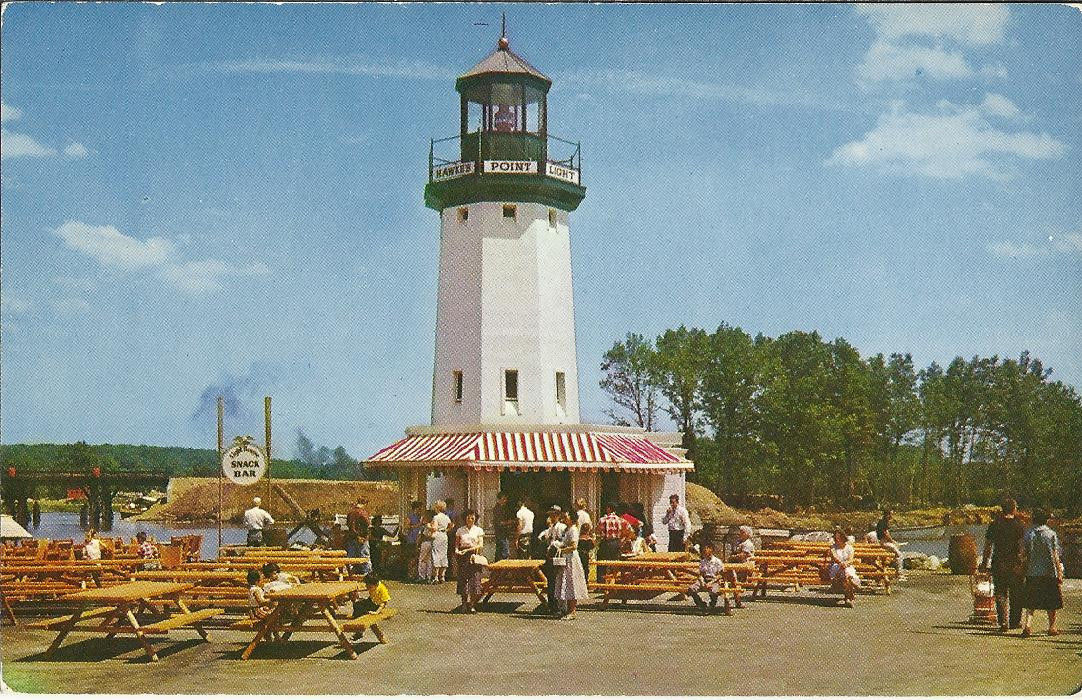
Faux (pronounced like "foe") means fake, false, phony, an imitation. In the case of lighthouses, faux lighthouses might be defined as those not listed as navigational aids in the official Coast Guard Light List.  You could call them unofficial lighthouses. They weren't built by the old U.S. Lighthouse Establishment or the U.S. Coast Guard, mariners often don’t know about them or use them, and they seldom appear in lighthouse books and history books.


Usually they stand on private lawns, in playgrounds and parks, or are built by businesses such as marinas, restaurants, gift shops, campgrounds, theme parks....  The list is long. Bob and Sandra’s lighthouse is sort of a metaphor for all the work they’ve done over the years to preserve “real” lighthouses in pictures and books. It’s a testament to their love for lighthouses. Some faux lighthouses memorialize something or someone.

Metaphors are strong in faux lighthouses too. "Lighthouse for the Blind" not only purports to show the way for those without physical sight, but it also represents itself with a lighthouse.  Below is Bruce Robie's photo of the old Lighthouse for the Blind building in New Orleans.


Purists in the lighthouse community often dismiss faux lighthouses. I'm not among them. Yes, I agree fake lighthouses aren't official navigational aids, and for many years I did not include them in my guidebooks. But I do like them, and with so many books now in print about official lighthouses I've begun including faux lights in my books. People love to hunt for them and take pictures of them. They like the various designs for them. They love their stories. I've never been on a lighthouse tour where group members didn't like faux lighthouses. Pass one without pulling over for a picture and some admiring looks, and someone will yell "Stop!"


The stories are usually fascinating, often heartwarming, and sometimes funny. No, they aren't the dramatic historic tales I've related in my books about real lighthouses. Nonetheless, there are reasons why faux lighthouses are built and there is meaning attached to them. I think this is the reason I like them. There’s always a story surrounding a faux lighthouse.

 
Last year I published a book on the lighthouses of Pennsylvania. Some eyebrows raised. Pennsylvania? There are official lighthouses in the Quaker State...a few of them on Lake Erie and around Philadelphia....but also there are many, many faux lights. The leaning faux lighthouse above fascinated me for a number of reasons, not the least being its presence in a Pennsylvania community where I lived from 1963-1972. I passed it many times in my little Volkswagon Beetle, long before I became interested in lighthouses. In summer, the cattails and duckweed surrounded it; in winter snow piled up on its cupola and its base was iced in. Sometimes people would ice skate around it and pose for pictures. From time to time, someone painted it or did repairs. I never thought much about it after I was married and left the area.

Then, a couple of years ago, I received an email through my website from a man named Ryan Brown who lived in Limerick, Pennsylvania. He had purchased the property on which the lighthouse sat in its small lake and wanted to know if I had any history of it. I didn’t, but I was excited to tell him I knew that lighthouse from my youth. I was interested in what he might discover and asked him to remain in touch with me. After all, it was a memory from my youth, a faux lighthouse I had driven by hundreds of times.

Ryan got back in touch a few weeks later and said the local historical society had given him some images and information. I examined the images closely and began a search online for anything that looked similar. After a few days, I hit pay dirt! On eBay I found an image from about 1925-1930 of a faux lighthouse at a small lake resort in southeastern Pennsylvania. The seller said she had bought a lot of old photo albums in the Pottstown area, not far from Limerick. I couldn't be sure, but it really did look like the faux lighthouse Ryan owns. I don't know the identity of those women in the image below, clinging to the base of the lighthouse, but they definitely look as if they were having fun.


I’ll excerpt a profile of this lighthouse. I’ve named the Landis Creek Lighthouse. The excerpt is from my eBook, Itty Bitty Kitty Guide to the Lighthouses of Pennsylvania:

In 1915, Aldes J. Bernhardt purchased land from the Hunsicker family in the small community of Limerick, Pennsylvania, about 40-miles northwest of Philadelphia. Bernhardt created a large pond on his new property by building a small dam on Landis Creek. After this, he opened a summer camp at the pond. The hot, humid days at the popular camp were made more fun with a faux lighthouse Bernhardt built on a rock foundation in the pond.

The camp closed many years ago after the property was sold into private hands, and the lighthouse deteriorated. It was a bit of an eyesore back when the author lived in the area in the 1960s. The present owner, Ryan Brown, is researching the history of the property and is planning to refurbish the lighthouse, which is in bad shape. Very little is known about it, and Brown is anxious for information.

The recent photo that follows, courtesy of Ryan Brown, shows what remains of the lighthouse. The rock foundation of the lighthouse appears to be overgrown. The tower was leaning precariously and had no door until Brown made it level and added a temporary door. Inside are traditional spiral stairs. This small decorative sentinel is a little treasure from Limerick’s past and deserves preservation. Contact Ryan Brown at mrryanbrown@gmail.com if you have additional information or old pictures of this lighthouse, or you’d like to help with refurbishment and preservation efforts.
 
Ryan, is indeed, intent on fixing up this little fake lighthouse and learning/preserving its story from beginning to present. He sent me the image above after he straightened the lighthouse and stabilized it with 2x4s. Behind it is the road I used to drive as teenager before I left the Limerick area.

I salute Ryan for his effort. As with any lighthouse, this one is part of a community. It deserves to be researched and saved. It has a history, one bound up in the aura of most lighthouses—real or fake. Someone took the time to build it and keep it painted and in good shape. It is remembered fondly, and people have memories of their experiences with it. They cared enough to take pictures of it when it was part of a water resort. They still take pictures of it. And like me, they remember it as being part of my neighborhood for many years.

With that in mind, here’s a short selection of the many faux lighthouses I've discovered in my lighthouse travels. I could post hundreds of pictures here. Maybe you have some too. Enjoy them, and know that they have meaning for someone, somewhere….which makes them important.


Monday, July 6, 2015

Absecon Lighthouse: Atlantic City's First Landmark


Atlantic City, New Jersey has changed a lot since I was girl and drove there every few weeks in summer to swim, sun, and walk up and down its famous boardwalk. Back then, the big casinos and mega-hotels were yet to be built. The steel pier was known for Dick Clark and his "American Bandstand," and the Miss America Pageant was held in the city. Driving down Pacific Avenue, you could easily see Absecon Lighthouse, a landmark in the city since the 1850s.

Today, Atlantic City looks more like a mini-Las Vegas. You'll need a GPS to find the Absecon Lighthouse near the intersection of Pacific Avenue and Rhode Island Avenue, and it doesn't come into view until your car is almost upon it. But I'm glad to report the lighthouse looks much better than it did years ago, even in the 1960s when I first saw it. It's loved and protected today and venerated for its beauty and its long history as a beacon for the city.

 
Atlantic City as seen at night, by Ron Miguel for Wikimedia Commons. No wonder Absecon Lighthouse was deactivated! How would a mariner find it in this glare of lights?

The Atlantic City Coastal Museum opened the lighthouse as a museum in 1979, after it was deactivated. The Coast Guard was looking to close budget loopholes, and a lighthouse beacon upstaged by the bright lights of casinos and hotels was of little use to the mariner. Ships easily recognized Atlantic City from sea as first a loom and then a glare of light! Hidden in all the glitzy glare was Absecon Lighthouse.

So the light station was closed and given to the city. Volunteers got to work refurbishing the place. The tower was spruced up and painted, and a brand new replica of the keepers' quarters was almost ready to be opened as a museum when disaster struck. It happened on July 6, 1998--seventeen years ago today. A police officer patrolling the city in the early morning hours noticed flames coming from the new keepers' dwelling. He reacted immediately, but not before the fire raged through the dwelling and destroyed it.

An investigation pointed to arson. The Absecon Lighthouse Committee, in charge of the project, mourned the loss the new dwelling...but not for long. An insurance settlement allowed them to start over again, and the dwelling was rebuilt and finished in 2001. In the meantime, the tower (it escaped fire damage) was opened for tours. The grand opening of the rebuilt dwelling took place in October 2001.

A bit of history--
Absecon Lighthouse takes it name from the island hunting grounds of Absegami, as the present-day area around Atlantic City was called by the Lenni-Lenape when Henry Hudson passed by in 1609. The name means little water.

Absecon had a busy seaport by 1776. When Dr. Jonathan Pitney arrived and made his home on the island in the 1820s, he began touting the place as healthful and encouraged people to come for vacations and recuperation from illness. Tourists began flocking to Absecon. Pitney urged Congress to approve funding to build a lighthouse at Absecon, but it wasn't until the Camden-Atlantic Railroad connected the island with Philadelphia that the government got serious about a lighthouse.

Absecon Lighthouse was completed in 1856 and lighted on January 15, 1857. It was the first lighthouse completed by the new U.S. Lighthouse Board. Several noted engineers worked on the handsome brick lighthouse, including George G. Meade (he later led Union forces at Gettysburg). When inaugurated it was the tallest lighthouse in New Jersey. It still is.
At 178-feet tall, it's stately indeed, and certainly majestic for its time. Composed of over 500,000 bricks it has a 228-step spiral staircase and for all of its active career exhibited a first-order lens made in Paris. Two homes for the keepers stood beside the tower. They were later expanded to allow a third keeper to reside on the site and help with the work.

But nature, in the unpredictable way she works, soon began changing the shoreline. The tower stood 1,400-feet back from sea when it was built. Slowly, sand was stolen away by the waves until high tides encroached on the lighthouse property. To remedy the situation, several short jetties and one long jetty were constructed. These not only slowed the erosion, they eventually reversed it! Sand piled up and enlarged the island, leaving the lighthouse a considerable distance from the tideline.

In the meantime, the U.S. Lighthouse Board wavered on what the tower's daymark should be. Over the years, it has worn bands of yellow, orange, and blue. Today it sports a dark blue and white banded pattern.

As throngs of beachgoers invaded Atlantic City every summer, visitors began coming to the lighthouse asking for tours. In 1922, for example, 117 people climbed the tower in a single day. The lighthouse became somewhat of a showplace, with pretty gardens and everything kept shipshape by its three keepers. There was no fog signal to tend, but there was plenty of work to do maintaining the place for the public and guiding visitors up and down the tower. The lighthouse earned the nickname "Eiffel Tower of the Atlantic."

 
Absecon Lighthouse keeper Frank Adams on the lantern gallery with a guest, possibly the district inspector. The photo is dated September 1914 and is courtesy of Jim Claflin.

Today the lighthouse is owned by the New Jersey Dept. of Environmental Protection Division of Parks & Forestry. It is open to the public 10:00-5:00 daily in July and August (until 8:00 pm on Thursdays) and 11:00-4:00 Thursday through Monday the rest of the year.

Lots of fun events are held throughout the year, including weddings, full moon tours, and holiday fun. Check with www.abseconlighthouse.org for more information.

I especially love this part of the website: http://www.abseconlighthouse.org/members/. It honors all the hard workers who keep this lighthouse in good shape and open to the public!

Photo at the beginning is from Wikimedia Commons.