Sunday, February 28, 2016

A Sweet Story

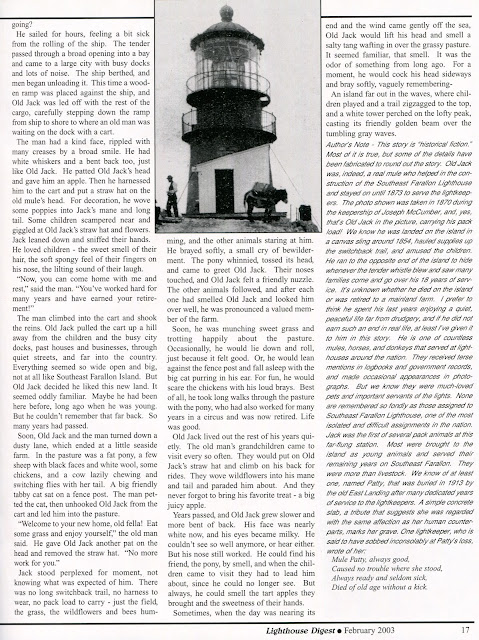
This story appeared in Lighthouse Digest magazine in February 2003. It has a happy ending, so don't bail on it midway through the tale.

It's historical fiction--the telling of the story with the best information available. We do know for sure there was a mule named Jack at Farallon Island Light, brought out to the island to help in the construction of the light station. He remained at the island for many years. As to whether he died on the island or was retired to a nice pasture ashore, history doesn't tell. I'd like to think he was.

The picture shows one of the mules that lived on the Farallon Island Light Station. All information I have indicates it's Old Jack. He did a lot of work for the keepers.

There were many quadrupeds at this remote place. I have several images that show them. They were beloved members of the crew. A few are buried on the island. My "Author's Note" at the end of the article explains more about the Farallon Island four-footed helpers.

Many thanks to Tim Harrison, editor of Lighthouse Digest, for printing this story. (To subscribe to Lighthouse Digest, go to www.lhdigest.com)

Click on the images to make them larger for easier reading.


Wednesday, February 17, 2016

Documentary on Puerto Rico's Lighthouses


Director Sonia Fritz of Marina Films recently sent me this wonderful 2015 documentary on the lighthouses of Puerto Rico. She used a quote of mine at the beginning and sent me a copy as a thank you. It's a well-done, accurate piece of work, very colorful and nicely written--about 70 minutes long.
 
Puerto Rico's early lighthouses were built by Spain. There were twelve operating before 1898, when the United States gained control of Puerto Rico as a territory following the Spanish-American War. Several more lighthouses were built by the U.S. Lighthouse Service, and over the years aging towers have been replaced. Today, the U.S. Coast Guard manages Puerto Rico's lighthouses.


Cape Muertos Lighthouse about 1898--Coast Guard Archives Photo
 
Fritz and her crew visited fifteen lighthouses, including El Morro, Aricebo, Point Borinquen, Rincon, Mona Island, Cape Rojo, Guanica, Cape Muertos, Cardona, Point Figuras, Point Tuna, Point Mulas, Port Ferro, Culebrita, and Fajardo. She interviewed people involved with their maintenance and preservation, as well as former keepers and their families. A number of historic, archival photos are used to trace the history of the lighthouses. Modern-day filmography presents them as they are now--some well-preserved and others in ruins.
 
The stories of Puerto Rico's lightkeeping bear much similarity to those we find familiar elsewhere--the painting, cleaning, weather reports, storms, rescues, and isolation. Especially interesting are memories of the great earthquake of 1918, which shook the entire island of Puerto Rico and damaged many structures, including lighthouses. I have an anecdote in The Lightkeepers' Menagerie: Stories of Animals at Lighthouses about the Point Boringuen Lighthouse dog alerting the family moments before the quake struck. Hurricane Georges in 1998 also is remembered for the havoc it caused for lightkeepers and their families.


Point Mulas Lighthouse from Wikimedia Commons
 
The sentinels have their own special beauty and history. Families have memories of fishing and swimming, and meals of green turtle or hawksbill turtle caught around their light station homes. These same turtles are protected and studied today. Fritz spent time interviewing modern fishermen too, and discovering that they depend on the lighthouses today as much as ever.
 
Mona Island still has handsome large iguanas with an attraction to all things yellow. They live only on this isolated island off western Puerto Rico. A yellow dress or straw hat could cause trouble for the wearer! Yet, if food stores ran low, roasted iguana may have tasted good to a hungry lighthouse family.
 
At Point Tuna, some fifty local residents took refuge in the lighthouse during a hurricane in the 1960s. Flimsy wooden and grass homes are quickly torn down by storms, but the stone lighthouses stand tall and strong. One keeper's wife comically recalled having a fear of heights and climbed her husband's assigned lighthouse only once. A girl who grew up at Culebrita Light Station called it the "palace" of her youth. Imagine her heartache to see it in ruins today and a rusty steel tower next to it holding a modern light.
 

Rincon Lighthouse, from Wikimedia Commons
The glorious Genovese tile floor is still intact at Fajardo Light, the first lighthouse sighted by ships coming to Puerto Rico from Europe. Fajardo Light is on a preserve and is well-maintained. Point Figuras Light is resplendent in a bright yellow daymark. (Good thing the iguanas don't live there!) Cardona Lighthouse is a mix of old tower and new equipment. It sports an LED optic comically known as a pancake light for its appearance. Each light is stacked on another, pancake style. The beacon can be controlled remotely by the Coast Guard AtoN.
 
The stories seem endless...and fascinating.
 
The film is narrated in Spanish but there are English subtitles. The documentary won first place at the 2015 International Puerto Rican Heritage Film Festival. To see a trailer and find out more, go here: http://www.15farosdepuertorico.com/trailer/
 
(I apologize for the lack of diacritical marks--BlogSpot does not seem to offer them, at least not that I can find. Also, there's an awkward mix of Spanish and English in the spelling of the light station names. Please forgive the errors. Thanks.)

Wednesday, February 10, 2016

Feeling Honored


I have been so occupied with my move from the Northwest to New England, I'm just now finding time to post this honor I received on January 8th from the U.S. Coast Guard.

On that day, my husband and I (exhausted from packing and preparing for our cross-country move) attended a farewell party held for us by the volunteers at the U.S. Lighthouse Society HQ in Hansville, Washington. We all met at the Point No Point Lighthouse for refreshments and fun. Many friends were there--good folks who love lighthouses as much as I do and devote themselves to worthy projects. I was really surprised when Capt. John Moriarity (Ret.), former head of Aids to Navigation in Seattle, greeted me at the party. He's now a civilian working at the 13th District AtoN office.

"Gosh! How kind of him to come and see me off!" I thought.

About an hour into the party, I discovered the real reason he was there. He presented me with the Coast Guard's Meritorious Public Service Award!

Check out my medals in the photo above, taken by my daughter. I also was presented with a handsome award certificate, signed by Rear Admiral R.T. Gromlich, Commander of the 13th Coast Guard District. Whew!!!!

Capt. John Moriarity presented me with the Coast Guard's Meritorious Public Service Award. Jeff Gales is in the background holding the medals.
I've received a number of honors for my work in lighthouse education and preservation, but this tops them all. The Coast Guard has kindly and generously assisted me with all my lighthouse books, articles, and projects. To receive this award from "Semper Paratus" is truly an honor.

Thank you to all who made this happen. I know Jeff Gales and Capt. John Moriarity pushed for it, and I am grateful to both. I'll miss the crew at society HQ. Special thanks go to Capt. John for making the trip from Seattle to present the award. I will miss him too, and his crew at District 13--always willing to let me dig in the files and borrows items, and eager to attend whatever lighthouse event I cooked up.

With many thanks and much gratitude,


Tuesday, February 2, 2016

A Cross-Country Move & Searching for a Lost Cat!


Many apologies to all my readers for my long absence! It's been weeks since I've posted a blog. But I have a good excuse; I've had important business to do. 

For the past few weeks my husband and I have been relocating from Washington to Connecticut. As we both recently retired from our day jobs (I retired from teaching at Olympic College in December), we decided to move back to Connecticut to be near our grandchildren. They are growing up so fast; we don't want to miss any of that!

Our house sold quickly, quicker than we expected. The furniture was packed and loaded onto a United Van Lines truck, and off it went. My car shipped too. That left us with Jon's truck and a flatbed trailer with his Kubota tractor on top. We only had 3,200 miles to go!
The trip across country this time of year was challenging. It was exceptionally cold, and we encountered two snow storms--one on the Wyoming/Utah border and another in Ohio courtesy of Lake Erie. Temperatures were frightfully low day and night. We slept in our truck, since we wanted to be with our kitties and also to keep watch on the valuable items we were hauling. One night in Nebraska the wind howled and the temperature got down to 8 degrees below zero. Whew! No matter how many blankets I snuggled under, I couldn't get warm. Jon started the truck every hour to keep us from freezing. Thankfully, we had only four nights of F-150 Truck Hotel until we reached our destination.

I learned to appreciate several things in those five days and four nights--the hard work and friendliness of truckers (we slept at truck stops), the goodness of a hot meal, and the wonderful warmth of a hot shower!


**********************************


As I write this blog, the crossing seems far behind me. I am sitting in my new office in Canterbury, Connecticut. It's full of boxes yet to be unpacked; but, I can get to my computers and begin work again. The sunny window next to my main desk has a view of the winter woods to the south of the house. It's a very different view than I had in Washington--no mountains or Douglas firs, no eagles flying by or green grass, no blue water in Hood Canal. Instead, there are endless maples and hickories and beeches, some with brown leaves still clinging. There are oaks too--so many oaks!--presiding over carpets of fallen acorns. Squirrels are busy burying and exhuming the bounty. Gray squirrels, not the little Douglas squirrels I saw in Washington. Stellar Jays have been replaced with the Eastern Blue Jays. And there are male Cardinals, wearing bright red feathers, looking for seed in the empty feeders. They are striking! I must get them some birdseed.

I've already experienced a snowstorm. About six inches fell last weekend, very powdery. It whirled around the porches and decks and put down a pure cover on everything. Snow was a rarity in the Puget Sound area, and when it came it was almost never powdery. There are commonalities though. This place is rural, and quiet, and beautiful. It had character, just as the Pacific NW had. But now, it's New England-ish.

The most humorous commonality was the little gray house mouse I found the other morning in death's repose in my bedroom slipper. A gift from Sadie. She's our Maine Coon, and she has settled in comfortably here, almost as if she's where she truly belongs. I suspect her great-great-great-great-great grandpappy cat came here to New England on a sailing ship a century or more ago. And that mouse? He might be a descendent of a mouse on that very same ship. I think she caught the little guy in the basement. Go Sadie, go!

Sophie, our older kitty, took some time to adapt. In fact, she's still learning the ropes here. She may be bred from a strain of Northwest cats, descended from the pet of some Norwegian lumberjack or Chinese worker in a salmon cannery. I must tell you a short story about her...

Sophie frightened us the first night in our new home, and for several nights thereafter. She is timid and shuns most humans other than us; thus, she immediately went in a search of a good place to hide while all the noise and confusion of the furniture movers was going on. In fact, she found a near fatal hiding place in a narrow opening at the top of the basement steps that gave access into the floor. She crawled into that dark, cold, labyrinthine space between the upstairs floor and the basement ceiling. The more noise she heard from strangers, the more heavy footsteps and loud voices, the farther into the floor space she crawled...until she was deep into a maze of pipes, wires, and floorboards.

That night, I called and called but couldn't find her. My husband assured me she'd appear from wherever she had hidden in due time. Our house remained rather noisy for several days, and there was no sign of Sophie and no meowing. By day four we were both panicked. We had made several thorough searches of the house. Then, I noticed that small opening under the top step of the basement stairs, an opening just big enough for a skinny cat to squeeze through it. I felt sure she's gotten into the floor. Again, I called and called. No answer. 

Then, as we were about to go to bed that fourth night, I thought I heard a distant, faint meow. Jon listened too, and after a few minutes he was sure he heard it.

Ears to the floor, we traced the origin of the sound. Then we rushed to the basement and called for Sophie. A desperate and feeble meow above our heads told us her whereabouts. She was, indeed, far from the place where she'd entered and unable to find her way back. Jon got a step ladder and removed some tiles from the basement ceiling. Moments later, a frightened but grateful feline face peered down at us. Sophie! We lured her onto a floorboard with cat treats and then lifted her out of the ceiling. Both of us were thrilled and relieved to have our kitty back!


As you can imagine, she was thirsty and hungry beyond description. We hugged and petted her as never before! Sadie seemed blase about the whole affair. Perhaps she had enjoyed her four-day stint as top cat just a bit too much. 

Reunited, we went to sleep that night, kitties curled next to us. It was a story with a purrfect ending, to be sure, though I think Sophie may have used up one her nine lives. This tale has been dubbed "The Lost Sophie Saga." I think we may tell it again and again.

You've probably noticed there hasn't been a single mention of a lighthouse in this blog entry. I apologize for that, and I can rectify it easily! This area was my home twice before, from 1976 to 1979 and again from 1986 to 2002. I wrote several books and many articles about lighthouses in those years. I presented many talks and school programs as well. Connecticut has been fertile literary ground for me, and I expect it will be again.

I'm excited to get back to the Nutmeg State!


Publicity photo taken by a photographer for The New London Day in October 1995 for the debut of my book, Guardians of the Lights: Stories of U.S. Lighthouse Keepers.

My "moving" hiatus ended, I'm getting back to work and will finish two Itty Bitty Kitty lighthouse guides--one about Bermuda and the other about Rottnest Island, Western Australia. Then, it's on to a fresh New England project, a book about a favorite Massachusetts lighthouse. I'll let you dangle there....wondering which lighthouse! Stay tuned.


Thursday, December 31, 2015

It's a New Year!


From Card Cow on eBay

Lighthouses and the New Year--there's a connection! (I pride myself on finding lighthouse connections to just about everything!)

Did you know many lighthouses were illuminated on New Year's Day? It's a fact. January 1st was a good date to add a lighthouse to the lineup of beacons, in the United States and in many other nations. Mariners knew to check monthly notices about changes to navigational aids. December's list of changes was always long, with many new lights to be lit on the first day of the coming year. In fact, New Year's Day was likely the most common day for lighthouses to be illuminated for the first time.

Dr. Henry Maggs, the first keeper of Point No Point Lighthouse in Hansville, Washington, was supposed to light up the lighthouse for the first time January 1, 1880. However, the lens did not arrive on time, probably due to the bad weather the area was experiencing. Maggs, a dentist by trade, and his assistant, Henry Edwards, were concerned that no light would show in the lighthouse on its scheduled opening, so they hung an ordinary household kerosene lantern in the light tower. It was feeble but better than no light. The wind blew it out frequently. The two keepers were vigilant, though, and quickly relighted it. They tended this makeshift light until February 5 when the lens finally arrived. (There was no need for either man to resolve to be more dedicated in the New Year!)

The Point No Point Lighthouse shortly after the lens was installed. Note the fogbell to the right of the tower. Photo from the U.S. Lighthouse Society archives.

 
The symbolism of lighthouses as guiding the way forward was adopted for use in New Year's postcards and greeting cards in the nineteenth century. Here are a few examples, some from my collection and a few from eBay. It's curious that around 1900 Father Time was thought to live in a lighthouse!


Here's Father Time with his lantern signaling to a ship. Notice the clock in his lighthouse reads midnight.


Lighthouses illustrate many New Year's trinkets. My mom always got a calendar towel for Christmas every year. I don't recall her ever having one with Cape Cod lighthouses on it, but I've had several with lighthouses on them. You can find lots of lighthouse calendar towels online. When the year ends, they can be re-purposed as tea towels!
 
 
There are scads of paper lighthouse calendars available for purchase, to get the New Year going. Foghorn Publishing always has them. http://www.shop.foghornpublishing.com/
There are regional lighthouse calendars, state lighthouse calendars, national lighthouse calendars, or collections that feature lighthouses around the world. The images are always stunning. I think lighthouses are really appropriate for calendar, not just because I love them, but because lighthouses function 365 days a year. The lights are ALWAYS shining. Keepers wrote in daily journals and logbooks, which kept them in touch with the passing days. I've even visited lighthouses where a lighthouse calendar was hung on the wall!


I could post many, many images of lighthouses calendars here! I've always wanted to produce one of my own. I've certainly got plenty of images to use. The caveat--they aren't sellable after the year ends, or even a few months into the year. The ones I do buy from other publishers get re-used for kids' activities in schools. I tear out the pages and laminate them so kids can see the variety of lighthouses on duty.

Did lighthouse keepers of the past make New Year's Resolutions? I suppose so. The tradition of making promises to do something in the new year is very old, dating back at least to the Babylonians. While lightkeepers often made comments about the New Year in their logbooks and journals, I can't recall any resolutions that were placed in the books. These were serious, business-like folk, and most of their written comments were not of a personal nature. They weren't very candid people, at least not in the record books. Also, their lives were regulated by their duties--the lighting and extinguishing of the beacon, cleaning, painting, operating the fog signal, and more--and by nature, which controlled the weather, the tides, and the behavior of wildlife around a lighthouse. There was plenty to do, so there wasn't much time for thinking about self-improvement and dreaming of a better life.
 
Being far from civilization and bound to their duty 365 days a year, no fireworks or parties or other public celebrations were part of lightkeepers' New Year's Eve or New Year's Day. No doubt they had their own family traditions. All of us do! There might have been a special meal, or some singing.


My family has a New Year's tradition. Some of our ancestors were German, and like them we eat pork and sauerkraut on New Year's Day. It's supposed to bring luck, happiness, and prosperity in the New Year. (And it tastes great, especially piled on fluffy mashed potatoes!)
 
The New Year will bring some big changes for me. In that regard, I apologize that I have not been doing regular posts on this blog of late, and I probably won't post much until February. The reason? I'm in the process of moving from the Pacific NW to New England. My husband and I have retired from our jobs and want to live closer to our grandchildren. Within a week, my office will be entirely packed up and loaded on a moving truck. By February, I'll be settled in Connecticut, and I'll be back to my lighthouse work. I look forward to living and working in a new home nearer my family. Wish me luck and safe travels!
 
And thanks for visiting my blog!


Thursday, December 10, 2015

Lighthouse Fun for Kids


The holiday vacation is just ahead. I remember well the Christmas crazies the final week of school before my students went home for the holidays. I had a file full of fun activities to use up their extra energy and keep their anticipation channeled toward educational endeavors. Many of the projects in my file were related to lighthouses.

Are you wondering what do to with the kids on these cold December days leading up to holiday vacation or when school is out? Visit my Pinterest Board called "Lighthouse Fun for Kids" to see some good activities. You'll find it here: https://www.pinterest.com/fineshine/lighthouse-fun-for-kids/

Examples are in this blog entry. First up--Tangrams.

Above is some Tangram artwork done by a second grader. A Tangram is a puzzle developed long ago in China. It consists of seven geometric pieces that form a perfect square when placed together. The pieces can be used to form other objects too, like lighthouses. This is pure problem solving, and it's hands-on too. Here's a Tangram template to download, print, and cut apart. See if you and the kids can put it back together as a perfect square.


Then, have some fun. Make lighthouses with the pieces. Here are more Tangram lighthouses done by second graders. Have your kids replicate them, or they can design their own. The only rules about Tangram pieces are that they must lay flat on a surface, like a table or the floor, and they cannot be cut or twisted or folded. Have fun!


Who doesn't like to color? Kids do, from a very early age. Coloring is now a trendy activity for adults too. It's supposed to make us feel calm and rested; it slows down the brain and the body from the frenetic pace of daily life, especially around the holidays. Here are a few lighthouse coloring pages. You'll find more on my Pinterest Board.


How about making some lighthouse crafts with the kids, using around-the-house materials? There are many projects on my Pinterest Board that are easy and inexpensive. Here are a few to whet your child's or students kinesthetic appetite....on a snowy, cold, holiday vacation day!
 
 
Got paper plates, waxed paper, a glue stick. some yarn for a hanger, and a few bits of construction paper and other decorations--tissue paper, sequins, buttons, etc.? Make a lighthouse sun-catcher to hang in the window. Simply adorable, and it's loads of fun to make. You can use clear adhesive paper too.


Learn some sign language! No kidding; this is a valuable skill that not only teaches kids a new way to communicate, but also is quiet, calming, and develops small muscles in the hands.


Have some fun with food! Taste is much about "presentation," and these plates look really appetizing! Kids can brag after lunch that they ate lighthouses and sailboats!


Paint some rocks. Is there any craft so easy and inexpensive? Have kids sketch a design first, then add paint. Acrylic paint is best, as it stays on the rocks long after the painting is done and is waterproof. These make wonderful paperweights that can be given as gifts.


Or, resort to that good old-fashioned amusement all kids should do: Read some books. I have lots of lighthouse-themed books on the Pinterest Board, and you'll find more on Amazon and other book sites.


Find lots of fun ideas at "Lighthouse Fun for Kids"  --- https://www.pinterest.com/fineshine/lighthouse-fun-for-kids/
 
 
If you have a lighthouse-related activity not found on my Pinterest Board, send it to me and I'll add it to this blog entry. Add it as a comment to this blog, or if you have pictures email the activity to lightkeeper0803@gmail.com.
 
 
Enjoy the anticipation of the holiday season!


Tuesday, December 1, 2015

From the Lighthouse Kitchen


Cape Cod is known for many things, including lighthouses and cranberries. After a presentation on Cape Cod more than twenty years ago , a lady in the audience greeted me and said she was the ex-wife of a Coast Guard bos'un who had been a keeper at Nobska Lighthouse. (Photo above from Wikimedia Commons)

We chatted a few moments and then I asked if she had any memories to share. She did, and among them was this recipe for Nobska Lighthouse Cranberry Bread. It's perfect this time of year. I've made it a few times and can vouch for the good taste, especially warm with butter. I included the recipe in my Lighthouse Almanac, (Sentinel Publications, 2000, now out of print).


Nobska Lighthouse Cranberry Bread
 
 
2  1/4 cups of flour
3/4 cup of sugar
1 tsp. of baking soda
1 large egg
3/4 cup of milk
1 tbsp. of lard or other shortening
1 cup of cranberries, cooked in a little water to make a gel
1 cup of chopped nuts
 
 
Combine dry ingredients and set aside. Combine egg, sugar, milk, and lard and beat well. Work in flour a little at a time, then add cranberries and nuts and mix until blended. Dough will be thick. Spoon into two greased and floured loaf pans and bake at 350 degrees for about an hour, or until a knife inserted in the bread comes out clean. You can sprinkle on a little extra sugar or make a thick drizzled icing for more sweetness.


Nobska Lighthouse was first placed in service in 1829. Below is an image of the 1829 lighthouse, which cost about $3,000. It was a classic New England saltbox design! This tower lasted until the 1870s. (Photo courtesy of the Coast Guard Historian's Office)
 
 
In 1876, the original lighthouse was torn down and replaced.  Cast iron pieces for the new tower were fabricated in Chelsea, Massachusetts and shipped to Woods Hole. The cast-iron lighthouse was assembled and lined with brick.

The 40-foot tower stands on a hill next to the keeper's residence overlooking the spot where Buzzards Bay meets Vineyard Sound and the entrance to Woods Hole Harbor. A Coast Guard officer and his family live in the quarters. This is a heavily visited and photographed lighthouse--one that typifies New England sentinels.