Friday, July 22, 2016

July 22--Happy Birthday to Painter Edward Hopper


If you love lighthouses, you probably know about the oils and watercolors of realist Edward Hopper. His painting of "The Lighthouse at Two Lights," completed in 1929, got lots of mileage in 1970 when it was chosen by the U.S. Postal Service to represent Maine's 150th anniversary of statehood. (It cost just 6-cents in 1970; oh how the price of a stamp has risen!)

The lighthouse Hopper painted, of course, is one of the twin towers at Cape Elizabeth. A website devoted to Hopper notes that the painting "symbolized the solitary individual stoically facing the onslaught of change in an industrial society." I'd like to think it simply represents Hopper's love for the beautiful Maine coastline and his fondness for its handsome and purposeful buildings.


Born on this day, July 22, 1882, in Nyack, New York, Hopper was the son of a merchandiser and a homemaker. Despite his parents' Baptist faith and no-nonsense attitude toward life, they recognized their son's talent and sent him to art school in New York City. Like many creative people, he struggled to find his identity and style while working various jobs, some of them he detested. Designing posters was not to his liking, nor was advertisement art.

In his off time, he painted. His medium at first was oils, but his watercolors were done during a period when he seemed to be infatuated with lighthouses--the 1910s through the 1930s.


"Squam Light" was the first, painted in oil in 1912. (above) As you compare it to his later lighthouse paintings, you'll quickly see how watercolor allowed Hopper to add details. But in this painting, everything suggests "mood." I can easily imagine myself in this painting...taking a walk and wondering if I should hurry to avoid the rain. And then I find this lovely scene down the sandy road! It's pastoral and marine, all in one.

Hopper later painted just the houses at the Annisquam Light Station. He had moved to Gloucester for inspiration and found plenty at Annisquam. It seems to have have launched his love for lighthouses. He also painted Eastern Point Lighthouse. (below) The sunrise over the point dominates, washing everything in a near-lavender hue.


Subsequent visits to Cape Cod and Maine inspired Hopper to continue painting lighthouses. Check out the selection of them below--


Hopper painted a few generic lighthouses. I wasn't able to identify this one above, though it looks somewhat like Tarrytown Lighthouse on the Hudson River. Hopper would have seen this one as he grew up in nearby Nyack. The rock foundation resembles that of Tarrytown Lighthouse, as does the shoreline. Here's a photo from 1910 for comparison. (Coast Guard)


Two other lighthouse paintings focused more on the sailboats. The lights in both of the paintings below appear to be Wood End Light Station on Cape Cod. In the second painting, it appears Hopper added a house and woman at a window and put a moody sky over the lighthouse.


Portland Head was a Hopper favorite. He painted several versions, sometimes providing enormous detail, as in the foghorn paintings below. He also painted the keeper's house and named the painting for Capt. Joshua Strout, the keeper during the years Hopper visited the site. Strout is a much-loved and well-remembered character at Portland Head Light. He had a loquacious pet parrot that knew all the business of the light station and would implore Strout to "turn on the foghorn" when the fog rolled in. I can well imagine Edward Hopper sitting at the table with Capt. Strout to have coffee, with Billie the parrot participating in the conversation.


I love the contrasts here--white tower and fog signal building, red roofs, brown rocks, and the black foghorn jutting seaward!

This is Capt. Strout's house, a duplex. His assistant lived on one side and Strout on the other. It's one of the loveliest keepers' dwellings in Maine. Hopper was smitten with houses!


Equally compelling for Hopper were the twin lighthouses at Cape Elizabeth. As with Portland Head, he painted several views.


Below is Capt. Upton's House. I love the gingerbread trim, a small and inexpensive appointment the lighthouse service was willing to add. The USLHE ethos was all about economy, but sometimes a small bit of decoration appeared.
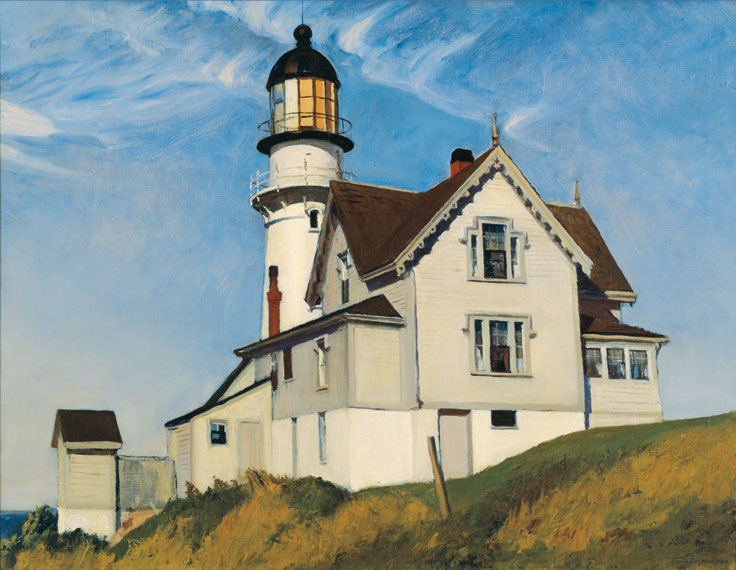


Hopper undoubtedly knew the lightkeepers of Portland Head and Cape Elizabeth, as well as the nearby Coast Guard surfman. Having grown up around the water, he appreciated the solicitous and unselfish work of these men. He likely had free run of the light stations and surely shared coffee and conversations with the keepers on a regular basis.
Above is Hopper's 1930 rendering of Highland Lighthouse on Cape Cod. It looks so much like the first view I had of the light station in the late 1970s. Here, the Atlantic lashes the cape with fury. Hopper may have stood on the bluff here overlooking the Clay Pounds and the slate gray sea and realized how imposing and important this lighthouse is. He loved the cape and all its nautical structures.


Man of the Year in 1956! Or, at least a cover guy. Note the small image of Cape Elizabeth Light in the background.

Edward Hopper died in New York City May 15, 1967. I vaguely remember hearing about his death in art class. I was in 9th grade that year and deeply involved in artwork. I did an series of cartoon caricatures that were put on exhibit in the school. (You might be surprised to know I won an award in June 1967! Everyone expected me to leave high school and study art. I chose education instead.)

Surprisingly, none of Edward Hopper's lighthouse paintings is ranked as "notable" by the art world. I suppose "notable" depends on the prism through which you view his work. (Lighthouse pun there---did you catch it?) I'd like to think all of Hopper's lighthouse paintings are notable. Obviously, the U.S. Postal Service thought so. The dozen or so lighthouse canvases he completed are definitely a body of work.

Would some art museum or gallery kindly put together a show--"The Lighthouse as Viewed by Edward Hopper."

I'll be the first one through the door on opening night!


\


Monday, July 18, 2016

A Hardy Alaskan Lightkeeper

I interviewed Alaskan lightkeeper Ted Pedersen by phone in the late 1980s. He was friendly, talkative, and happy to be reminiscing about his work for the old U.S. Lighthouse Service. Later, a few calls to the Coast Guard and some poking around in archives netted some great images of Pedersen and his assignments. The following pages are excerpted from The DeWire Guide to the Lighthouses of Alaska, Hawai'i, and the U.S. Pacific Territories. It was published by Paradise Cay Publications in 2012 and is available on Amazon or from other online booksellers. You can also get an autographed copy from me by emailing 
lightkeeper0803@gmail.com. 
($25, including shipping). 

Unfortunately, Ted Perdersen died before seeing any of the articles I wrote about him or the anecdotes about him in my books. I know he is keeping a light somewhere and has been well-rewarded for his good work.

Click on the images to make them larger.


Sunday, July 10, 2016

RLS...A Tribute to Lighthouse Keepers

Robert Louis Stevenson didn't fulfill his father's dream of becoming a marine engineer who built lighthouses. I'm glad he followed his heart and became a writer. He did, however, give tribute to his family's work building lighthouses around the world. This is one of his poems, "The Light-Keeper."

The Light-Keeper II
by Robert Louis Stevenson
As the steady lenses circle
With frosty gleam of glass;
And the clear bell chimes,
And the oil brims over the lip of the burner,
Quiet and still at his desk,
The Lonely Light-Keeper
Holds his vigil.
Lured from far,
The bewildered seagull beats
Dully against the lantern;
Yet he stirs not, lefts not his head
From the desk where he reads,
Lifts not his eyes to see
The chill blind circle of night
Watching him through the panes.
This is his country’s guardian,
The outmost sentry of peace,
This is the man
Who gives up what is lovely in living
For the means to live.
Poetry cunningly guilds
The life of the Light-Keeper,
Held on high in the blackness
In the burning kernal of night,
The seaman sees and blesses him,
The Poet, deep in a sonnet,
Numbers his inky fingers
Fitly to praise him.
Only we behold him,
Sitting, patient and stolid,
Martyr to a salary.

Tuesday, June 28, 2016

Nutty for the Nubble

Courtesy Yankee Magazine
Who doesn't love Maine's Cape Neddick "Nubble" Lighthouse? It's one of my favorites, not only because of its quaint beauty--sitting just offshore on a tiny islet--but also for its storied past. Built in 1879, it gets much attention from photographers and lighthouse hunters. The Internet and eBay are loaded with baubles and images of this lighthouse. My collection of pictures and old postcards is enormous. I include a few of them here...but also some grist to grind the wheels of fascination.


This postcard shows the old fogbell and the pyramidal structure that held the bell striker and clockworks. Note the covered way between the lighthouse and the bellhouse.


In the 1930s, the Nubble was home to Sambo Tonkus the cat, a rough and tumble 19-pound tom that loved to swim back and forth to the mainland to carouse with other cats and catch mice. He was a tourist attraction as well as the rodent eradicator for the islet and a companion for the keepers. He became a part of the light station and its work, and he was passed down from keeper to keeper. It seems the islet had a bad problem with rats. They foraged on the mainland where tourists left garbage and remnants of their picnics. When that food was gone, the rats swam to the Nubble. The keepers fought the rats with shotguns, traps, poison bait, pitchforks, brooms, and more. Sambo Tonkus was, perhaps, the most skillful rat fighter! Stealth and huge jaws aided his effort. 

My friend and colleague, Jeremy D'Entremont, has a picture of Sambo Tonkus here http://www.newenglandlighthouses.net/cape-neddick-nubble-light-history.html. Scroll down to see the image on the right--Sambo sitting on the lap of Keeper Eugene Coleman.

Below is Karyn Terry and her lighthouse pets. She and her husband were the lightkeepers in the mid-1980s. It seems that felines were prominent in this light station's story.


Lightkeeper rowing visitors from shore to the lighthouse.
The Winchester family, who lived on the Nubble in the Coast Guard years, were known for putting their son, Ricky, in the cable car crate that connected the islet with the mainland. The crate was designed to ahul such things as mail and groceries, but the Winchesters found it useful in other ways. Ricky was pulled across the tidal isthmus, called the Hellespont, in the cable car crate, and then he hopped out on the mainland and went to school. At the end of the school day, he was pulled back across the water in the cable box. His was the most unique school bus yet! Jeremy has a picture of Ricky in the box on his website, not far below the image of Sambo Tonkus. All this happened in the 1970s, and the publicity surrounding Ricky's daily ride to school soon reached the Coast Guard. Officials in the district told the Winchesters to stop the practice, as it was too dangerous.


At one time, the lighthouse was painted a dark color. Photos of this daymark, which likely was dark brown, are from the late 1800s. The Lighthouse Establishment experimented with tower colors at a number of lighthouses, always looking for the best one to help the lighthouse show up against its background. Ultimately, it was decided white was the best color for the Nubble.


Note that the Nubble's bellhouse varied in design through the years. This is how it originally looked. It was tall so that weights for clockworks could drop and power the bell striker.


If you fancy whimsy, visit the Nubble at Christmas time and in July to see it lighted with holiday lights. There's a Nubble Christmas in July and then a real Nubble Christmas in December. Over the years, the lighting has grown somewhat commercial. Sales of hot cocoa and trinkets became part of the event, as well as holiday music. Then a welcome center was built. The viewing area for the lighthouse is called Sohier Park. It's packed with people most every clement day in summer and also crowded for the holiday lights.


Getty Images


Jeremy D'Entremont

Another whimsical aspect of the lighthouse are the finials on its lantern railing. They are miniature lighthouses! And to think the Lighthouse Establishment--an organization known for its straightforward, frugal practices--took time to add something so lovely to this lighthouse. How many hands have touched them? Portsmouth Harbor Lighthouse also has lighthouse finials of the same design. The photo, courtesy of Jeremy D'Entremont, shows the simple design.


Oooops! The Hassan Cigarette Company created a set of lighthouse cards in 1910 and put a card in every pack of cigarettes. This was the Nubble card. The house, oilhouse, and belltower were somewhat accurate, but the tower...not so much.


Voyager I--artist's impression. Courtesy of NASA.


A final note about the Nubble is indeed a special one. An image of this lighthouse was digitized years ago and added to a collection of sights and sounds on a disk for inclusion in the time capsule that was placed aboard the Voyager I spacecraft. The probe was launched in the 1970s and began its tour of the large outer planets Jupiter and Saturn. Afterward, it went adrift and journeyed to the outer reaches of the solar system. As far as we know, it's still traveling--an ambassador from Earth carrying images and sound from our planet. Should aliens encounter it, they will know that Earth has water and civilization, a world where lighthouses stand to guide and protect, welcome and warn.


Yes, I'm "nutty for the Nubble." Here I was in the 1986 with my kids, visiting the Nubble. The flag was flying straight out. The little oilhouse was bright red. And the white tower held much romance. My husband took this picture of the DeWire Lighthouse Hunters. It's been thirty years, and I must go back!


Wednesday, June 22, 2016

The "Bright" Poets' Society

Poets compress... 
into so few words,
what the rest of us
can only feel.
ED


Sunday, June 12, 2016

A Recycled Lighthouse

The U.S. Bureau of Lighthouse began publishing the Lighthouse Service Bulletin in 1912. It was an internal publication, devised by the forward-thinking and personable commissioner of the service, George Putnam, and aimed at informing employees of the news and accomplishments of the lighthouse service. But Putnam's primary goal was to increase camaraderie and give voice to the solicitous and benevolent work of his employees.

The bulletin continued in publication until 1939 when the lighthouse service was transferred to the U.S. Coast Guard. Stories ran the gamut from new construction to brave rescues to recipes to instructional pieces to superlatives and curiosities, and more.

The monthly issues, archived at various museums and nonprofits, have always fascinated me and provided grist for my articles and books. I enjoy spending time just perusing each issue to discover something new about the old lighthouse service and its people.


Below is an entry from June 1921 telling about the relocation of a lighthouse from Virginia to Maryland. The recent move of Sankaty Lighthouse out of danger from erosion, captured a great deal of media attention. "Imagine that!" a newscaster reported on our local news. "Moving a big lighthouse!" It might surprise you to know this is nothing new. Block Island Lighthouse, Nauset Lighthouse, and Cape Hatteras Lighthouse are among a few sentinels that have been relocated in recent years. But in the mid-to-late nineteenth and early twentieth centuries, lighthouses were moved as a matter of course. Some of their designs were devised for that purpose. In 1921, the Cherrystone Bar Lighthouse in Virginia was moved north to the Choptank River entrance in Maryland. Read the Lighthouse Service Bulletin report about it--

The moving of a lighthouse intact with all the furniture in place a distance of more than 70 miles over the waters of Chesapeake Bay was completed recently when the structure was shifted from its scow to its new foundation at the mouth of the Choptank River.

This lighthouse was formerly located on Cherrystone Bar, near Cape Charles City [shown above], and was replaced in 1919 by the first automatic light station, fog signal, and bell to be established in this country. The building was placed on a lighter and taken to Cape Charles City on December 15, where it remained until April 1, when it was towed up the bay to its new location. The keeper, Walter S. Hudgins, who had all of his personal belongings in the building, continued to live in the structure. He even made the trip up the bay with it.

The light is expected to be placed in commission on July 1 and will be a white light with red sectors showing other dangerous waters.


The old Cherrystone Bar Light as it looked after being moved to the entrance of the Choptank River. This image, and the one above, courtesy of the U.S. Coast Guard.

Several things about this event strike me as unusual. First, the Cherrystone Bar Lighthouse, a screwpile light pictured above, was moved in winter, a time when ice often covered parts of the Chesapeake Bay and the weather was difficult. The lighthouse had to be sawed off its foundation and lifted onto a barge. The meddle of the men of the lighthouse service should never be underestimated!

I'm also amazed, and amused, by the fact that Keeper Hudgins' belongings and furniture remained in the lighthouse as it was lifted from its original foundation, moved, and placed on a new foundation. A crane was used for the lifting onto the barge and the placement on the new foundation. I can imagine the crane operator being extra careful to not jostle the lighthouse too much. I also know, from years of living in the Chesapeake region, that the Chesapeake Bay can be rough in winter. Can you picture the barge hauling the lighthouse while being rocked in the waves. Perhaps Keeper Hudgins sat inside drinking a cup of coffee??!! Did he sleep soundly as his home was conveyed up the bay? Did he wind up his Victrola and dance around on the lighthouse floor? If he had a chicken coop underneath his lighthouse, was it also taken aboard the barge and shipped north?

Finally, I note that the light placed on the Cherrystone Bar after the screwpile lighthouse was removed and relocated is listed as being "the first automatic" light and fog signal in the nation. That's a benchmark on the history of U.S. navigational aids. It was also the advent of the ugly light, a fact not lost on the public. People often objected to the replacement of a traditional and beautiful old light with a skeleton tower.

One thing is certain: Few lightkeepers had such an experience, being transferred from one light station to another in this unusual way! And we should recognize that the old lighthouse service was not only creative and innovative, but also determined  and penurious. Why build a new lighthouse when there's an old one to be recycled?

The Cherrystone-moved-to-Choptank lighthouse was destroyed by storms years ago. Today, a replica of it stands near the bridge at Cambridge, Maryland. It's open to the public. Go visit!


The replica of the Cherrystone Bar-Choptank River lighthouses, by Brian Wallace.


Here's a Coast Guard photo of the automatic light and bell light that replaced the Cherrystone Bar screwpile lighthouse. No wonder the public was disenchanted. It resembles a huge sparkplug rising from the bay. But such is progress...not always pretty. Photo courtesy of the U.S. Coast Guard.