Sunday, August 14, 2016

Lights on the Panama Canal


Today, August 14th, marks 102 years since the opening of the Panama Canal, one of the greatest marine engineering projects in modern history. Great fanfare marked opening day with dignitaries in attendance to give speeches and praise those who designed and built the canal. It was an expectedly hot and muggy day, typical of August in Panama.


Construction of the canal began in 1904. Cost for the project was approximately $387-million. Much of the budget was used for digging the canal and building locks, but there was also money spent on navigational aids.

Forty-six lighthouses were built at the Atlantic (Caribbean) and Pacific entrances of the canal and its inland lakes. These lights were intended to assist pilots in entering and exiting the canal and negotiating the inner parts of the waterway that were open or contained locks.


Most of the light towers were range lights--beacons built close together so that when lined up one atop the other they kept a ship in the channel. Huge Gatun Lake is home to most of the 46 lighthouses.

Concrete was the primary building material, since wood and steel easily deteriorate in tropical climates. Even the spiral stairways usually were concrete. Three basic designs were used, and most of the lighthouses had ornate embellishments, adding to the beauty of the canal. The original lighthouses ranged in height from 28 to 88 feet tall. A heavy foundation and base design protected against hurricanes and earthquakes.


In the first years after the canal opened, remote lighthouses were fueled by acetylene gas lamps inside Fresnel lenses. The remainder were electric. Of course, today, all of the canal's lights are either electric or solar-powered and operate automatically.

The lighthouses, like the canal itself, are divided into five sections. The Atlantic (Caribbean) section extends from the Atlantic entrance to Lake Gatun. From there, the Lake Gatun sections travels through the lake to Gamboa. Next is the Culebra Cut section from Gamboa to Pedro Miguel Locks. Then follows the Miraflores Lake section from the Pedro Miguel Locks to Miraflores Lake. Last is the Pacific section from Miraflores Lake to the Pacific Ocean.

The Lighthouse Division of the Panama Canal was established on April 14, 1914, four months before the canal opened. Its chief of operations was  W.F. Beyer. The division experienced several reorganizations during its career. It was transferred to the canal's Dredging Division in the late 1900s. In the 1990s the Coast Guard assigned officers to advise the Panama Canal Commission regarding navigational aids as plans were finalized for returning the canal to Republic of Panama. On December 31, 1999, the canal was officially returned to the government of Panama, which now administers its lighthouses.


One of the best ways to see the lighthouses of the Panama Canal is to take a cruise through the canal.

There are several excellent online sources of pictures and information about the lighthouses of the Panama Canal.

Larry Myhre of Washington has excellent images posted here:
https://www.flickr.com/photos/larrymyhre/7346506020/in/photostream/

Another good source is here:
https://www.unc.edu/~rowlett/lighthouse/resources/PanamaCanalLighthouses.pdf

And here:
https://www.unc.edu/~rowlett/lighthouse/pans.htm
https://www.unc.edu/~rowlett/lighthouse/pan.htm


Tuesday, August 9, 2016

The Ingenuity of Blind Man

Alexander Mitchell was born in Dublin, Ireland in 1780, one of thirteen children. He was always a curious boy and loved to design things and conducts experiments. Sadly, his eyesight began to deteriorate when he was a teenager. By age sixteen he could barely see to read, but his siblings kindly read to him and helped him obtain a good education. By age twenty-two, Mitchell was totally blind.


While most of us might despair such a fate, Mitchell learned to use his hands to examine and learn and invent. He became a tinkerer and borrowed money to start a brick company in Belfast. He oversaw construction of about twenty buildings and was quickly acknowledged for his brilliant ideas. He designed several useful methods and tools for his company. During this time he also married and had a family.

Living near the sea, Mitchell loved all things nautical. His son, John, became his eyes, assisting him in his experiments and travels. The family had a boat, and Mitchell designed a special sail for it. In 1832, while on Belfast Lough, he tested the sail. It was attached to a pole on which a large flanged screw had been mounted to make it swivel.

It was windy that day, so Mitchell thrust the screw of the sail's pole into the sand while he positioned the boat in order to affix the sail to it. He told his son to hold the sail, but to their surprise, the wind caught the sail and whirled the pole around and around, screwing it firmly into the sand. When Mitchell tried to remove the screw he found it so tightly anchored in the sand it wouldn't budge. It took great effort to free it.

This got Mitchell to thinking about screws. He had always been fascinated with them. Even the corkscrew that opened a wine bottle at dinner interested him. He began to think about larger screws that might anchor iron piles for wharves, piers, bridges, even lighthouses. He set to work getting drawings prepared and had a few examples of his invention made. He called it the screwpile.

In the spring of 1833, he and his son, then aged nineteen, took one of the fabricated screwpiles out to Belfast Lough in their boat. Together father and son screwed the pile deep into the mucky sands of the lough until only a few feet of it remained above water. They returned home, and in the night a storm passed through Belfast. The next day, they rowed out to the lough and found the screwpile still firm in the seafloor.

Mitchell knew his design would not only anchor lighthouses firmly, but also that wind and waves could pass through the iron piles unhindered.

Mitchell's proposed method for inserting screwpiles into the sea floor.


A second test of a screwpile in Belfast Lough gave similar results. Confident in his idea, Mitchell had his screwpile patented later in the year. At first, no one seemed interested. But in 1838 the Corporation of Trinity House--the lighthouse authority of England--contacted Mitchell and asked if he would design the foundation for a lighthouse at Maplin Sands in the Thames Estuary.

Mitchell's design called for eight iron legs to be screwed twenty-two feet into the mucky estuary floor. The legs were heavily braced and then a house for the lightkeeper was mounted on top. The lighthouse was first lit in February 1841 and was a great success.


In the years that followed, Mitchell supervised the construction of many projects involving screwpiles, including the lighthouses at Wexford, Cobh, Soldier's Point, and Spit Bank. Perhaps he was happiest when a screwpile lighthouse went into service in his home harbor at Belfast Lough, where he had first experimented with screwpiles.
Belfast Lough Lighthouse

A photo of the Belfast Lough Lighthouse years after its construction. Today, Blackhead Lighthouse and other beacons around Belfast have replaced it.

Remains of the Wyre Lighthouse a few years ago at Port Fleetwood. The superstructure was destroyed by fire in 1948, but enough of the foundation remained to mount a small light. It still stands but is crumbling. A group has formed to save it. 

Lighthouse authorities around the world quickly adopted Mitchell's design. Brandywine Shoal in the Delaware Bay was the site of the first screwpile lighthouse in the United States. The image below shows the old lighthouse next to its new, caisson-style replacement. 


Eventually, over one-hundred of these designs would be built in the nation. Among the more famous ones are the tall, iron screwpile lighthouses of the Florida Strait. Lt. George Gorden Meade, who would later distinguish himself as the Union commander at the Battle of Gettysburg, oversaw construction of these lighthouses. When he discovered that coral reefs were hollow, he designed a spinoff of Mitchell's invention and called it the diskpile. It had special shoes that anchored the screwpile to the underside of the crust of a coral reef.

Sand Key Lighthouse, which successfully replaced a traditional masonry lighthouse that was washed away by the sea.

Carysfort Reef Lighthouse off the Florida Keys.

Fowey Rocks Lighthouse, southeast of Key Biscayne, Florida

Today, few of Mitchell's screwpile lighthouses remain. Many have been replaced by caisson lighthouses, which sit on large concrete tubes filled with riprap. Some stand on heavy tubular legs similar to those of marine oil platforms. But you will find several screwpile lighthouses preserved in museums and a few that remain standing.

Thomas Point Lighthouse is the last Chesapeake Bay screwpile lighthouses standing and operating on its original site.

Seven Foot Knoll Lighthouse, now on display at Baltimore's Inner Harbor.

Alexander Mitchell died in 1868 at the age of 88. He is buried in Belfast.


Wednesday, July 27, 2016

A Quote and a Bucket of Paint

Rany Jennette 1921-2001


“Lighthouses are not just stone, brick, metal, and glass. There's a human story at every lighthouse; that's the story I want to tell.”  Elinor DeWire


This is a quote I gave to someone; I don’t recall who and when. I may have said it in a speech when one of the U.S. Postal Service series of lighthouse stamps debuted. Or, it may have been given during an interview by a newspaper. Its origin hardly matters. What is amazing is how quickly it has circulated on the Internet.

I won’t say it’s gone viral…not yet…but somehow it got published and gained traction. Of late, I see it almost everywhere on the web—on Facebook, Tumbler, Twitter, Pinterest, Instagram, Goodreads, and more. It’s been adopted by a number of websites and is now included on quotation websites.

I’m flattered, of course, but more than that I'm hopeful people will type the quote or my name into a browser and find the real stories, the authentic history of lighthouses. That is, after all, my primary goal—telling the history and lore in the hopes people will gain a love for lighthouses and will want to work to save them. The stories broadcast in the beams of lighthouses are what are important.

Here a lighthouse story that really does fit my quote. It's a tale of paint and brick and stone, and of a boy who learned a valuable lesson.


As a young boy, Rany Jennette lived at Cape Hatteras Lighthouse on the Outer Banks of North Carolina. His father, Unaka Jennette, was keeper of the light station from 1919 to 1937 and was one of the most respected men in the Lighthouse Service. He often spoke with his children about the importance of hard work, duty, and running a clean, shipshape light station.

One day when Rany saw his father deflating the tires of the station’s automobile, he knew it was time to fetch the Lighthouse District Inspector. His father would drive up the sandy beach to Norfolk (thus the deflated tires) and pick up the inspector. They would return to Cape Hatteras Lighthouse, and the inspector would go over everything at the station to be sure the place was clean, in tip-top order, and properly operating. If everything was in excellent shape, Unaka Jennette might be awarded the coveted “Efficiency Star” from the inspector.

Unaka Jennette, courtesy of Lighthouse Digest.

Much of the light station had recently been painted, but the octagonal base of the majestic lighthouse was still raw red brick and gray stone. Rany wondered if it ought to be painted too. Perhaps his father had not had time to do it. The boy fetched some paint to match the black and white spiral daymark of the tower and began applying it to the base of the lighthouse.


He hadn’t gotten far on his paint job when his father came to say good-bye before driving up to Norfolk to get the inspector. Unaka Jennette stopped cold in his tracks when he saw what Rany was doing. His face took on a scowl such as Rany had seldom seen. Rany explained that he was helping out with the painting in hopes his father would win the “Efficiency Award.” Keeper Jennette’s face registered a quick moment of understanding, then returned to a scowl. He told his son to stop the paint job immediately and he would deal with it when he returned from Norfolk.

Rany was confused. After his father left, his mother tried to explain the issue. She felt great sympathy for the boy, knowing he was merely trying to help. She reminded Rany that nothing could be done at the light station without first getting permission and instructions from his father. She told Rany, in a very serious voice, that he had not done that. "The base of the lighthouse is not to be painted," she said. "It has always been red brick and gray stone."

Inspector King arrived and went over the light station with a white glove and a fine-toothed comb. He stayed the night as a guest and enjoyed Rany's mother's fine cooking. At dinner, there was no mention of the paint on the base of the lighthouse. Neither was there mention of it in Inspector King's official report. Instead, Keeper Jennette was given high marks once again. The next day, Inspector King shook hands with everyone, including Rany, and got in the family car. Keeper Jennette drove him up the beach and back to Norfolk.

When Rany's father finally got home, he took his son aside and gave him a serious reprimand about taking liberties at the light station without permission. He then gave the boy a wire brush and set him to work removing the paint from the base of the lighthouse.


Weeks later, Rany finished the job to his father’s satisfaction. It had been much easier applying the paint than removing it! Next time he had a good idea about doing anything around the light station, he would ask his father first.

The Jennette kids are pictured on their father's car. Rany is at the wheel, which says something about his adventuresome nature! Photo courtesy of Lighthouse Digest.

Rany Jennette is pictured at the top of this blog. When he grew to be a teenager, his father allowed him to help with painting the huge 197-foot tall Cape Hatteras light tower. The task involved chairs rigged to ropes on a pulley system. It wasn't for the faint of heart!

Later, Rany became a ranger at Cape Hatteras National Seashore. He loved sharing stories of his life at the lighthouse. The story I related above was told to me by Rany himself when I visited Cape Hatteras Lighthouse in the 1980s. He also told me how much he enjoyed joking with visitors. 

For example, when a woman asked him how his father managed to get the spiral black and white daymark painted onto the lighthouse, his response was tongue in cheek. He said that at first the tower was painted white. Then his father painted one thick vertical stripe down the side. To achieve the spiral affect, Keeper Unake then went to the lantern and used a giant wrench to turn the tower around until the black stripe became a spiral swirl of paint!

So much for stone and bricks, paint, and the human story. I could relate many, many more.

Friday, July 22, 2016

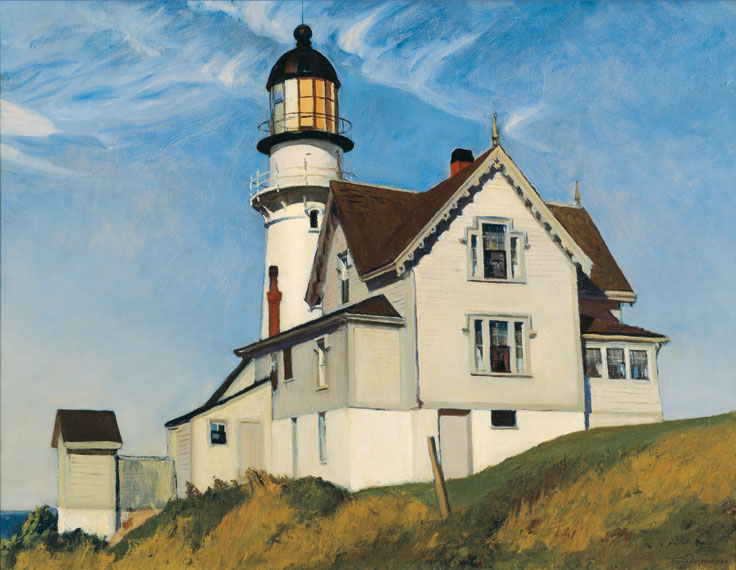
July 22--Happy Birthday to Painter Edward Hopper


If you love lighthouses, you probably know about the oils and watercolors of realist Edward Hopper. His painting of "The Lighthouse at Two Lights," completed in 1929, got lots of mileage in 1970 when it was chosen by the U.S. Postal Service to represent Maine's 150th anniversary of statehood. (It cost just 6-cents in 1970; oh how the price of a stamp has risen!)

The lighthouse Hopper painted, of course, is one of the twin towers at Cape Elizabeth. A website devoted to Hopper notes that the painting "symbolized the solitary individual stoically facing the onslaught of change in an industrial society." I'd like to think it simply represents Hopper's love for the beautiful Maine coastline and his fondness for its handsome and purposeful buildings.


Born on this day, July 22, 1882, in Nyack, New York, Hopper was the son of a merchandiser and a homemaker. Despite his parents' Baptist faith and no-nonsense attitude toward life, they recognized their son's talent and sent him to art school in New York City. Like many creative people, he struggled to find his identity and style while working various jobs, some of them he detested. Designing posters was not to his liking, nor was advertisement art.

In his off time, he painted. His medium at first was oils, but his watercolors were done during a period when he seemed to be infatuated with lighthouses--the 1910s through the 1930s.


"Squam Light" was the first, painted in oil in 1912. (above) As you compare it to his later lighthouse paintings, you'll quickly see how watercolor allowed Hopper to add details. But in this painting, everything suggests "mood." I can easily imagine myself in this painting...taking a walk and wondering if I should hurry to avoid the rain. And then I find this lovely scene down the sandy road! It's pastoral and marine, all in one.

Hopper later painted just the houses at the Annisquam Light Station. He had moved to Gloucester for inspiration and found plenty at Annisquam. It seems to have have launched his love for lighthouses. He also painted Eastern Point Lighthouse. (below) The sunrise over the point dominates, washing everything in a near-lavender hue.


Subsequent visits to Cape Cod and Maine inspired Hopper to continue painting lighthouses. Check out the selection of them below--


Hopper painted a few generic lighthouses. I wasn't able to identify this one above, though it looks somewhat like Tarrytown Lighthouse on the Hudson River. Hopper would have seen this one as he grew up in nearby Nyack. The rock foundation resembles that of Tarrytown Lighthouse, as does the shoreline. Here's a photo from 1910 for comparison. (Coast Guard)


Two other lighthouse paintings focused more on the sailboats. The lights in both of the paintings below appear to be Wood End Light Station on Cape Cod. In the second painting, it appears Hopper added a house and woman at a window and put a moody sky over the lighthouse.


Portland Head was a Hopper favorite. He painted several versions, sometimes providing enormous detail, as in the foghorn paintings below. He also painted the keeper's house and named the painting for Capt. Joshua Strout, the keeper during the years Hopper visited the site. Strout is a much-loved and well-remembered character at Portland Head Light. He had a loquacious pet parrot that knew all the business of the light station and would implore Strout to "turn on the foghorn" when the fog rolled in. I can well imagine Edward Hopper sitting at the table with Capt. Strout to have coffee, with Billie the parrot participating in the conversation.


I love the contrasts here--white tower and fog signal building, red roofs, brown rocks, and the black foghorn jutting seaward!

This is Capt. Strout's house, a duplex. His assistant lived on one side and Strout on the other. It's one of the loveliest keepers' dwellings in Maine. Hopper was smitten with houses!


Equally compelling for Hopper were the twin lighthouses at Cape Elizabeth. As with Portland Head, he painted several views.


Below is Capt. Upton's House. I love the gingerbread trim, a small and inexpensive appointment the lighthouse service was willing to add. The USLHE ethos was all about economy, but sometimes a small bit of decoration appeared.


Hopper undoubtedly knew the lightkeepers of Portland Head and Cape Elizabeth, as well as the nearby Coast Guard surfman. Having grown up around the water, he appreciated the solicitous and unselfish work of these men. He likely had free run of the light stations and surely shared coffee and conversations with the keepers on a regular basis.
Above is Hopper's 1930 rendering of Highland Lighthouse on Cape Cod. It looks so much like the first view I had of the light station in the late 1970s. Here, the Atlantic lashes the cape with fury. Hopper may have stood on the bluff here overlooking the Clay Pounds and the slate gray sea and realized how imposing and important this lighthouse is. He loved the cape and all its nautical structures.


Man of the Year in 1956! Or, at least a cover guy. Note the small image of Cape Elizabeth Light in the background.

Edward Hopper died in New York City May 15, 1967. I vaguely remember hearing about his death in art class. I was in 9th grade that year and deeply involved in artwork. I did an series of cartoon caricatures that were put on exhibit in the school. (You might be surprised to know I won an award in June 1967! Everyone expected me to leave high school and study art. I chose education instead.)

Surprisingly, none of Edward Hopper's lighthouse paintings is ranked as "notable" by the art world. I suppose "notable" depends on the prism through which you view his work. (Lighthouse pun there---did you catch it?) I'd like to think all of Hopper's lighthouse paintings are notable. Obviously, the U.S. Postal Service thought so. The dozen or so lighthouse canvases he completed are definitely a body of work.

Would some art museum or gallery kindly put together a show--"The Lighthouse as Viewed by Edward Hopper."

I'll be the first one through the door on opening night!


\


Monday, July 18, 2016

A Hardy Alaskan Lightkeeper

I interviewed Alaskan lightkeeper Ted Pedersen by phone in the late 1980s. He was friendly, talkative, and happy to be reminiscing about his work for the old U.S. Lighthouse Service. Later, a few calls to the Coast Guard and some poking around in archives netted some great images of Pedersen and his assignments. The following pages are excerpted from The DeWire Guide to the Lighthouses of Alaska, Hawai'i, and the U.S. Pacific Territories. It was published by Paradise Cay Publications in 2012 and is available on Amazon or from other online booksellers. You can also get an autographed copy from me by emailing 
lightkeeper0803@gmail.com. 
($25, including shipping). 

Unfortunately, Ted Perdersen died before seeing any of the articles I wrote about him or the anecdotes about him in my books. I know he is keeping a light somewhere and has been well-rewarded for his good work.

Click on the images to make them larger.


Sunday, July 10, 2016

RLS...A Tribute to Lighthouse Keepers

Robert Louis Stevenson didn't fulfill his father's dream of becoming a marine engineer who built lighthouses. I'm glad he followed his heart and became a writer. He did, however, give tribute to his family's work building lighthouses around the world. This is one of his poems, "The Light-Keeper."

The Light-Keeper II
by Robert Louis Stevenson
As the steady lenses circle
With frosty gleam of glass;
And the clear bell chimes,
And the oil brims over the lip of the burner,
Quiet and still at his desk,
The Lonely Light-Keeper
Holds his vigil.
Lured from far,
The bewildered seagull beats
Dully against the lantern;
Yet he stirs not, lefts not his head
From the desk where he reads,
Lifts not his eyes to see
The chill blind circle of night
Watching him through the panes.
This is his country’s guardian,
The outmost sentry of peace,
This is the man
Who gives up what is lovely in living
For the means to live.
Poetry cunningly guilds
The life of the Light-Keeper,
Held on high in the blackness
In the burning kernal of night,
The seaman sees and blesses him,
The Poet, deep in a sonnet,
Numbers his inky fingers
Fitly to praise him.
Only we behold him,
Sitting, patient and stolid,
Martyr to a salary.