Tuesday, November 8, 2016

Tombstone Territory

Courtesy of Lighthouse Digest
Over my years of collecting information and minutia about lighthouses, I've discovered a number of gravestones with lighthouses on them. The salvation symbolism of a lighthouse, plus its enduring meaning as a refuge from storms and woes and an icon to show the way, make it appealing to families as they decide on a monument for the hereafter. Another reason we see so many lighthouses on gravestones is that people just plain love them.

This is the grave of lightkeeper Abbie Burgess Grant in Spruce Head Cemetery, Maine. The photo was taken when the small lighthouse was placed on her grave in the 1940s. That's Edward Rowe Snow on the right and Wilford Snow on the left. This image is from Jeremy D'Entremont's website about New England lighthouses.

Quite a few of my cemetery images are old slides, so I cannot share them until they are converted to digital files. Having a digital camera and a cell phone is terrific for cemetery sleuthing, as I have the images instantaneously and can share them right away. 

I love walking through cemeteries--I always have--as the serenity, quiet, and storied stone monuments have great stories to tell.

Enjoy this sampling from my files. Many are my photos, and in the very polished stones you can often see my reflection as I snapped the photo. A few are from monument companies or other photographers. Study them, and note the details. They were all lovingly designed.

And please be respectful of these stones and their owners, as you would be if you were walking through a cemetery. I said a quiet thank-you to each one as I took a photo.

Cemetery in Brooklyn, Connecticut


Evergreen Cemetery in Jacksonville, Florida


Bozrah, Connecticut


Photo by Lisa Pisa. 

This image was on Pinterest, with no info attached. It's quite the monument!


Octave Ponsart was a lightkeeper from New England. His daughter Seamond is a digital friend of mine, meaning we communicate on FB and email often but have never met. Someday, Seamond!! You're a true lighthouse kid. Note the service badge on the keeper's grave. It's part of a program to honor lightkeepers. You can learn how to help with that by emailing tim@lhdigest.com. Photo by Scott Coup.


Brooklyn, Connecticut.


Burwen cemetery in the United Kingdom, from Wikimedia Commons

This lighthouse mausoleum is in Memorial Park Cemetery in Michigan. I found it on a way-making website. Apparently, it is a geocaching spot. Neat!

I found this stone in cemetery in Lewes, Delaware. It has the shape of a lighthouse, but it may be a cross.

Barrow Cemetery in the UK has this monument to John Gall, one of the rescued crew of the wrecked ship Forfarshire. If you recall your lighthouse history, Grace Darling helped with this rescue. She was the daughter of the lightkeeper of Longstone Lighthouse. This monument does resemble that lighthouse--the beacon that saved John Gall. Photo by Stephen Middlemiss.


This lovely stone featuring New London's Ledge Lighthouse is in the Mystic Cemetery in Connecticut.

Richardson Memorials in Maine did this nice engraving of Portland Head Lighthouse.

This man was a lightkeeper at old Willapa Lighthouse on the coast of Washington. His lighthouse washed into the sea many years ago. His grave has been moved once, due to erosion of the shoreline at Willapa Bay. The last time I paid him a visit, the sea was encroaching again.

If you have images or directions to lighthouse gravestones, let us know! lightkeeper0803@gmail.com


Monday, October 24, 2016

The Many Moods of Nauset Light

I am besotted with Nauset Beach and its lighthouse! So much history lies there, plus the handsome Nauset Beach Lighthouse. It once stood at Chatham as one of the twin lights. In the 1920s, after the Three Sisters Lighthouses were discontinued, the north tower at Chatham was barged up the shore to Nauset and erected on the beach. Erosion threatened it, and in the 1990s it was moved back to its present location. It's one of Cape Cod's most photographed lighthouses and also famous as the icon of Cape Cod Potato Chips. Not long ago, the company paid to have the lighthouse repainted!

National Park Service Poster

I've been collecting material on Nauset Beach for many years. A part of my collection that most intrigues me is the many ways Nauset Beach Lighthouse has been portrayed by painters. Have a look! What follows are paintings with captions. They might inspire you to do your own Nauset rendering!

Al Woodford did this gentle, rural scene showing the lighthouse in its new location, along with the relocated keeper's house and the oilhouse. But where's the red and white beacon?

Albert Swayhoover viewed Nauset Light in its old location with a sand fence and shrubs. I love the muted tones of the background. If I had to guess, I'd say he did this painting in November. The lighthouse is bit too stubby and fat, though.
This charming view is from Alfred La Banca.

Alice Kaplan did this rendering. Nice colors, and the sunlit side of the tower is a focus for the scene. I can't quite pinpoint this view, however. Is there a road behind the lighthouse and dwelling in their new location? Perhaps as the road curves around the site, we get this view.

The lighthouse seems to float in the clouds in this Annie Flynn painting.


C. Pinkard caught the view from the Nauset Beach parking entrance. I once stood here, as seen in the next photo from about 1998. If you look closely, you'll see lighthouses on my sweatshirt.


This is a similar view from a slightly different angle. It's the work of artist Charles Cooke. The red side of the beacon is spot on!

This is possibly the lighthouse in its old location painted from the beach side. Or it may be a view from the new location. Last time I was there, I did not see much shrubbery around the new location. This is a lovely painting though. Nauset is famous for how the light plays on it throughout the day.

The lighthouse seems to set higher in real life than in this Dana Wheeler painting I'm nitpicking I know. I do like the bright colors.


So many artists choose this view. I hope the house isn't cut off in the original painting. Nice details. The trees in the back look a bit dense. Maybe they've grown up since I was at Nauset last. Painting by Claire Klaum.

Debi Hinshaw chose the same popular view. She has fewer details than other artists.


Here's Dianne Lanning interpretation. Her lantern is a bit small compared to the gallery. I do love the clouds!


George Jacobs did a wash with pen and ink outlines. He didn't forget the beacon. I like it!


Harold Durand White painted the lighthouse in its old location. I visited Mary Daubenspeck when she owned the lighthouse, and it looked just like this as I drove up. I have a postcard of this painting somewhere in my collection.


This is a lovely impressionist rendering by John Glass. It would look perfect on the wall of my front sitting room!


Hall Groat Sr. painted a peek through the woods at the lighthouse. I can imagine this being the view author Edward Rowe Snow might have gotten as he walked Cape Cod in his youth. This painting has such a nice composition.


Tom McCarty did an afternoon rendering, with sunlight bold against the tower and dwelling. His shadows are perfection!


Wouldn't this look nice over a sofa or a console table? Larry Lerew painted this long view of the lighthouse, dwelling and oilhouse, plus some nearby objects. I've always liked pen and ink over a wash. I've done a few myself...but not Nauset Light. Perhaps I'll dig out my watercolors and give it a go.


Colored pencils are always a fun medium. You can do them anywhere. Whenever my daughter does with me on a trip, she takes her pencils and sketches as she rides. Sue Field sketched the back path to Nauset Light.


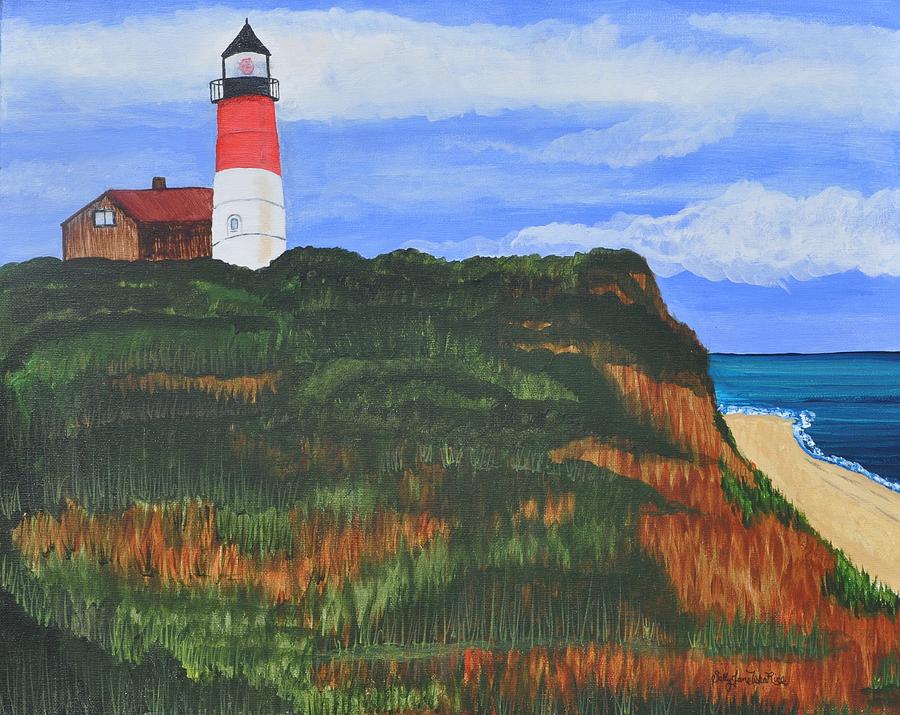
Sally Rice captured the full sweep of the lighthouse on the cliff and the beach. This appears to have been done when the lighthouse stood at its old location and before eroision had become too troublesome for it.


Lee Gorman Smith zeroed in on just the top of the lighthouse and part of the dwelling. I like the detail on the beacon.

Marguerite Bride's painting is so amazing--great color combo, nice details, and the tower accurate. Those soft touches with the bare or nearly bare branches make this one look so real. I'll take it!!


I so love this one by Joel Popadics. It reminds me of so many visits to Nauset in the late 1980s and early 1990s, before the tower was moved. There are many memories on that piece of cliff, some of it now tumbled over the side. I walked here with Pam Nobli and Mary Daubenspeck. The park rangers at the Cape Cod NS also walked here with me and then took me to the VC to see images of the lighthouses at Nauset. The small gray building below the dwelling was once the gift shop. Some of my books were sold there, and I bought goodies for myself.
Beautiful, stories Nauset Beach and and its lighthouses. My research file on them is fat. Might there be a book in the future?


Wednesday, October 19, 2016

A 1995 Interview

In 1995 I spoke to the "Literature of the Sea" course at the University of Connecticut (my Alma Mater!) as part of the "Working on the Water" seminar at Avery Point. The students also interviewed me about my work as an author and as a lighthouse historian/preservationist. More than 20 years later, much of that information is still viable and important to me. I'm sharing the interview here. I hope you enjoy it!


An Interview with Elinor De Wire

Keynote Speaker, "Working on the Water Seminar"

University of Connecticut at Avery Point

1995

Interview transcript from students in “Literature & the Sea,” University of Connecticut at Avery Point

 
Photo by Jonathan DeWire, October 1995


Q:  Why do you feel it's important to preserve the stories of lighthouse keeping?

A:  The occupation of lighthouse keeper has officially ended in this country.  Except for the figurehead keepers assigned to Boston Light, there are no more lightkeepers in the traditional sense.  There's no need for them.  Lighthouses operate automatically and need only periodic checks by maintenance crews.  No one needs to turn the light or fog signal on and off.  There are all sorts of high-tech gadgets that have replaced the hands of the lightkeeper.  But they haven't replaced his heart.  Lightkeeping before the electronic age required a lot of devotion and fortitude.  The lifestyle was unique, and the people were special in many ways.  I think it's important to preserve the human history of lightkeeping before all the old keepers are gone.  Only a few are left.

Q:  How did you become interested in lighthouses and their keepers?

A:  My interest began in 1972 when I lived in Maine.  My husband and I were newlyweds then, with little money for entertainment.  We beach-combed a lot, and the lighthouses were there, wherever we went.  Maine has more than sixty lighthouses.  I was intrigued and started keeping a scrapbook on those I visited.  I took pictures, scribbled notes, wrote poems and stories, jotted down the names of people I met at lighthouses.  Before I knew it, the scrapbook had become a box, and then a bureau drawer.  Today, it occupies four filing cabinets in my office, and my house is full of trinkets and mementos from my lighthouse travels.  I think everyone ought to have a passion in life — something to care about, to be devoted to.  My passion is lighthouses.

Q:  Why do you think the public is so fascinated with lighthouses?

A:  Lighthouses symbolize things that are important to us, and things that give us comfort — strength, safety, guidance, salvation, a light in the darkness, the welcoming home of a weary traveler.  People have always regarded them as emblems of humanity, and, of course, their keepers have become legendary for their courage and sacrifice.  A lighthouse is a metaphor for human goodness.  It represents the best humanity has to offer, so naturally people are drawn to it.  For this reason, you see lots of images of lighthouses in advertising:  A bank or investment company might use the rock-solid, brightly-lit tower to sell itself, a soup company or clothing manufacturer might choose a lighthouse to represent traditional goodness and reliability, or a church might use the warm, comforting beam to convey divine guidance and deliverance from evil.  You can think of lots of examples — Cape Cod Potato Chips, Snow’s Seafood Soups, Mitchell College, WNLC Radio.  It's a very popular and meaningful symbol.

Q:  Do you have a favorite lighthouse?

A:  I love them all, of course, no matter how beautiful or plain.  But if I had to choose a favorite, it would probably be Nauset Lighthouse on Cape Cod.  It’s so well-preserved and interpreted for the public.  It embodies everything I think a lighthouse ought to be — tall, strong, architecturally handsome, a beautiful daymark, a classic look, a friendly place for people to visit.  The iron spiral stairs are wonderful.  The acoustics and air currents inside the tower are indescribable.  The grounds are beautiful too, with the backside beach nearby and the roar of waves.  The lighthouse’s history is compelling too. The site once had three small lighthouses lined up together, the nation’s only set of triple lighthouses. They are now displayed in the woods nearby.

Coast Guard Historian's Office Photo

Photo by Jonathan DeWire, 1979

Photo by Chris Cook


Q:  Few traditional lightkeepers are still living, but you were able to interview some of them.  Was there one you found particularly interesting?

A:  Frank Jo Raymond, who served on Latimer Reef Light off Stonington, Connecticut was fascinating to talk with — very candid.  He said some surprising things and dashed a few of my long-cherished images.  He couldn’t understand why people found lighthouse life so attractive.  He said if you lived that life you wouldn’t find it so fascinating.  He kept reminding me that it was “just a job;” yet, at times he waxed sentimental about it.  He talked a lot about nature, especially the weather.  He was very sensitive to wind and the most minute changes in it.  He was on the lighthouse during the 1938 hurricane, which devastated southern New England.  Frank was also an artist and musician, and that was an interesting facet of his life.  He was painting on the day I spoke with him.


Q:  What made the lightkeeping profession unique?

A:  There were aspects of lightkeeping that were found in few other jobs, and sometimes no other jobs.  The main characteristic of the lightkeeper was solicitude.  Early on, before the Lighthouse Service began regulating the job and assigning several personnel or relief keepers to lighthouses, lightkeepers worked 365 days a year, 24 hours a day.  It was truly a full time job, and it could be dangerous and exhausting.  Lightkeepers were expected to accept great personal risk during storms, wars, and other catastrophes; and they were required to rescue, house, and care for survivors of shipwrecks, as well as their neighbors, who also might be refugees from storms that carried away their homes.  Everyday life itself presented its own special problems, especially if the keeper and family were isolated on a remote island or headland.  Things like food and fresh water were often difficult to get and keep.  There was loneliness and anxiety.  It was hard to get mail, fetch a doctor, or send the children to school.  Living next to the sea exacted a price in loss of life and property.  There were good things, of course.  Lightkeepers were witness to incredible sights of nature, they had the sea for a playground and, when the fishing was good, a supermarket.  They were respected government servants, venerated for their virtuous duty.  And they must have experienced enormous job satisfaction knowing they were saving lives and shining a light to guide "those in peril on the sea."  The stories of lightkeeping are striking for their special, sea-spun character.  Think of all the joys and challenges that faced lightkeeping families, because they lived on or by the sea and had to keep a light through every kind of pleasure and tragedy.  No one will ever live that life again, because lightkeeping is obsolete.


Q:  Guardians of the Lights is a collection of stories about lightkeeping that exemplifies the life of the lightkeeper in America.  Is there one particular story that's your favorite?

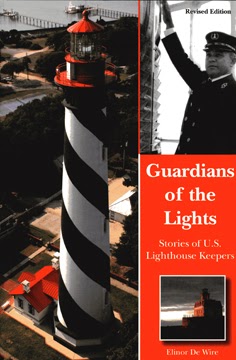
At the time this interview was done, Guardians of the Lights had just been published and was in its first edition. The copy above is the 2007 edition. Steve Jones, who taught "Literature of the Sea," was featured on the cover. The tiny guy next to the lighthouse is my son, then age 16.


A:  As an author, I have a special feeling for all the stories I write. I love them all.  When I give my slide talk on lighthouse keepers, there are a few stories that always touch the audience more than others — make them laugh or sigh or gasp in surprise.  The story about the baby found in a box from a shipwreck off Hendricks Head Lighthouse is a touching one; so is the story about the rock garden on Mount Desert Rock Light, planted from soil brought out from the mainland.  I think people like these stories because they show the strength of character lightkeepers had and how they overcame adversity.  The story of the bull at Destruction Island who thought the lighthouse foghorn was a rival bull always brings a hearty laugh.  People are amazed, too, at the bird attacks and the storm stories and their attendant rescues.  I suppose my favorite story is the one I delight so much in telling — I call it "Buried and Married in the Same Day."  It's in the first chapter of Guardians, and it brings both a tear and a chuckle.  It's about a Massachusetts lightkeeper who takes his fragile new bride to live at remote Egg Rock Lighthouse.  She becomes ill and dies the first winter.  The keeper cannot get her ashore for a proper funeral, so he makes a coffin, places her in it, and puts her in the oil house to freeze.  In the spring, he takes her body ashore and has a quick funeral service.  Not wanting to return alone to the dismal isle lighthouse, he finds a willing spinster and gets married that very same afternoon.  His new wife returns with him to the lighthouse before sunset.

Q:  Was isolation, then, the most difficult aspect of lightkeeping?

A:  In most cases it was.  I think it really depended on the assignment.  Some isolated lighthouses were wonderful assignments, like Kilauea in Hawaii and Sanibel in Florida.  But those that were separated from land by difficult stretches of water had their problems.  St. George Reef Light was one; so were the lights at Farallon and Minots Ledge.  If you got sick on these stations, and the sea was too rough, you couldn't get ashore to a hospital, and a doctor couldn't get to you.  Sometimes people died.  Kids couldn't get to school; delivery of supplies was at the whim of the sea.  Loneliness made life on remote lighthouses difficult too.  The Lighthouse Service eventually forbade families to live at isolated stations.

Q:  What do you think the future holds for lighthouses now that the lightkeeping profession has ended and many electronic advances are replacing lighthouses?

A:  It's true we don't need lighthouses anymore — traditional lighthouses, that is.  The modern navigator has much more accurate and dependable systems available, such as GPS.  But any navigator, from the small boater to the skipper of a huge tanker, will tell you there's something very comforting about seeing a lighthouse and using its beacon to determine position or guide a vessel to safe harbor.  No matter how sophisticated the electronics become, we still feel more at ease when there's visual confirmation.  This is sentimentality, of course.  It's not easy to grab hold of new technology without a pang of regret at letting go of the old, especially when the old is as beautiful and nostalgic as a lighthouse.  I think lighthouses will become obsolete someday, maybe soon.  Many of them already are.  The small boater still needs them, but the day will come when even he or she won't.  Then it will be up to the public to see that these old relics are saved.  We'll have to decide which ones are worth saving, because it's going to be difficult, if not impractical, to save them all.  We're experiencing that now.  Many communities are angry with the Coast Guard and their local governments because a beloved lighthouse is deteriorating or being vandalized or slated for demolition.  It's important that we decide what to save and then do a commendable job saving it.  A retired lighthouse deserves respect.  It shouldn't have to masquerade as a gift shop, a hamburger stand, or a decoration on a mini golf course.  There are plenty of willing souls out there who'll scrape and paint and sweep to keep a lighthouse, even after it's been retired.  I call them the "New Keepers."

Photo by Jonathan DeWire, 1986


Thursday, October 13, 2016

A Little Lighthouse Minutia

Minutia--I love that word. It pretty much describes the inside of my brain and my house. How many of you collect lighthouse minutia? Mugs, patches, pillows,  picture frames, magnets, candles, t-shirts, wind chimes, and more. I have SO MUCH lighthouse minutia. You'll find it all over the internet too, especially on eBay. So, I thought I'd share some of it here. Please share yours too! Tell me what secret, somewhat-useless baubles you have in your lighthouse collection!


Got any Cape Neddick "Nubble" chapstick? Yes, you can get almost anything with the Nubble on it, especially at the gift shop at the viewing area for the lighthouse. I wonder if this is specially made for the effects of the raw sea air?
Have you got a cigar box label? Not many cigars are found in households these days, but my older cousin, Duke, always smoked them. He gave me a cigar box to cover and decorate as my first pencil box used in school. Many cigar boxes feature lighthouses. This is an old one I found on eBay showing El Moro Lighthouse.


And while we're on the subject of labels, there are many products that feature lighthouses. Here's Sea Watch Clam Chowder. I can attest that as canned chowders go, it's not bad!


Lighthouse topiary, anyone? This is an old photo, from about 1987, of a topiary boxwood at the Lewes, Delaware ferry terminal. It's probably gone now, but it sure caught my eye.


I wish I had one of these! This is a lighthouse-style ukulele in the collection of the Maine Lighthouse Museum. I just took this photo last Saturday when I was at the museum to give a talk. I had never seen one of these before.


This is a lighthouse shaped Tangram Puzzle. Tangrams are shapes made from seven geometric pieces. They will make everything from a perfect square to animals, people, and more. I had sets of these for my students in elementary school. They not only make geometry fun but also help develop spacial thinking, creativity,  and problem-solving.


This is a giant lighthouse made of apples! It was supposed to be Eddystone Light. The postcard says that it was featured at an apple show in August 1913. Amazing!


I have scads of patches in my collection of lighthouse minutia. This one used to be worn by the Biloxi Police Dept. I'm not sure if they still sport a lighthouse patch on their uniforms. Maybe someone reading this blog knows. And by the way, the lighthouse shown doesn't look much like Biloxi Lighthouse. It's the thought that counts, I suppose.


This mean-looking lion is actually a rain-spout on the cupola of Old Point Loma Lighthouse, California. As you can see, it was sunny the day I snapped this photo, so I didn't get to see him spitting rain. A number of lighthouses have ornate rain-spouts. Sandy Hook Light in NJ, for example, has gargoyles.


I've photographed a number of drive-thru coffee stands in the shape of a lighthouse. This one at Manchester, WA is a really cute one. When I lived in WA, I usually stopped here on my way to Vashon Island to see my daughter. Coffee was kept on the stove at all lighthouses during the years they were tended by lightkeepers. It was an important drink if someone was chilled or if visitors stopped by, and it kept watchmen awake in the night.


Palo Duro Canyon in Texas has one of nature's lighthouses--a rock worn away by wind and rain until it looks like a lighthouse. I'd say it resembles Coquille River Lighthouse in Oregon. Someday, before too much weathering destroys it (or vandals!), I want to see it.


Sweet! A hand-crafted lighthouse birdhouse I found in Nova Scotia, Canada.


I dearly wish I owned one of these. It's an antique Lighthouse Clock from the late nineteenth century. Lighthouses were as much loved then as now, but perhaps for different reasons. Today, they are fascinations, but back then they were true symbols of rescue and salvation. This is such a Victorian fancy, but a useful one. I could see this is the parlor of a well-to-do family.


The Coast Guard gave me this funny photo. Someone in the 13th District Public Affairs office got creative with a real photo of a helicopter getting ready to land on top of Mile Rocks Light in San Francisco Bay. The caisson once had a telescoping light tower on it, but it was removed and the beacon was put on a post on the remaining platform. It was the perfect spot for a seagull to nest, the PR staff thought...but this mama bird is gigantic!


My longtime friend and penpal, Klaus Huelse of Germany, sent me this postcard of a French lighthouse. The fog here must have been horrendous! Check out the four-trumpet setup. It makes the lighthouse look a little like a windmill. Ah, those French lighthouse engineers were clever!


This cute little gadget is a pillar sundial. You can see the sun marks on its sides and the hours on the bottom. It was designed to take along on trips in order to get the time while traveling, or anywhere for that matter. It's old, possibly from the 1600s. This was made long before wrist watches or even pocket watches. Probably only the wealthy would have owned such a trinket. People of that day seldom traveled far from home, unless they were explorers or on a crusade, so the sundial would work most places they went. (Sundials must be made to correspond to latitude, so if you traveled far north or south of your home, this one wouldn't work.) I think it's neat that it was made in the shape of a lighthouse--a symbol of guidance.
Finally, in this lineup of lighthouse minutia, is a curious image from Yaquina Head Lighthouse. Can you guess what this shows? If you visit lighthouses regularly, then you know these are deck prisms. Each small circle of light is a prism, mounted in a circular disk that sits in the floor of the lantern room. The prisms bring light down into the lower part of the tower--cheaper than installing lots of windows in the tower. Since prisms can bend and concentrate light, they not only work well in a lighthouse lens but also for adding light to darker floors below the lantern. Each prism is about the size of a walnut. You can also see the base of the base of the lens in the upper part of the picture. Why not just install electric lights? This lighthouse was built in the 1870s, before electric lighting came to lighthouses...or other places.
I hope you enjoyed this trip into the land of lighthouse minutia! I have many more peculiar collectibles...but I must save some for a future blog. Do leave comments and tell me which of these items is your favorite and why, and also tell what kind of odd items are in your collection.