Monday, August 27, 2018

A Long Climb to the Top


I've climbed many, many lighthouses over the years since 1973 when I first developed an interest in them. The tallest lighthouse I've climbed is the magnificent Ile Vierge Lighthouse on the island by the same name almost a mile off the Brittany Coast of France. 


The almost-15 acre island has two lighthouses. The original 108-foot-tall Ile Vierge Lighthouse was built in 1842-1845. It;s the square white tower shown above. Its replacement, the 271-foot-tall Ile Vierge Lighthouse, was completed in 1902. This younger lighthouse is the tallest stone lighthouse in Europe and the tallest traditional lighthouse in the world.


My husband and I toured the two lighthouses in July with the U.S. Lighthouse Society. Twenty-seven society members were with us. It was an amazing trip! We are shown below boarding the boat to the island.


The crew of our boat all had the lighthouse on their shirts!


The rocks around Ile Vierge are evidence of the need for good navigational aids. It was foggy on the way out to the island. A sailboat appeared ghostly as it passed in front of us--


Magically, when we arrived, the fog was lifting.


This is a selfie I took while climbing the taller, 1902 tower. (Jon did not climb with me, as he is not fond of open stairways like this one.) Notice the beautiful opaline tiles lining the granite walls of the interior. They were made by the glassworks at Saint-Gobian, the company that made prisms for Fresnel lenses. It was a long way up, almost 400 steps. I had to stop several times to catch my breath.

Ile Vierge means "Island of the Virgin" and refers to the 1450 Franciscan monastery built there. It was abandoned in 1507. In 1844 the nation of France purchased the island from its owner for 6,000 francs and set it aside for lighthouse purposes. Four different Frresnel lenses served at these two lighthouses. The taller tower was automated in 2010, ending over 120 years of lightkeepers on duty on the island. One of the last keepers was Theodore Malgorne, who was made famous by photographer Jean Guichard's image of a great wave hitting La Jument Lighthouse in a storm. Malgorne was the keeper in the doorway.

Ile Vierge can be visited from April through September. The taller tower is open for climbing on special arranged dates in the summer. In winter...well, you probably would not want to visit!


Thursday, August 2, 2018

Phares et Balises

I apologize for the long drought of posts. I've been on travel for a month in Europe. Some of my travels took me around the Brittany Coast of France, visiting lighthouses. One of my stops was at the museum of Phares et Balises--Lighthouses and Beacons. It was an amazing place! Although everything in the museum was French, I managed to ID a few things. In this post, I'm sharing images and info on the many items the museum had on display.

The first and most stunning artifact was the historic first order lens from Cordouan Lighthouse. It was Augustin Fresnel's first lens, constructed in 1822 and installed at Cordouan in 1823. I nearly fainted when I realized what it was. Here it is, looking just like a sketch I have of it! Note the mirrors on top to reflect light down to the middle of the lens, and the tiny chariot wheels to revolve the entire lens. The revolving mechanism sits to the right of the lens. I admired it for a very long time and thought I could almost see Fresnel hard at work on it.


It was, hands down, the most exciting exhibit in the museum. 


But other items grabbed my attention and will grab yours too. Check out this huge clamshell lens--


A second order flashing lens is below. That's me with Wanda Mayo and Darlene Chisholm in the background. (We got so tanned walking to lighthouses in France.) My husband took this shot from the museum's second level.


A drum lens in a small lantern.


Clockworks to turn reflector lights.


A model of La Jument Lighthouse under construction in 1904. La Jument was made famous by Jean Guichard's photo of a huge wave smashing into it and one of the keepers in the doorway.


Models galore! Here's Cordouan Lighthouse, built for a king.


Amidee Lighthouse in New Caledonia


And much, much more! Enjoy!


Au revoir!


Tuesday, June 19, 2018

Fogs, Dogs, and Smogs

Back in the 1980s, I regularly wrote articles for Mobil Oil's in-house magazine, The Compass. Looking through tear sheets of my past articles, I found this one about fog signals. The Compass has ceased publishing--too bad. It had some wonderful maritime and marine pieces. If you loved the sea and all things nautical, it was the perfect read. I hope you enjoy this article. The pictures are a bit faded, but the grist is there. As always, click on each image to enlarge it.

.


Tuesday, June 5, 2018

Did You Know?

Dear Readers,

My files are rife with slips of paper on which little bits of lighthouse lore and facts are handwritten. I have a couple of drawers full of notebooks with similar grist. (Someday I must cut up the notebooks and file the info where it belongs.) 

So, I've decided to drop some notes into a blog. I hope you enjoy the trivia. At the next party you attend, break the ice with one of these!


·        In 1925 a typhoon hit China.  The lighthouse family near the town of Reiyushan took refuge in their lighthouse. The roof of the fog signal building was torn off and all outside equipment was washed away. A sampan was lifted up by the storm surge and deposited on the 120-foot-high lighthouse. It balanced perfectly for some time, then was taken away by the wind.

·        The lens in place at Point Vicente Lighthouse served at a lighthouse in Sitka, Alaska for forty years before being sent to Palos Verdes for use in Point Vicente Lighthouse.

   
Keeper and the lens courtesy of the Nautical Research Center.


·        Augustin Fresnel, inventor of the Fresnel lens, opposed Napoleon and was banished from his Royal State position as a builder of bridges and roads. He used this period of banishment to experiment with optics. In 1815, after Napoleon’s defeat at Waterloo, Fresnel was reinstated, this time by the French Bureau of Lighthouses. In 1823 he exhibited the first Fresnel lens.

National Archives


·        At Flat Island Lighthouse on the island of Mauritius, wild donkeys roamed. Bill Scott, an engineer for Chance Brothers of England, was sent to the island to build the lighthouse in the 1920s. His crew had made a makeshift latrine—a hole over which was placed a bench and the entire thing enclosed in a canvas hut with a flap for a door. A workmen went to the latrine one night and was quietly attending to his business when one of the wild donkeys stuck its head through the flap and heehawed loudly. The workman was so surprised he fell off the bench down into the hole. He could not get out and had to wait until morning for help to come. The rest of the workmen were so amused by the event, they could not work. Bill Scott, himself wracked with laughter, gave everyone the day off.

Courtesy of Mauritius Attractions


·        In the late 1960s, Jack Roche was keeper at Kish Lighthouse in Ireland, marking the entrance to Dublin Harbor. Bird migrations were always amazing at this lighthouse. Roche wrote of one night when the birds came: “It was a kind of soft, slightly misty night, and I came on watch at 12:00 a.m. When I went out on the balcony, I just couldn’t get over it. In the rays of the light, the birds must have been in countless thousands. I went up onto the helicopter platform, and there wasn’t a vacant space on that. All the little balcony rails were lined with birds, shoulder to shoulder, everywhere.”

Kish Lighthouse photographed by Paul O'Donnell for Wikimedia Commons.


·        In 1612, two years after it was completed, lightning hit the Corduoan Lighthouse off the coast of France. The top portion was knocked off and fell into the sea. It was hastily rebuilt, as this was the King’s lighthouse, with an apartment for him, should he wish to stay in the lighthouse, and even a chapel should he be there on a Sunday.

The original Cordouan Lighthouse from Wikimedia Commons.


·        In July 1894, keeper Conrad Hansen and his wife left their children alone at Robben Island Lighthouse, Table Bay, South Africa, while they went ashore to a funeral. The kids decided to make coffee so they could act like adults. They added a number of ingredients to it, thinking to make it taste good. But when it was ready, it tasted very bitter. So the older kids threw it out. Little William, aged 4, got a cup of it though and drank several swallows. By the time Hansen and his wife returned, the kids were frantic. William was convulsing and crying in pain. The little boy later died. An investigation determined the child had consumed strychnine poison. A few of the other kids fell slightly ill, but did not die. Mrs. Hansen was so traumatized by the event, she committed suicide.

Robben Island Lighthouse by Manfred Leiter.


·        Augustin Fresnel was the first to suggest revolving his lenses in mercury, a high-density but frictionless element that could support a heavy object but allow it to move effortlessly. The French did not act upon the suggestion until Monsieur Leon Bourdelles built and experimented with a mercury float in 1890 at La Teignouse Lighthouse. The first lighthouse to officially use a mercury float was Cape Le Heve Lighthouse in 1893. Scotland adopted the mercury float technology in 1898. Dr. John Hopkinson and Sir James Timmins Chance of England together worked on improving the mercury float idea. Many mercury floats have been removed from lighthouses, due to the dangers inherent in mercury. A few lighthouses worldwide still use them.


·        A Finnish lighthouse first lit in 1753 on the Island of Utö  used candles in its lantern. During its first year of service, it consumed 936 pounds of candles.

Utö  Lighthouse today.


·        In the late 1880s, Jones Point Lighthouse at Alexandria, Virginia was the site of experiments with natural gas lighting. Pipes were laid out to the lighthouse from the city, but problems ensued. The pipes often broke and allowed water to intrude, fouling the gas. There also were dangerous gas leaks. In 1900 the experiment ended and the Jones Point Lighthouse was given an Incandescent Oil Vapor lamp fueled by kerosene.

Me...at Jones Point Lighthouse in 1999. The lighthouse must have liked the tilt of my head; it followed suit! Photo by Jonathan DeWire.


·        In 1912 there were 351 portable oak-case libraries circulating to remote lighthouses in the United States. These were exchanged every quarter and provided much-desired reading materials for lightkeepers and their families.

The reproduction traveling library on display at Admiralty Head Lighthouse.


·        Famous writer Ernest Hemingway visited Key West Lighthouse early in his career. He loved the sentinel so much he later returned to Key West and bought the house across the street from the lighthouse. He said he wanted the beacon to shine in his window.

Ernest Hemingway loved lighthouses and cats. My kind of guy! Wikimedia Commons photo.


     Wouldn't it be wonderful if we all had a guiding light shining in our window!


Monday, May 21, 2018

Waddah Island Light

Most people have never heard of Waddah Island, but if you journey to Neah Bay at the very northwest point of Washington, you'll see the island offshore. It encompasses 33 acres and sits a third of a mile off Baada Point. The Makah tribe, who still live at Neah Bay and nearby Ozette, once used the island for fishing camps and gardening. They grew mainly potatoes on Waddah Island.

The tiny Waddah Island Lighthouse stands on a cleared spot 63 feet above water on the west end of the island. Photo taken in 2002 by www.seaotter.com

My interest in the island concerns the little lighthouse that sits on the northwestern end. It had a fog signal years ago, but I believe that's gone now. When I lived in Washington, I made the long drive to Neah Bay several times and attempted to get across the breakwater from Baada Point to Waddah Island, without success. The weather usually foiled my attempts (or a sensible husband who knows how clumsy I am). So I was never able to visit the light up close. Every summer, the Coast Guard families at Neah Bay have a picnic on Waddah Island. I was invited to join them one summer, but as luck would have it, a heavy summer fog rolled in dense as pea soup, and the picnic was held ashore.

Here are some maps to help you orient the location of the island and lighthouse.


The lighthouse was established in 1877 as a post beacon, a very common navigational aid at this time in the Northwest. An eight day lens-lantern light hung from the post. It's likely the lifesavers stationed on the island tended the beacon. 

In 1888, because of the many perils around the island, buoys were anchored. Here's a report from the U.S. Lighthouse Board. It includes other locations in Washington.


The lifesaving service set up a manned station on Waddah Island in 1877 after the U.S. Government had purchased the island (1860). So many wrecks occurred inside the entrance to the strait, lifesaving services were needed. The lighthouse at Cape Flattery helped ships find the entrance to the strait, but once inside, they were on their own until they sighted Slip Point Lighthouse at Clallam Bay. If there was fog, or a storm raging, it was easy to go aground on the many rocks inside the entrance to the strait.

Slip Point Lighthouse was some 30 miles east of Waddah Island. It's lighthouse was in service from the early years of 1900 until about 1940 when a landslide pushed it into the strait. Note the foghorn--a necessity on the Strait of Juan de Fuca. (Photo from the Coast Guard Historian.) Today, the light is on a steel tower.


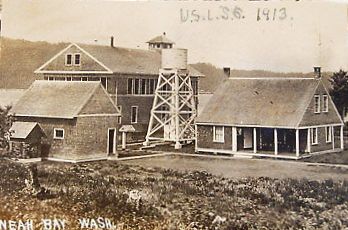
An old postcard shows the lifesaving station after it was moved to Baada Point.

Among the rocks mariners had to avoid were the fingers of Waddah Island, extending northwest off the island. They were not only a danger if passing vessels ran off course, they also endangered ships headed into the small harbor at Neah Bay. For a look at the Waddah Island Fingers, click here. You'll also see the breakwater and Waddah Point, where the lighthouse sits.


Here's a picture of a ship wrecked on the "fingers" in 1910 at Waddah Island. Photo courtesy of the Nautical Research Center.--


At various times over the years, people have resided on Waddah Island. The Makah gardeners and fishermen were there, of course. Then the lifesavers came in 1877. They left in 1910 when their station was moved to Baada Point.

A few residents remained, but by World War II everyone was gone. The Coast Guard continued to maintain the tiny lighthouse, but keeping the pathway clear up to the lighthouse was a challenge. The solution was to station a few goats on the island. The photo below, given to me by the Coast Guard Museum Northwest, shows those rowdy goats, with their big appetites for salal, blackberry bramble, and other invasive plants. A Coastie holds them by their horns. Otherwise, they'd be pummeling and butting him.

The goats must have reproduced because even in recent years they've been reported on the island. They greet visitors and mooch food. Be careful if you meet them. They can be overwhelming!

In 1944, the U.S. Army Corps of Engineers built the breakwater between Waddah Island and Neah Bay. It made the tiny harbor much calmer. It also gave interested hikers a way to reach the island...that is if the weather is cooperative. It's a very slippery hike, so if you go, be careful. And don't tell any wardens I sent you!

While you're in Neah Bay, visit the Makah Cultural Center. It has a fascinating history of the tribe and archaeological artifacts from an old village exhumed at Ozette. Nearby is the town store where you can get lots of goodies, including ice cream.

Then drive to the parking area at the trailhead for Cape Flattery Lighthouse and park. (I think there's a fee. Ask anyone in town for directions if you don't see the sign for the trailhead.) Walk the plank-board trail through the ancient forest to a viewing landing for the lighthouse. On one of my visits to the landing, there was a wedding party getting hitched. They wanted to tie the knot with their fave lighthouse in view.

Photo from the Makah Nation

The view from the landing. This is a postcard from the 1970s when the trail to the viewing spot was just a muddy path through the woods. Today, it's much nicer.